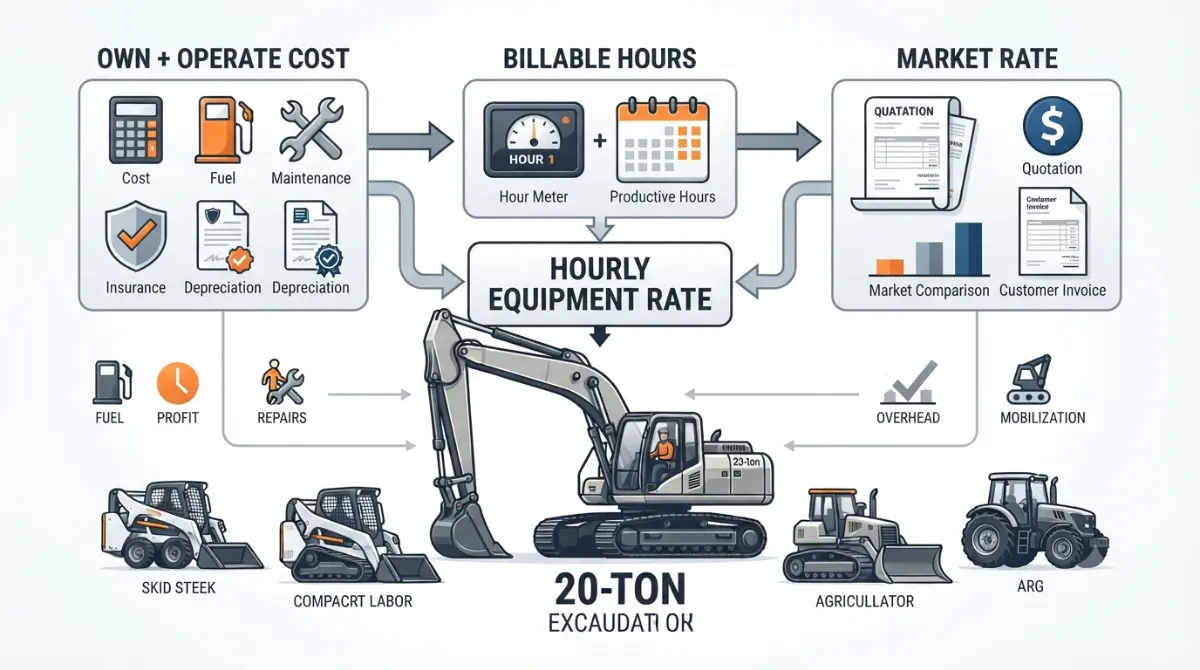
Equipment Rates Per Hour for Skid Steers, Excavators and Dozers
Table of Contents
This guide covers hourly equipment rates in the US for skid steers and compact track loaders, mini and mid-size excavators, backhoe loaders, crawler dozers, wheel loaders, motor graders, and farm tractor custom work. It uses 2025–2026 data and applies to financed Tier 4 Final machines and older paid-off machines alike. Cranes and trucking aren’t covered.
Most rate advice hands you one number. A usable rate comes from three places instead: what public schedules say a machine costs to own and run, what your own books say, and what customers in your area actually pay.
If a customer wants a quote today
Go straight to the rates-by-machine table. It shows a cost floor for your machine and, where survey data exists, what operators charge. Then read the minimums and mobilization section before you send the number.
If you just bought your first machine
Start with the rate formula, then the utilization test near the end. A new machine that sits most of the year needs a higher rate than a busy one, and sometimes no rate will cover it.
If you’re a farmer pricing custom work, jump to the custom farm rates section. If you’re hiring an operator and checking a quote, read the next section first so you compare like with like.
💵 About These Numbers: Machine rates come from FEMA’s 2025 Schedule of Equipment Rates (effective July 2025). Market rates come from the 2026 Iowa Farm Custom Rate Survey (surveyed February 2026). Wages come from the Bureau of Labor Statistics (May 2025). Rates vary by region, machine condition, utilization, attachments, and season. Treat them as orientation, not accounting, tax, or legal advice. Force-account, FEMA-reimbursed, and prevailing-wage public work follows your contract terms, not these figures.
Wet, dry, or operated: what an hourly rate includes
A dry rate covers only the machine. A wet rate adds fuel. An operated rate adds fuel and a person running it. Before comparing any two numbers, confirm which of the three each one is.
Dry rate: the machine only
Dry rates are what rental yards usually quote. You supply the fuel and the operator, and you pay for any damage beyond normal wear under the rental agreement.
Wet rate: machine plus fuel
A wet rate bundles fuel into the hourly charge. It’s common on longer rentals and in public cost schedules. FEMA’s schedule rates, for example, cover depreciation, overhead, maintenance, field repairs, fuel, lubricants and tires, but not the operator’s labor.
Operated rate: machine, fuel and operator
This is what most owner-operators quote a customer. When a landowner says “the other guy charges $110 an hour,” it’s almost always an operated rate. It rarely says anything about minimums or travel.
Why government schedules sit below market rates
Public rate books are built to reimburse costs, not to set prices. Caltrans says its calculated rate reflects the cost of owning and operating the equipment, which is likely lower than a rental yard’s rate, since yards may add overhead, profit and a premium for short-term rentals.
🔍 Why It Happens: A rental yard carries the risk of its machine sitting idle between jobs. A contractor bidding against a public rate book doesn’t carry that risk, because the book assumes the machine is working. Your rate has to cover your idle time, which is why it lands above a cost schedule.
How to calculate your equipment hourly rate
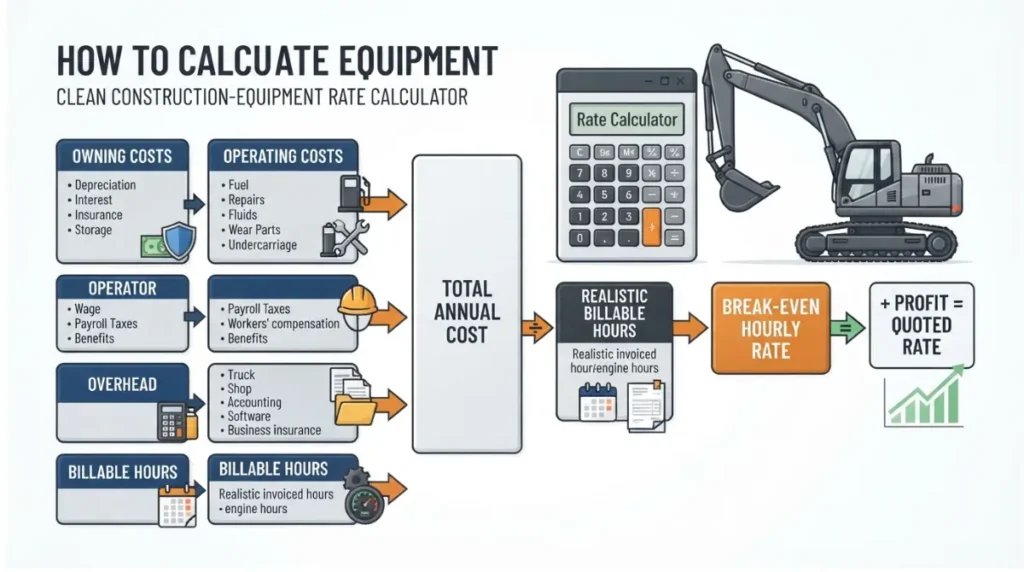
Your break-even hourly rate is total annual cost divided by the hours you can actually bill. The calculation takes five steps:
- Add up annual owning costs: depreciation, interest, insurance, storage.
- Estimate operating cost per hour: fuel, repairs, wear parts, fluids.
- Add operator wage plus payroll taxes, workers’ comp and benefits.
- Allocate your business overhead to the machine.
- Divide by realistic billable hours, then add profit.
This follows the owning-plus-operating structure the U.S. Army Corps of Engineers uses in its equipment rate pamphlet, EP 1110-1-8. The Corps also adjusts for site conditions: rates are set for average and severe operating conditions, and the “difficult” rate is the midpoint between the two.
Step 1: Owning cost per hour
Owning cost is what the machine costs you whether it runs or not. Depreciation is purchase price minus expected resale value, spread over the years you’ll keep it. Interest on the loan, or on your own cash tied up in the machine, counts too.
Step 2: Operating cost per hour
Operating cost rises with every hour on the meter. Use your machine’s real fuel burn, not the brochure figure. Set aside a repair reserve that includes undercarriage wear on tracked machines, because that bill arrives all at once.
Step 3: Operator wage plus labor burden
Wages are the easiest input to get wrong by leaving costs out. The BLS reports a median annual wage of $59,600 for construction equipment operators as of May 2025. Spread over 2,080 hours, that works out to roughly $28.65 an hour. That hourly figure is our own arithmetic, not a BLS number.
Payroll taxes, workers’ comp and benefits sit on top of the wage. Pull your real percentage from payroll records or your accountant rather than using a rule of thumb.
Step 4: Overhead, profit and the markup-vs-margin trap
Overhead covers the pickup, the shop, insurance on the business, phones, accounting and software. Split it across your machines by expected hours. Then add profit, and be clear whether you mean markup or margin.
A 15% markup on a $140 break-even gives $161. A 15% margin requires $164.71, because margin is profit as a share of the final price. Mixing the two up can quietly cost you money on every hour you bill.
Billable hours: the number most owners get wrong
Billable hours are not engine hours. Rain days, travel, repairs, bidding, and winter all eat into them. As one comparison shows, a rental house might bill 1,800 hours a year on a machine where a small contractor bills 1,100, and fewer billed hours means each one has to carry more cost.
✅ Do This: For the next 30 working days, log the hours you actually invoiced against the hours on the meter. Use that ratio for your billable-hours estimate instead of guessing.
Worked example: one machine, start to finish
Below is a financed 20-ton excavator. Every input is an illustrative assumption. Replace each one with your own records.
| Cost line | Assumption | Per billable hour at 1,000 hrs |
|---|---|---|
| Depreciation | $150,000 lost over 6 years | $25.00 |
| Interest + insurance | $20,000 per year | $20.00 |
| Overhead share | $20,000 per year | $20.00 |
| Fuel, repairs, wear, fluids | $35 per engine hour | $35.00 |
| Operator, loaded cost | $40 per hour | $40.00 |
| Break-even | $140.00 |
All figures are illustrative assumptions, not market data.
At 600 billable hours, the same machine needs about $183 an hour just to break even. At 1,400 hours it needs about $121. Run your own numbers in our equipment cost-per-hour calculator, and estimate fuel burn for your machine rather than guessing.
For tracked machines, see what undercarriage wear really costs per hour. Insurance is a real line in this formula, so get a current contractor equipment insurance quote rather than reusing last year’s premium.
Equipment hourly rates by machine: cost floor vs market
The table below puts FEMA’s 2025 machine-only rates beside what operators reported charging in the 2026 Iowa survey. The first column sets a floor. The survey column shows real operated rates where they exist.
| Machine (FEMA reference, HP band) | FEMA 2025, machine only | FEMA + $40 operator* | 2026 Iowa survey (median) | What It Means |
|---|---|---|---|---|
| Skid steer, Bobcat S76 (to 74 hp) | $45.23 | $85.23 | Skid loader rental, no operator or fuel: $100 (n=8) | Short-term rentals run well above cost-based rates |
| Skid steer, Bobcat S86 (to 105 hp) | $60.67 | $100.67 | Not surveyed | Larger frame, higher floor |
| CTL, Bobcat T86 (to 105 hp) | $62.38 | $102.38 | Not surveyed | Tracks add cost over wheels |
| Mini excavator, Cat 305 CR (to 45 hp) | $57.14 | $97.14 | Not surveyed | Small machine, not a small floor |
| Excavator, Cat 320 GC (to 150 hp) | $107.93 | $147.93 | Not surveyed | Matches our worked example |
| Excavator, Cat 330 GC (to 201 hp) | $150.99 | $190.99 | Not surveyed | Price the move separately |
| Backhoe, Cat 420 (103 hp) | $110.03 | $150.03 | Backhoeing, operated: $130 (n=23) | The survey median sits below this floor |
| Dozer, Cat D3 (to 104 hp) | $64.18 | $104.18 | Bulldozing: $16.50 per foot of blade per hour (n=16) | Multiply by your blade width |
| Dozer, Cat D6 (to 215 hp) | $135.15 | $175.15 | Same survey line | Blade width drives the survey rate |
| Wheel loader, Cat 926 (to 170 hp) | $116.74 | $156.74 | Snow removal with loader: $115 (n=34) | Snow work only |
| Motor grader, Cat 120 (to 171 hp) | $131.96 | $171.96 | Not surveyed | High floor, specialized skill |
The $40/hr operator figure is an illustrative loaded-labor assumption, not survey data.
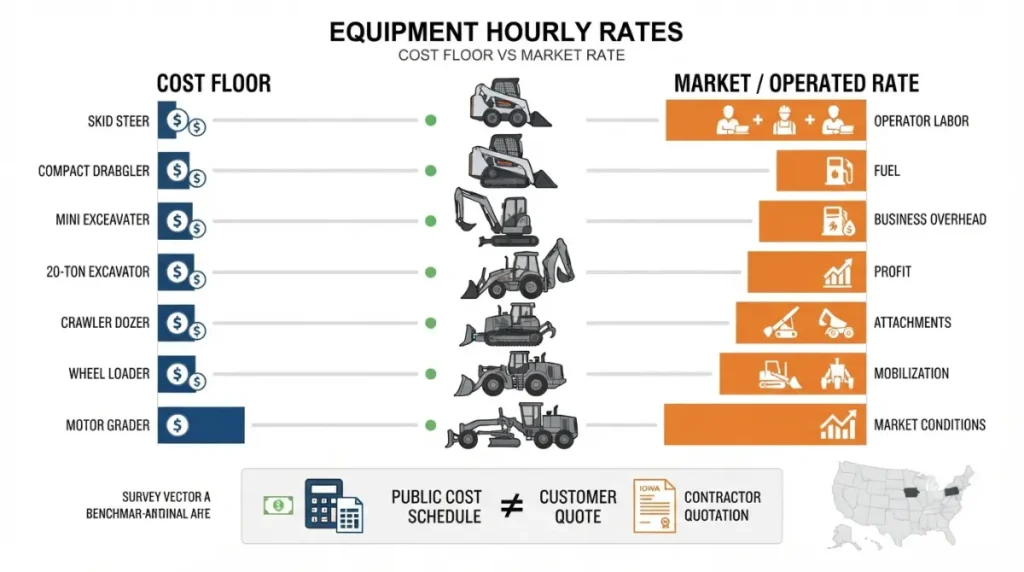
Sources: the machine-only rates come from FEMA’s 2025 Schedule of Equipment Rates. The market rates come from the 2026 Iowa survey, where rates include fuel and operator labor unless noted, and the reported range drops the single lowest and highest responses.
Skid steer and compact track loader rates
FEMA prices a 74-hp skid steer at about $45 an hour without an operator. The Iowa survey’s median skid loader rental was $100 an hour, with no operator or fuel, from only eight responses. Short-term rental pricing clearly carries a premium over cost-based rates. Compare how skid steer and track loader ownership costs compare before choosing between them.
Mini excavator rates
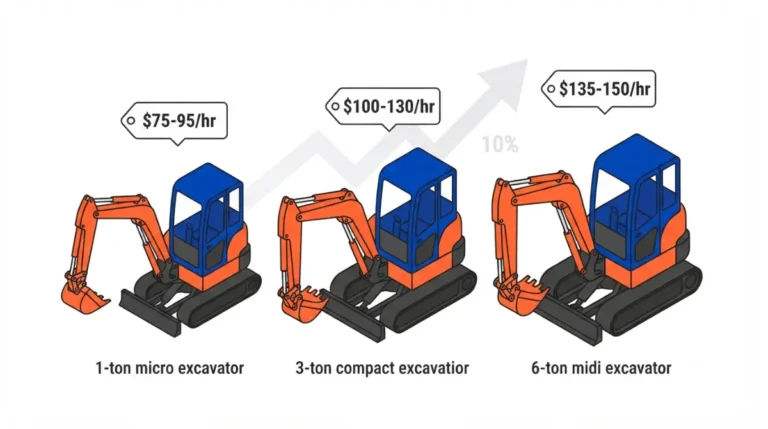
A 45-hp mini carries a FEMA machine-only rate of $57.14. Add your operator and the floor is near $100 an hour before profit or travel. No 2026 survey line exists for minis. Calculator sites quote $75–$120 with operator but don’t publish their sources, so treat those figures as unverified.
Backhoe loader rates
Backhoes are the one class where both columns tell a story. Iowa operators reported a median of $130 per hour for backhoeing, with a range of $70–$200 across 23 responses. That median sits below FEMA’s machine rate plus a $40 operator. Either those owners run older, paid-off machines, or some of them are underpricing.
Mid-size excavator rates
FEMA’s 20-ton reference machine is $107.93 an hour without an operator. With a $40 loaded operator, that’s about $148, close to the $140 break-even in our worked example at 1,000 billable hours. At 30 tons the floor climbs past $190.
Dozer rates
The Iowa survey prices dozing per foot of blade per hour, at a $16.50 median. A dozer with a 10-foot blade would work out to about $165 an hour at that median. Measure your own blade rather than assuming a width for your model.
Wheel loader and motor grader rates
The only loader survey line is snow removal, at a $115-an-hour median from 34 responses. Summer dirt work may price differently. Graders carry one of the highest machine-only floors in the table, and finish grading skill is part of what you’re selling.
How we built this table
FEMA lists one reference model per horsepower band. We use it as a size marker, not a brand recommendation. The survey column uses only Iowa State’s published 2026 lines, with sample sizes shown, and leaves a class blank rather than filling it with an estimate.
Survey rates reflect Iowa respondents and may not match your region. Set your rate from your own costs. Don’t set it by coordinating prices with competitors.
💡 Field Note: The Iowa report’s editor notes that the survey is a starting point for negotiation. Any rate charged or paid should still cover the operator’s cost of owning and operating the machine.
Custom farm work rates: hourly and per acre
Farm custom work is usually priced per acre, which hides your hourly return until you convert it. The 2026 Iowa survey is the most-used benchmark in the Midwest.
What the 2026 Iowa custom rate survey shows
The 2026 report draws on 205 responses and 4,698 rates from Iowa farmers, custom operators and farm managers. Rates rose in every category surveyed, from 0.3% for bin and machinery rental to 8.5% for pre-harvest work such as tillage, spraying and planting.
A few 2026 averages from the survey:
- Tandem disking: $19.80 per acre.
- Field cultivating: $19.20 per acre.
- Chisel plowing: $20.75 per acre.
- Hay mowing: $15.45 per acre.
- Tractor rental alone: median $0.35 per horsepower per hour.
- Hired machinery labor: median $22–$25 per hour.
The survey assumed diesel at $2.89 a gallon as of February 2026. If your fuel costs more, your rate needs to rise with it. Full tables are in Iowa State’s 2026 Farm Custom Rate Survey.
Converting per-acre rates to an hourly rate
Multiply the per-acre rate by the acres your rig actually covers per hour. At $19.80 an acre and an assumed 15 acres per hour, tandem disking grosses about $297 an hour, with tractor, fuel and labor included. Use the acres-per-hour calculator with your real implement width and speed.
Iowa State’s own worksheet runs the conversion the other way. A 150-hp tractor at $0.34 per horsepower-hour, covering 15 acres an hour, adds $3.40 per acre in tractor rental value.
Why your rate may need to be higher than the survey
Survey averages mix farmers with paid-off equipment and operators running new machines. If your costs are higher, charging the average means losing money. For per-operation detail, see custom rates by field operation.
Minimums, mobilization and standby: billing that pays
How you bill decides whether small jobs make money. A good hourly rate can still lose money on a two-hour job.
Minimum charges and half-day or full-day structures
Minimums protect you when a short job ties up the machine for most of a day. Owners on public forums have long described 4-hour minimums, with larger excavators often carrying 8. One contractor’s long-standing structure bills the skid steer per day plus the operator per hour, so a 4-hour job works out to about $105 an hour against about $70 for a 10-hour day. Those examples are dated, so check them against your current costs.
Mobilization as its own line item
Put mobilization on the invoice as a separate line. Burying travel in your hourly rate overcharges customers close to your yard and undercharges distant ones. The cost of the truck and trailer is a real input. Price it from your own hauling records.
Standby, attachments and severe-conditions pricing
Decide your standby charge before the job starts. Some reimbursement programs are strict about it: FEMA does not treat standby equipment costs as eligible, and pays only while equipment is actually working. Private customers may accept a reduced standby rate if it’s written into the quote.
Attachments such as mulchers and breakers wear faster and cost more to own. Price them separately. Rocky, wet or demolition sites deserve a severe-conditions rate, the same distinction the Army Corps applies.
⚠️ Watch Out: Quoting a small job at your full-day hourly rate, with no minimum and no mobilization line, is one of the most common ways owners lose money on a machine that looks busy. Put both on every quote.
Hourly vs bid-by-the-job
Hourly billing protects you on jobs where the scope is unclear. Bidding by the job rewards speed and skill once you know your production rates. Learn when to bid by the job instead of the hour.
New Tier 4 or paid-off machine: does your rate pencil?
The same machine class can need very different rates depending on its age, how it was paid for, and how many hours it bills. This is the check to run before you finance anything.
Why a financed Tier 4 Final machine needs a higher rate
A newer machine’s purchase price shows up as depreciation and interest on every billable hour. Depending on engine size and manufacturer, current EPA Tier 4 Final machines may also carry aftertreatment systems such as a DPF or SCR that uses DEF. Your operator’s manual lists what yours has.
Price those consumables and service intervals into your operating cost. See what Tier 4 Final aftertreatment adds to running costs.
The paid-off machine isn’t free
With no loan payment, owning cost drops, but it doesn’t reach zero. You still carry insurance, storage, and a larger repair reserve as hours climb. The machine’s resale value is also cash you could put to work elsewhere, and eventually you’ll replace it at today’s prices.
If you can’t bill enough hours, rent or sub it out
Take the worked example at 400 billable hours a year. Owning, overhead, operating and operator costs push break-even to about $237 an hour. Few customers pay that for a 20-ton excavator.
If your realistic hours are that low, the honest answer is to rent the machine for the jobs you land, or sub the work out to someone with a busier machine. Compare buying against renting with your own numbers before signing a loan. Financing makes sense only once your real billable hours support the rate.
Equipment hourly rate questions, answered
1. Does an equipment hourly rate include the operator?
It depends on the rate type. Dry and wet rates exclude the operator; FEMA’s schedule rates also exclude operator labor.
2. How many billable hours a year should I plan on?
Use your own invoiced hours. One published comparison puts rental houses near 1,800 billable hours and small contractors near 1,100.
3. What’s the difference between markup and margin?
Markup is profit on cost; margin is profit as a share of price. A 15% markup on $140 gives $161.
4. Do FEMA equipment rates include operator labor?
No. FEMA’s rates cover ownership and operation, including fuel and maintenance, but operator labor is excluded and approved separately.
5. How much did custom farm rates change for 2026?
Iowa’s 2026 survey showed increases in every category, from 0.3% for machinery rental to 8.5% for pre-harvest operations.
6. Should I charge a minimum for small equipment jobs?
Yes. Owners commonly use 4-hour minimums, often longer for large excavators, plus a separate mobilization line so short jobs still cover costs.
7. Is a paid-off machine cheaper to run per hour?
Its owning cost is lower, but insurance, repair reserves, storage, and the value tied up in the machine still belong in your hourly rate.
8. Should I charge by the hour or by the job?
Charge hourly when scope is uncertain. Bid by the job once you know your production rates and site conditions well.
Set your rate from your numbers, then check the market
If you’ve worked through this guide, you now have a cost floor for your machine, a way to compare quotes, and a structure for billing minimums and travel. The real risk is the one no table shows: a machine that bills too few hours will lose money at any rate the market will pay.
Your 10-minute next step
Plug your real costs and invoiced hours into the equipment cost-per-hour calculator. Download our free cost-per-hour worksheet to keep the numbers current. Then read how to bid excavation jobs or, for farm work, custom rates by field operation.
How we sourced this guide
Every rate here comes from a named public source with its date: FEMA’s 2025 schedule, Iowa State University’s 2026 survey, and 2025 BLS wage data. No figure was invented. Where no survey line existed for a machine, we left the cell blank. Before you quote your next job, calculate your own break-even.
One Comment