Mini excavator hourly rate and the right number for your class
Table of Contents
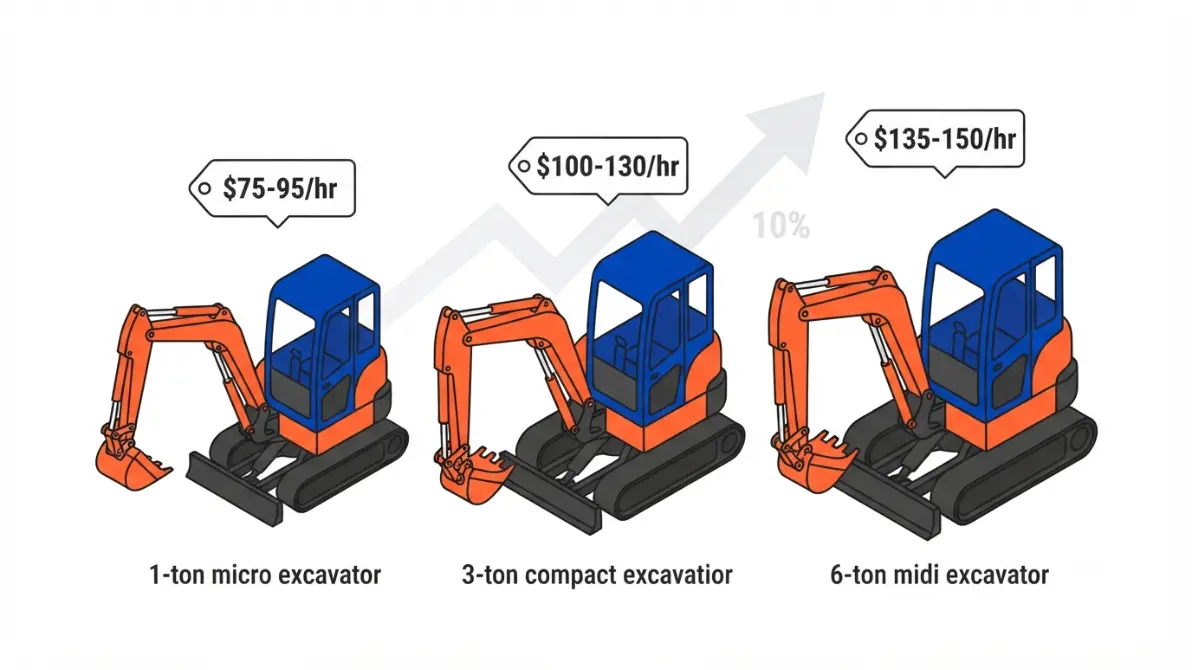
Published US rates for mini excavator work with an operator sit between roughly $75 and $150 an hour. That covers compact machines from about 1 to 9 metric tons (2,200–20,000 lb) operating weight, Tier 4 Final era, billed with an operator.
Quoting a job today? Go to the class table below. Deciding whether the machine pays for itself? Start at the break-even math. Checking a quote you received? The class table and the FAQ answer you.
One correction first, because it sinks more bids than anything else: the machine-only rate you see at a rental counter is a different number from what you bill with an operator. Rental covers the iron. Your rate covers the iron, you, your truck, and your overhead.
📋 Compliance Note: Excavation work is regulated under OSHA’s construction standards, and federally funded jobs carry prevailing wage requirements set per project. Requirements vary by state — 22 states run their own OSHA-approved plans — so verify with your state agency and the job’s wage determination before relying on anything here.
💵 About These Numbers: Rate figures below are compiled from published US rental rate cards, one rental marketplace dataset, and three published contractor pricing analyses, all reviewed in September 2026. They are national planning ranges, not quotes. Metro market, soil and rock, job duration, and attachment package each move a rate more than one weight class does.
What to charge by weight class, from 1 ton to 9 ton
Published operated rates are reported nationally, not by tonnage — so the honest way to use weight class is to locate yourself inside the national band rather than to invent a separate figure per class.
| Weight class | Machine-only rental (sourced) | Where operated billing lands | What it means |
|---|---|---|---|
| 1–2 t micro | ~$150–$200/day | Bottom of the $75–$150 band | Gate-access and backyard work; you’re paid for fitting, not production |
| 2–4 t | ~$275–$450/day | Middle of the band | The class most owner-operators bill; trenching, footings, landscape |
| 4–6 t | ~$290–$450/day, higher in metros | Upper half | Deeper reach and real production; competing on cost per hour, not access |
| 6–9 t midi | ~$475–$750/day | Top of the band and above it on commercial work | Utility and site work; commercial billing rules apply |
Rental figures: DOZR marketplace data (1,193 US and Canadian rental quotes, updated March 2026); regional dealer rate cards and metro planning guides, February–May 2026. Operated band: published contractor pricing analyses, March–May 2026.
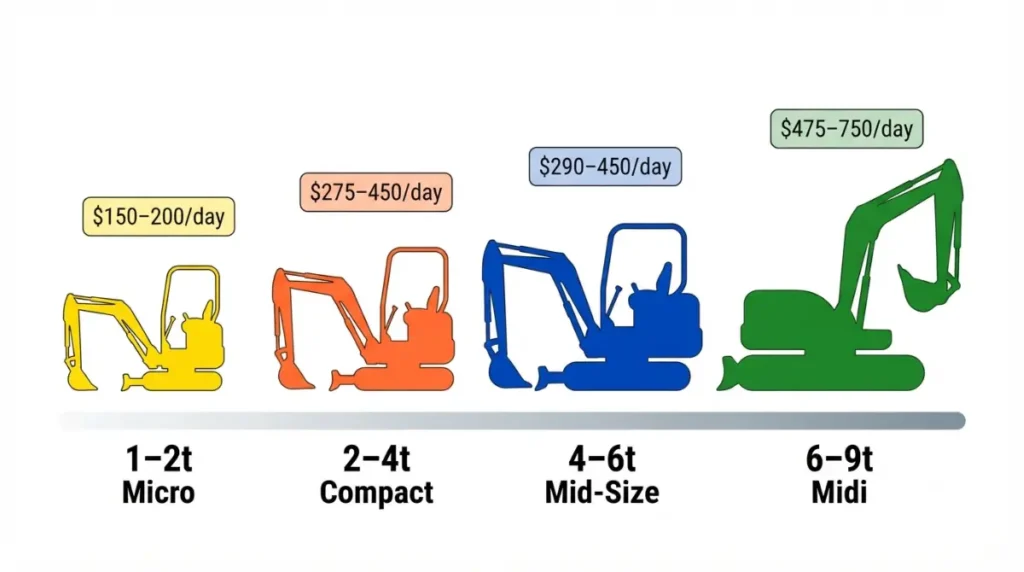
Methodology: the class ladder is built from machine-only rental rates, which published sources do break out by tonnage, and used to position the reader inside the operated band, which they do not.
⚠️ Watch Out: The gap between a slow market and a busy one is wider than the gap between two weight classes. Moving up a class buys you maybe a step inside the band. Utilization moves you further.
Work out your break-even before you quote anything
Your floor is ownership plus operating plus labor plus overhead, divided by the hours you actually bill.
- Ownership — payment or depreciation, interest, insurance, storage
- Operating — fuel, filters, fluids, undercarriage, repairs
- Labor — your own wage, at market, not zero
- Overhead — licensing, advertising, phone, accounting
- Divide by billable hours, not calendar hours
📊 Verified Spec: Published fuel-burn figures put a 1-ton machine near 0.5–0.8 gallons per hour and a 1.5-ton near 0.7–1.2, with 5–6 ton machines exceeding 2 under load (ztsupplychain, May 2026; ahmcorp, July 2026). Measure your own against your tank and hour meter — your operator’s manual and serial range govern capacities and service intervals, not this article.
Two inputs get fudged most. Use the federal wage data for construction equipment operators — correction, use the BLS occupational page linked in the verification block — and pull diesel from EIA’s weekly Gasoline and Diesel Fuel Update, remembering off-road dyed diesel runs below the on-highway average.
📉 Cost Reality: One published 2026 analysis puts pure operating cost — fuel, maintenance, insurance, repairs — at $8–$17 per hour, excluding both labor and ownership. Treat that as the smallest part of your number, not the whole of it.
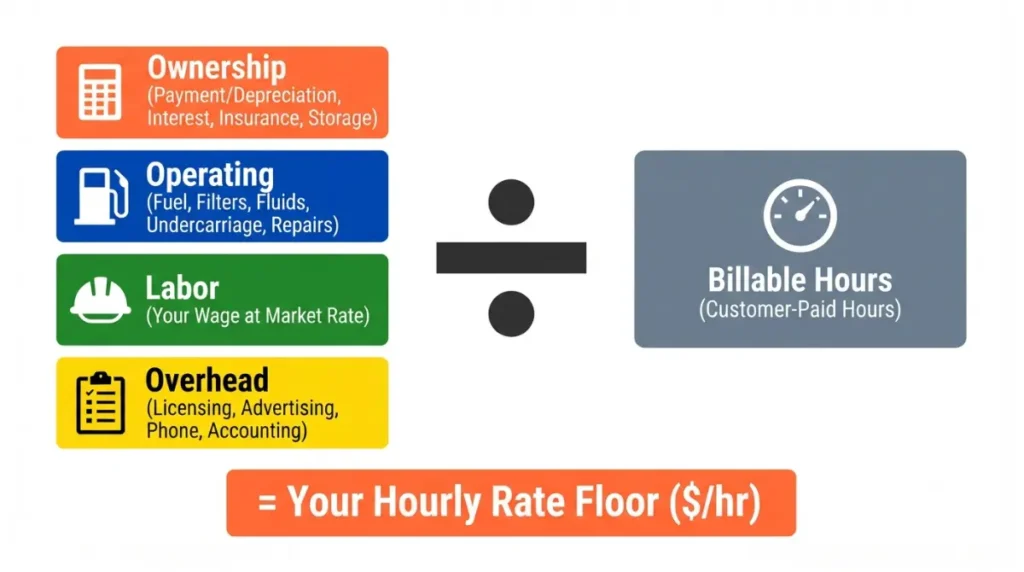
Rental-parity floor: your operated rate must clear the machine-only day rate for your class, divided by billable hours, plus labor and overhead. If it doesn’t, the customer can rent the same iron cheaper than you can show up.
Run your own cost-per-hour number before the next quote goes out, or read the detail in what it actually costs to run a mini excavator per hour.
Billable hours move your rate more than tonnage does
A billable hour is an hour a customer pays for. Your hour meter counts engine hours, which includes idling in a driveway waiting on an inspector.
🔍 Why It Happens: Fixed costs don’t care whether you work. Spread a $12,000 annual ownership bill over 1,100 hours and it’s about $11 per hour; spread it over 400 and it’s $30. Same machine, same payment, triple the burden.
One published contractor rate tool assumes 1,000–1,200 annual hours as realistic for a small excavation outfit. Published rent-versus-own guidance disagrees on the crossover — one source puts renting ahead below about 10 days a year, another puts ownership ahead past 20–25. The disagreement is real; both numbers are far below 1,000 hours.
✅ Do This: Read your hour meter today, write the number down, and read it again in 90 days. If you’re not tracking hours, you’re guessing at your own cost — and at buy-versus-rent breakeven by annual hours.
If you’re billing under a couple hundred hours a year, the honest answer is that ownership doesn’t pencil and no hourly rate fixes it. Rent per job, or sub the work out.
What the market will actually pay — and where the ceiling is
Three segments set your ceiling, and they’re separated by risk and paperwork, not by operator skill.
- Residential — published analysis puts contractor billing at $110–$150/hour; homeowners compare you against a rental counter
- Commercial — $160–$260/hour in the same analysis, paid for insurance limits, certificates of insurance, documentation and schedule risk
- Subbing to a GC — closer to commercial, with slower payment terms priced in
Region moves this more than class does. Metro planning guides put a 3–5 ton machine at $450–$750/day in New York against $290–$450/day in Austin — and those are stated as planning ranges built from benchmark data plus a market premium, not observed transactions.
On a half-day backyard job, tell the customer plainly that renting the machine themselves may cost less. The ones who can’t run it will hire you anyway, and the ones who can were never your margin. Same logic applies across machines — see skid steer hourly rate for a blended crew number.
The charges that don’t belong inside your hourly rate
Every line you bury in the hourly number makes your rate look high and your margin look thin.
- Mobilization — published ranges run $50–$150 as a delivery fee, and $75–$200 each way in the rental market
- Minimums — a one-day or eight-hour minimum is standard on excavation work, with published minimum project fees of $500–$800
- Standby — customer-caused delay is billable if your contract says so; that clause is your attorney’s call, not ours
- Attachments — breaker, thumb, auger and grapple carry their own upcharge
- Compliance — protective systems and a competent person on qualifying excavations are costs that belong in the quote
Read the requirements yourself in OSHA’s excavation standard. Hauling the machine is its own subject — trailer ratings and permitting aren’t covered here.
Five ways a good hourly rate still loses money
- Idle burn you don’t bill — published figures put idle at 0.3–0.5 gallons per hour, and one 2026 analysis estimates $600–$1,600 a year in idle waste at 500 annual hours
- No minimum — a 90-minute job that costs you a half day of travel
- Hourly on rock — unknown soil belongs in a unit-price bid or a rock clause, not your hourly table
- No delay clause — you eat the wait when the utility locate is late
- Forgetting the trailer hour — load, drive, unload, repeat
💡 Field Note: Extension machinery-cost method is consistent on this point — compute your own costs rather than adopting a published average. Iowa State’s Estimating Farm Machinery Costs lays out the ownership-and-operating split that the construction equivalent mirrors.
Mini excavator hourly rate: quick answers
1. What is the average hourly rate for a mini excavator with an operator?
Published US rates run about $75 to $150 per hour with an operator, before mobilization, minimums, or attachment upcharges.
2. How much should I charge for a 3-ton?
A 3-ton sits mid-band. Published operated rates put it near the middle of the $75–$150 range, adjusted for your market.
3. Is the rental rate the same as my hourly rate?
No. Machine-only rental covers the iron. Your operated rate covers the machine, your labor, your truck, and overhead.
4. What does it cost me per hour to run the machine?
One published 2026 analysis puts operating cost at $8–$17 per hour, excluding labor and ownership — the smaller part of your number.
5. How many hours a year do I need to bill?
A published contractor tool assumes 1,000–1,200 hours as realistic for a small outfit. Well under that, ownership stops working.
6. How big is the residential-to-commercial gap?
Published figures show $110–$150 residential against $160–$260 commercial, reflecting insurance limits, documentation, and schedule risk.
7. Do I bill travel and trailering time?
Bill it as mobilization, not inside the hourly rate. Published delivery fees run $50–$150, or $75–$200 each way.
8.What’s a normal minimum charge?
A one-day or eight-hour minimum is standard, with published minimum project fees of $500 to $800 on excavation work.
9. Do I charge extra for a breaker or thumb?
Yes — attachments carry a separate upcharge. Burying them in the hourly rate makes your base number look uncompetitive.
When should I not bill hourly at all?
On rock or unknown soil. Use unit pricing or a rock clause; hourly billing there transfers the risk to your customer and stalls the sale.
Setting your number
Find your class in the table, calculate your own floor, and price mobilization, minimums, and attachments as separate lines. The rate you can defend is the one you built, not the one you copied.
Full machine-by-machine comparison sits in the pillar: equipment rates per hour by machine. Wage data, diesel price, and rate cards get re-checked at each review.