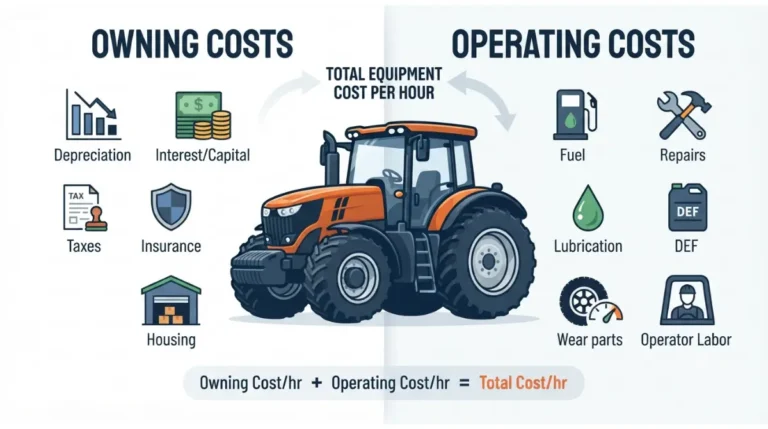
How much to charge for attachments on excavators and skid steers

Charging for attachments starts with one question: does your market expect a thumb to come with the machine? Augers and mulchers follow different rules.
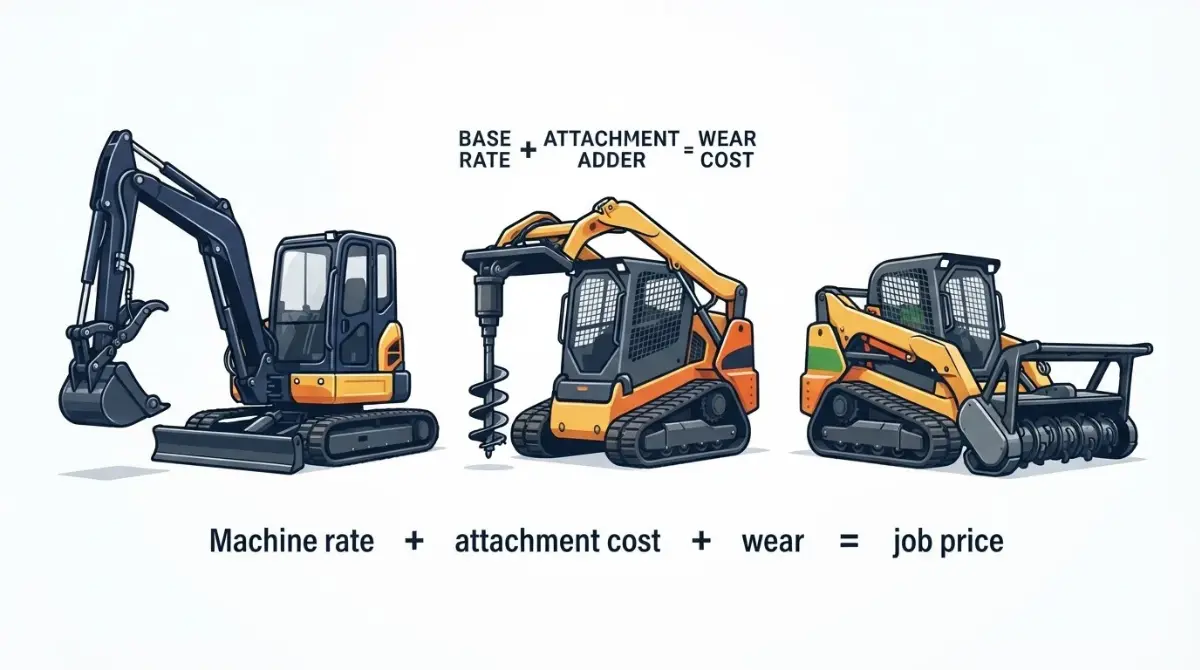
Table of Contents
What to charge for thumbs, augers and mulcher heads
Applies to mini and mid-size excavators, skid steers, and compact track loaders billed in the US, any model year. Covers hydraulic thumbs, augers, and mulcher heads as hourly or daily add-ons. Emissions era doesn’t change attachment pricing.
Who this is for
Quote due? Jump to your attachment’s section. Billing a neighbor? Start with the three structures below. Weighing a mulcher purchase? Go to the buy-or-rent section.
Three ways to bill an attachment
Bundle it into the base rate, add a flat hourly adder, or bill it separately with wear parts itemized. A thumb usually fits the first two, an auger the last two, and a mulcher the last.
ℹ️ Safety Note: Attachment work involves crushing, entanglement, and hydraulic-pressure hazards. This is a pricing guide, not a procedure. Follow your manuals, and have a qualified technician handle coupler and hydraulic work.
💵 About These Numbers: Rates vary by region, machine class, season, and term, so treat them as orientation, not a quote.
Bundle it, add it, or bill it separately
The right structure depends on whether your market expects the attachment to come with the machine.
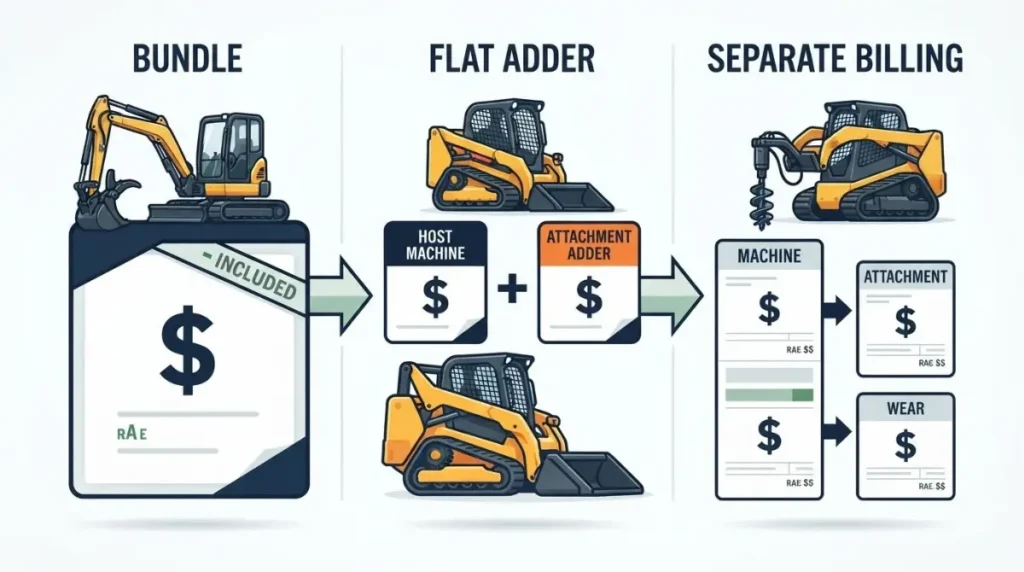
- Bundle it when local competitors include it.
- Add a flat hourly adder when it’s common but not assumed.
- Bill it separately when it wears fast or needs a specific carrier.
When a thumb belongs in the base rate
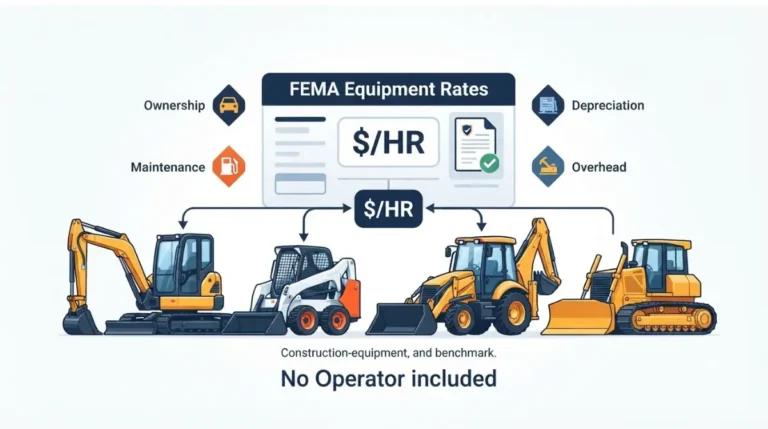
If nearby operators include a hydraulic thumb, an adder prices you out. FEMA’s schedule also bundles required attachments; see our FEMA equipment rates benchmark.
Flat adder or percentage adder
A percentage scales with your base machine rate; a flat adder is simpler to quote. Build the base first with our hourly rate by machine guide.
When to itemize bits and teeth
Itemize auger bits and mulcher teeth, which wear and come in sizes. Forum threads report all three conventions, so check local quotes.
Thumb and auger adders: what rate sheets show
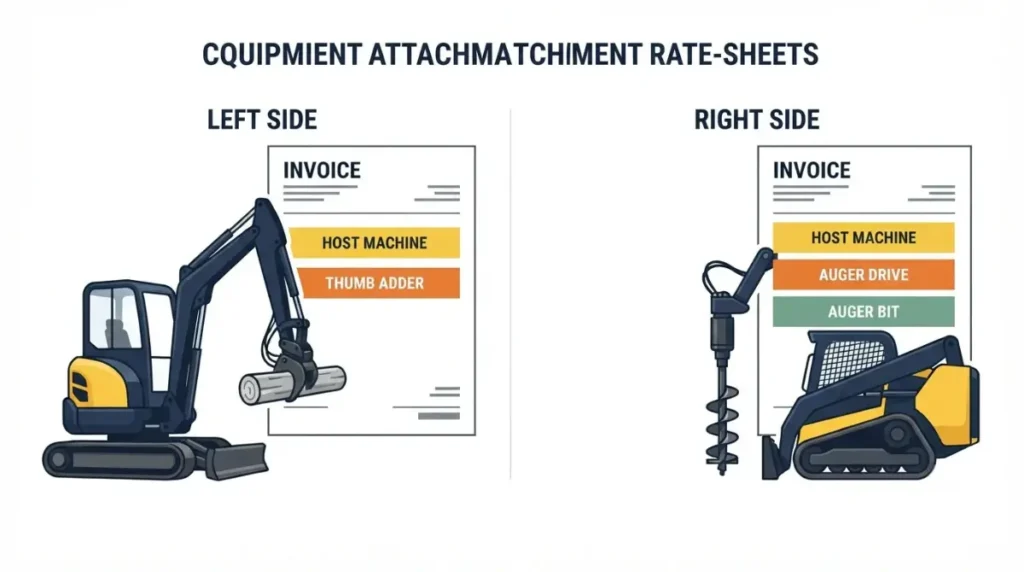
Hydraulic thumb: usually bundle it
Where competitors include a thumb, bundle it; where they don’t, a flat adder checked against rental rates is defensible.
Auger drive vs. bits
Quote the auger drive and each bit size as separate lines.
How the adder compares to the host machine’s day rate
Use the table’s third column to sanity-check your number. The base rate underneath is in our mini excavator hourly rate guide.
Confirm any thumb or auger fits your carrier’s size class and quick coupler in your operator’s manual before you quote it.
Mulcher heads: why a flat surcharge loses money
A standard-flow skid steer or track loader can run a forestry mulcher only with a head built for standard flow.
📊 Verified Spec: Fecon lists its standard-flow Bull Hog head at 17–34 GPM, up to 4,000 PSI, and 75 hp maximum, with a separate high-flow head above that. Source: Fecon’s published specification page.
Check carrier flow before you quote
✅ Do This: Ask a dealer service department or the maker’s technical support to confirm flow, pressure, and horsepower against your carrier’s manual.
Standard-flow versus high-flow carriers
Skid Pro’s SP 500 mulcher comes in 12–25 GPM low-flow and 25–45 GPM high-flow versions, so the head’s own spec decides.
Bill by the day or acre, with teeth itemized
A flat hourly surcharge hides tooth wear and production rate, which vary most from job to job. Bill by the day, or by the acre: day rate divided by acres you actually clear. Our forestry mulching rates guide covers going rates.
Build your attachment adder in four lines
Four lines turn an attachment’s cost into a per-hour number.
- Ownership per hour: purchase price minus expected resale, divided by hours you’ll run it.
- Wear per hour: wear-part cost divided by hours between replacements.
- Carrier effect: any added cost your base rate doesn’t already cover.
- Margin: your standard markup.
Ownership cost per attachment hour
Illustration only, not measured data: a $10,000 attachment with $4,000 expected resale over 600 hours costs $10 an hour to own.
Wear parts per hour
Track teeth, bits, and hoses as their own line.
Carrier effects and your margin
If the total lands above local rental rates for the same attachment, stop and recheck your hours before raising the price. Our owning versus operating cost guide separates the two.
Buy the head, rent it, or sub the job out?
Rent or sub the work out unless your yearly days clear break-even.
📉 Cost Reality: Skid steer mulcher heads run from about $4,000 for entry-level drum models to $30,000+ for large high-flow units. Source: Skid Pro’s buying guide, retrieved October 2026; a manufacturer’s marketing page, so treat it as a range.
Break-even days: the one number to compute
Divide the head’s yearly ownership cost by one rental day’s rate; that’s the days per year you must run it.
When renting beats owning
A few days a year rarely justifies the capital, storage, and wear-part risk.
When subbing it out wins
On a large one-off job, a mulching contractor carries the wear and production risk.
Orientation, not financial advice; ask your CPA or lender about tax and financing.
Quick couplers and guarding: price the risk in
Coupler checks, guarding, and inspection time are real costs; price them.
Never work under a raised attachment
⚠️ Watch Out: NIOSH’s quick coupler bulletin reports three worker deaths since 2019 (as of March 2022) from buckets falling off excavator quick couplers. Assume a coupler can fail: never be below a bucket, attachment, or load, or within an operating excavator’s swing radius.
Connection test and locking pin: follow the manual
NIOSH says to run the manufacturer’s connection test and, where required, set the safety locking pin before lifting. OSHA’s quick coupler bulletin covers the same hazard.
Guarding and PPE come with the attachment
Mulcher heads and augers add their own guarding and entanglement hazards; follow the head’s and carrier’s manuals.
🔧 Stop Here: Coupler inspection, locking-pin hardware, and hydraulic hose work belong with a qualified equipment technician or dealer service department. Ask what pin and connection test your manual requires.
Also ask your insurance agent whether your attachments are covered.
Frequently asked questions
1. Should I charge extra for a hydraulic thumb?
Bundle the hydraulic thumb if local competitors include one; otherwise add a flat hourly adder. Check nearby quotes first.
2. How much should I charge for an auger attachment?
Treat the table’s range as a ceiling, then build your auger adder from ownership and bit-wear cost per hour.
3. How do I price a forestry mulcher?
Bill a forestry mulcher by the day or acre, with teeth as a separate line, not a flat hourly surcharge.
4. Do I include attachments in my hourly rate?
Include attachments in your hourly rate when local competitors do, as with a thumb; bill wear-heavy ones separately.
5. What flat adder do contractors use for attachments?
A flat adder should cover ownership and wear cost per hour and be checked against local rental rates.
6. Can a standard-flow skid steer run a forestry mulcher?
Only with a head built for standard flow; Fecon lists 17–34 GPM for one such head. Check the head’s and carrier’s manuals first.
7. How do I calculate attachment cost per hour?
Attachment cost per hour is ownership, wear, any carrier effect, and margin; ownership is price minus resale over expected hours.
8. Should teeth and bits be billed separately?
Yes, when they wear fast or vary by size: itemize auger bits and mulcher teeth so the adder needn’t absorb them.
9. Is it cheaper to rent or buy a forestry mulcher?
Renting or subbing out a forestry mulcher wins unless yearly days clear break-even; heads cost about $4,000–$30,000+, per Skid Pro.
10. Is it safe to stand under an excavator attachment?
No. NIOSH says to assume a quick coupler can fail and never be below an attachment. Follow your manual and keep clear of the swing radius.
Bundle what the market expects, add a flat adder where you can defend it, and bill wear-heavy attachments like augers and mulchers as separate lines. Check every number against local rental rates and your own cost per hour. This week, pull two local rental quotes for the same attachment and compare them to your adder. Your manuals, not this article, set the rules for your machine.