Forestry Mulching Rates Per Hour vs Per Acre, With Clear Math

Forestry mulching prices hinge on one number: acres per hour. A USDA Forest Service study clocked 0.21 to 0.89 in the field, and your quote depends on it.
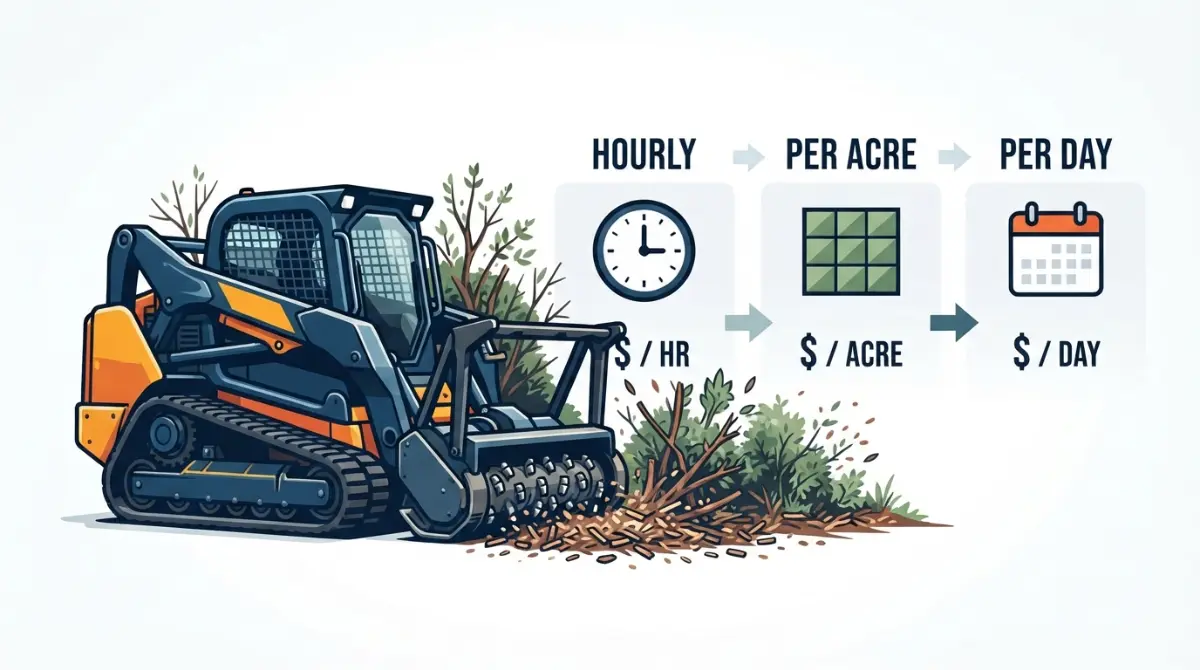
Table of Contents
Forestry mulching rates: per hour, per acre or per day
This guide covers forestry mulching rates for crews running high-flow skid-steer or compact track loader mulching heads and dedicated mulching tractors, using US rates published through September 2026. Emissions era doesn’t change this math, so it isn’t a factor.
All three pricing models are the same arithmetic. What differs is who carries the risk when the ground is thicker than it looked: you on hourly, the contractor on per-acre.
If you’re hiring
Check your quote against real production rates in Sections 3, 4 and 7.
If you’re quoting
Sections 2, 5 and 6 show how to price unseen ground without losing money. For the wider picture, see our guide to equipment hourly rates by machine.
💵 About These Numbers: Prices come from published cost guides and contractor rate cards observed in September 2026, plus a 2005 USDA Forest Service field study used for production rates only. Rates vary significantly by region, vegetation density, terrain, machine and acreage. Treat them as orientation, not a quote.
How hourly, per-acre and day-rate quotes are built
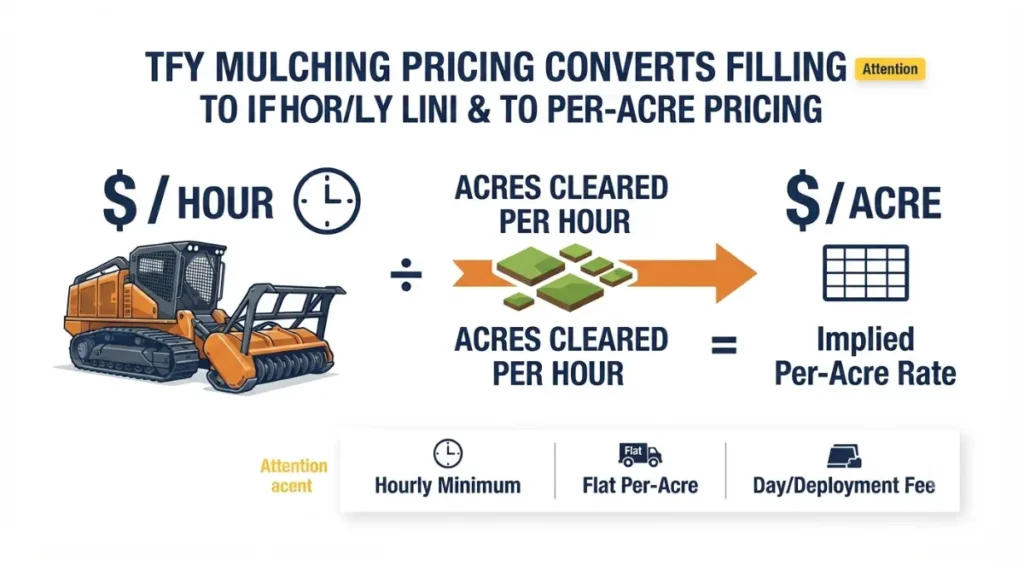
Neither model is cheaper by itself. A per-acre rate is simply the hourly rate divided by the acres a machine clears per hour.
Hourly with a minimum
Most hourly quotes carry a minimum charge. One Oklahoma contractor publishes $200 per hour with a 3-hour minimum, so even the smallest job starts at $600.
Per-acre flat rate
A flat per-acre price shifts the density risk to the contractor, who prices in a cushion to cover it. You pay for that cushion even when your land clears fast.
Day rate or deployment fee
Some crews bundle mobilization into a fixed fee. One eastern North Carolina contractor charges $3,500 for mobilization plus six hours of machine run time, then $250 per hour. The USDA Forest Service keeps a catalog of mulcher equipment research covering the machine types behind these rates.
What forestry mulching costs per hour right now
Across current published sources, most hourly mulching rates fall between $100 and $300.
Published hourly ranges
| Source | Published rate | Date | What It Means |
|---|---|---|---|
| Angi (cost guide) | $150–$300/hr; $1,000–$2,500/acre | May 2026 | Current homeowner-facing range |
| HomeGuide (cost guide) | $125–$300/hr; $1,000–$2,500/day | Sept 2023 | Older; use as a cross-check |
| Stronghold Vegetation, TX (contractor) | $100–$250/hr | Feb 2025 | One market’s view |
| Forestry Mulching Oklahoma (rate card) | $200/hr, 3-hr minimum | Observed Sept 2026 | One operator’s current card |
Sources: Angi, HomeGuide, Stronghold Vegetation Management, Forestry Mulching Oklahoma published pricing.
Day rates and what drives the spread
HomeGuide lists day rates of $1,000 to $2,500 with an operator. Rates shift with location and crew size. Angi notes that experienced operators may charge more but often work faster, which can lower your total bill.
Why per-acre quotes range from about $150 to $8,000
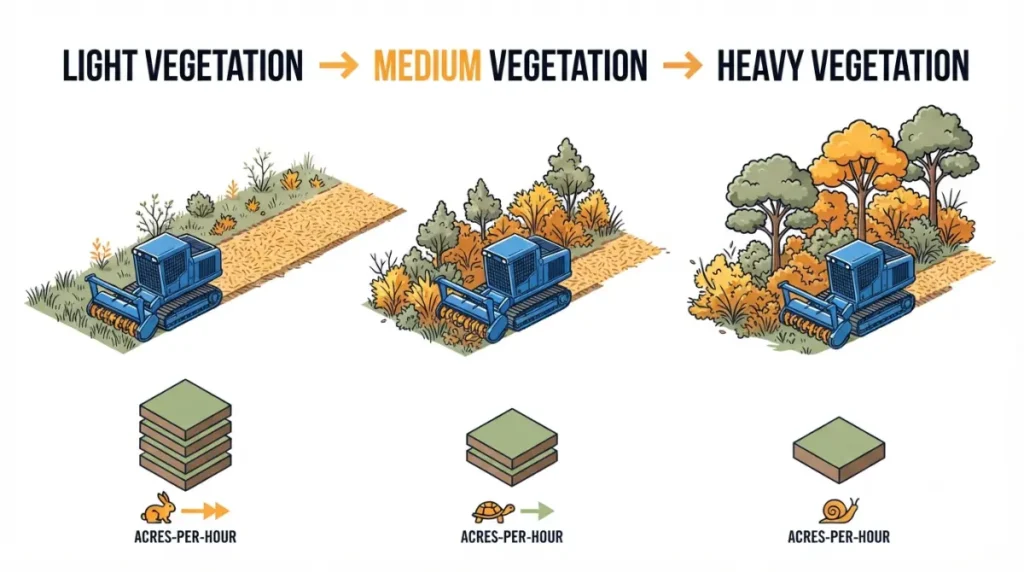
The hourly rate barely moves between jobs. Acres per hour can move tenfold, and that is what drives the per-acre price.
Acres per hour by vegetation density
| Vegetation | Acres per hour | Implied $/acre at $200/hr | What It Means |
|---|---|---|---|
| Light brush, grass, shrubs | 1–1.5 (OK contractor) | $133–$200 | Hourly usually wins |
| Small trees, thicker brush | 0.5–1 (OK contractor) | $200–$400 | Either model works |
| Rotary masticator, Idaho field study | 0.21–0.89, avg 0.57 (USFS) | $225–$952, avg ~$351 | Real-world spread |
| Heavy brush, larger trees | ~0.1 (8–10+ hrs/acre, OWNR OPS) | $1,600–$2,000+ | Per-acre protects you |
Methodology: implied per-acre = published hourly rate ÷ published acres per hour. Production rates come from a USDA Forest Service mastication study (2005 field data) and contractor-published figures observed Sept 2026. Figures exclude mobilization and minimums. Contractor rates are self-reported.
Same hourly rate, different land
The study’s own cost figures (average $530 per acre) are 2005 dollars, so they are historical rather than current prices.
How job size and mobilization change the per-acre price
Fixed costs don’t shrink with the job, so small lots pay more per acre.
Minimums on small lots
Take the $3,500 North Carolina deployment fee. Spread over half an acre, it is $7,000 per acre of fixed cost. Over five acres, it drops to $700.
Spreading the fixed cost
That contractor’s worked example puts five medium-density acres at roughly $1,400 to $1,700 per acre, less than half the half-acre figure. Contractors should build mobilization into rates the same way we show for a mini excavator’s hourly rate.
When hourly beats per-acre, and when it doesn’t
Pick the model that puts risk on whoever can see the ground best.
For landowners
Hourly suits light, uniform brush you can walk through, where production is predictable. Per-acre suits dense, mixed or hidden ground.
If it’s mostly grass and a few saplings you’ll keep mowing, get a brush hog quote first. Brush hogging is a temporary cut, while mulching is a clearing operation.
For contractors quoting
Walk the site before quoting per acre. A flat per-acre rate set without knowing the acreage pads big jobs or loses money on small ones. Most mulching heads ride on loaders, so start from how a skid steer or CTL hourly rate is set.
What to check before you sign or send a mulching quote
The fine print decides the final bill more often than the headline rate.
Tree size limits and surcharges
Virginia Cooperative Extension’s land-clearing guide puts typical mulching heads at stems up to 6 to 8 inches. Some operators add $25 to $100 per tree over 8 inches.
Rock, teeth and finish passes
Rocks, old fencing and metal slow the machine and wear teeth, so clear them first. Confirm the following before anyone signs:
- Is mobilization included, and what’s the minimum?
- What is the tree-diameter limit, and is there a surcharge above it?
- Is the finish single-pass or multi-pass? Finer mulch takes more passes and costs more.
- Does hourly billing count machine run time or time on site?
Forestry mulching rates FAQ
1. How much is forestry mulching per hour?
Published forestry mulching rates mostly run $100 to $300 per hour. Angi’s May 2026 guide cites $150 to $300.
2. How much is forestry mulching per acre?
Forestry mulching per acre runs from roughly $133 on light brush to $2,000-plus on heavy growth, because production varies tenfold.
3. Is per-acre or hourly forestry mulching better?
Hourly usually costs less on light, uniform brush. Per-acre protects you on dense or unseen land where production is unpredictable.
4. How many acres per hour can a forestry mulcher clear?
Published figures run from about 0.1 acre per hour in heavy growth to 1.5 acres per hour in light brush.
5. Why do small forestry mulching jobs cost more per acre?
Minimums and mobilization are fixed costs, so a half-acre job absorbs them over far fewer acres than a five-acre job.
6. What is a forestry mulching mobilization fee?
It covers getting the mulcher to your site. Some contractors bundle it with several hours of machine run time.
7. How big a tree can a forestry mulcher handle?
Virginia Cooperative Extension puts typical mulching heads at stems up to 6 to 8 inches. Larger trees often cost extra.
8. Do rocks raise forestry mulching cost?
Yes. Rocks, old fencing and metal slow production and wear mulcher teeth, so clearing debris first cuts billable hours.
9. What should a forestry mulching quote include?
It should state mobilization, the minimum charge, tree-size limits, finish passes, and whether hourly billing counts machine time or site time.
10. Should contractors quote forestry mulching per acre without seeing the site?
No. Per-acre pricing on unseen ground either pads large jobs or loses money on small ones, so walk it first.
The bottom line on mulching rates
Divide the hourly rate by realistic acres per hour, then add mobilization spread across your acreage. That is the real per-acre price, whichever model the quote uses. Run your site through the Field Efficiency Calculator before you sign or send anything.