Mini excavator vs skid steer, job by job, with rental rates

Skid steer or mini excavator? Two public schedules disagree on which costs more per hour, so the page prices both from one Maine supplier’s bid.
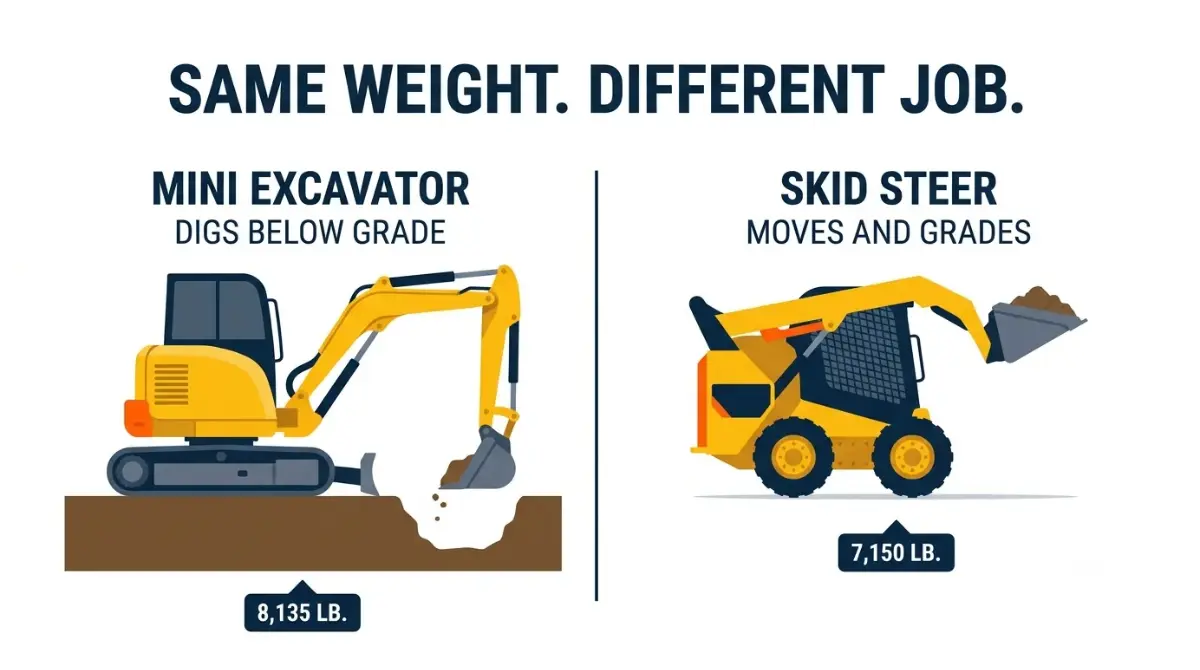
Table of Contents
Rates and sources checked on October 31, 2026.
A mini excavator digs below grade and swings the spoil aside, while a skid steer carries, loads and grades on the surface. In Maine’s statewide rental bids, one supplier priced its Deere/Hitachi 35 excavator about 31% higher by the week than a similar-weight Deere 320 skid steer, both delivered and rented without an operator.
That gap narrows against a larger wheeled loader and reverses against a tracked one. The machine worth owning is the one your most repeated task needs: trenching and stumps point to the excavator, moving material and finish grading to the loader.
The two machines at the same weight
Less than 1,000 lb separates Deere’s 35 P-Tier compact excavator from its 320 P-Tier skid steer on operating weight. Engine power is where they part, with the loader listed at almost three times the excavator’s net horsepower.
| Machine | Applies to | Operating weight | Net power | Capacity figure Deere gives |
|---|---|---|---|---|
| Deere 35 P-Tier compact excavator | Current model, configuration Deere lists | 8,135 lb (3,690 kg) | 23.3 hp (17.4 kW) | Lift chart by reach and height; digs to 10 ft 0 in (3.06 m) |
| Deere 320 P-Tier skid steer | Current model, base machine | 7,150 lb (3,246 kg) | 66 hp (49.4 kW) | Rated operating capacity, 2,190 lb (994 kg) |
Sources: Deere’s 35 P-Tier compact excavator page and 320 P-Tier skid steer page. The operator’s manual and spec sheet for your machine’s serial range govern.
Why 2,190 lb and a lift chart don’t compare
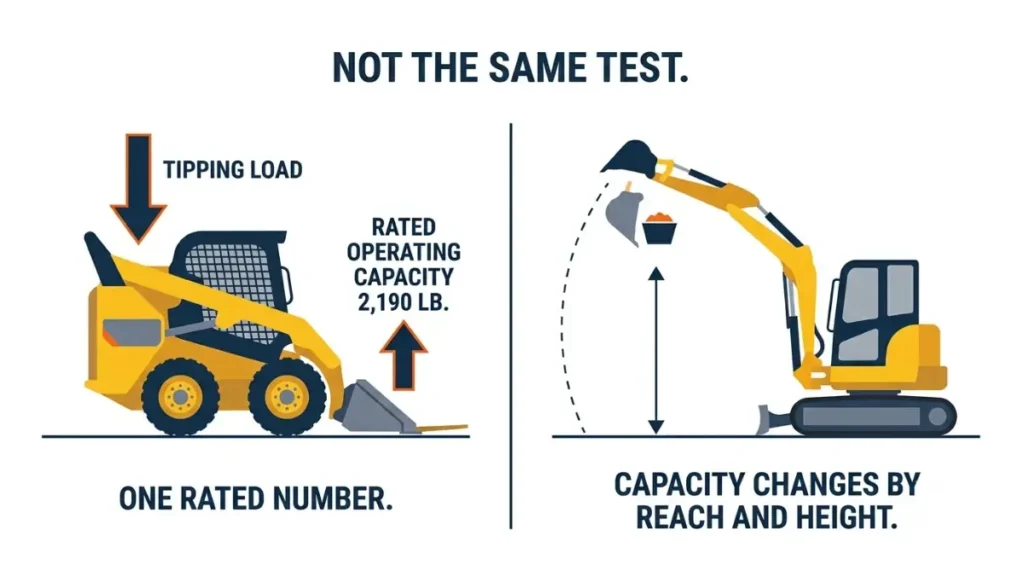
A loader’s capacity rating is tied to its tipping load. Deere’s spec sheet for the 320G, the model before the 320 P-Tier, lists a 4,380 lb (1,989 kg) tipping load, exactly twice its SAE rated operating capacity. Track loaders can be rated on a smaller share, with Cat’s compact track loaders rated at 35% of tipping load.
A compact excavator carries no single number of that kind. Its lift chart gives a capacity at each reach and height, so a loader’s rating set against one point on that chart compares two different tests.
Maine’s state rental bids put a price on both
One supplier priced both machine types in the same contract in Maine DOT’s March 2025 letting for on-call excavators and loaders, rented without an operator and delivered by the bidder. The state awarded that contract to Eagle Rental of Waterville a week after bids opened.
| Maine DOT statewide bid, without operator, delivered, USD, letting March 5, 2025 | Day | Week | Month | Week vs. Eagle’s excavator |
|---|---|---|---|---|
| Eagle Rental, Deere/Hitachi 35 excavator, 8,000 lb | $350 | $1,050 | $2,800 | Baseline |
| Eagle Rental, Deere 320 wheeled skid steer, 7,150 lb | $300 | $800 | $2,000 | $250 less |
| Eagle Rental, Deere 326 wheeled skid steer, 8,200 lb | $350 | $950 | $2,200 | $100 less |
| Eagle Rental, Deere 317 tracked loader, 8,600 lb | $400 | $1,350 | $3,000 | $300 more |
| Central Equipment, Doosan DX35Z-7 excavator with thumb and blade, 8,807 lb | $425 | $975 | $2,500 | $75 less |
Source: Maine DOT bid tabulation PH20250212EXO. Machine names and weights are as the bidders listed them.
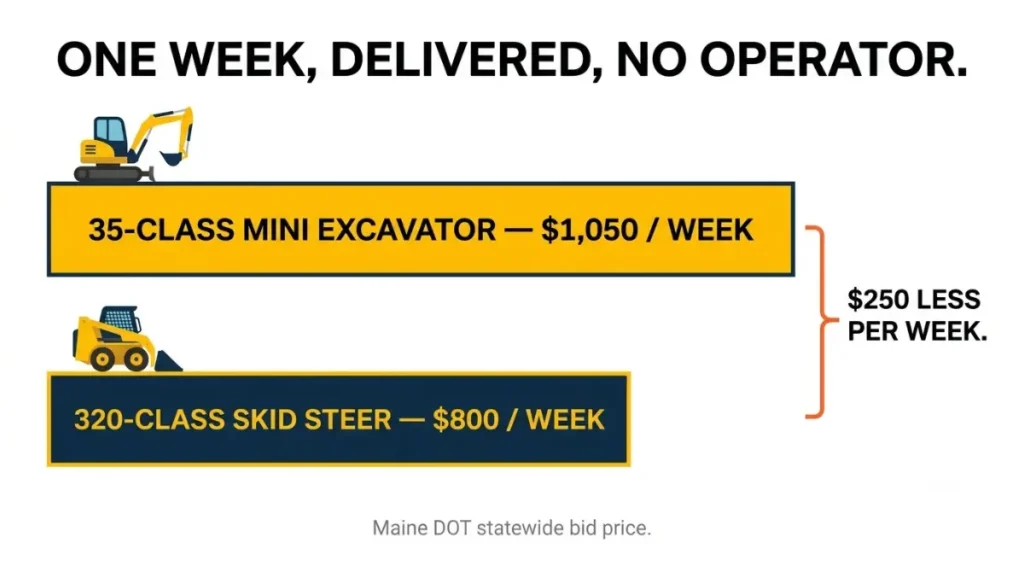
The weekly gap in the opening grows to 40% by the month. Against the bigger 326, the excavator’s day rate is a match and its week runs only slightly higher, while the tracked loader costs more per week than the excavator it would work beside.
A week of the excavator equals three of its day rates, so from the third day the weekly price costs no more than paying by the day. Renting the excavator and the 320 together from Eagle comes to $1,850 for one week at these bid prices.
These are prices bid to a state agency for on-call work, and the bid sheet doesn’t state who pays for fuel. A quote from your local yard can land elsewhere.
The prices held between lettings. Eagle’s 2023 bid for the same contract carried the same day and week prices for the excavator and its loader of the same weight class, with the excavator’s month at $2,700.
Hourly schedules point opposite ways
Per-hour cost schedules won’t settle this choice, because two public ones rank the machines in opposite order. A Cat 305 CR-class excavator runs $57.14 an hour in FEMA’s 2025 Schedule of Equipment Rates against $45.23 for a Bobcat S76-class skid steer. Those rates cover ownership and operating costs with fuel included; the operator’s wages are left out. That puts the excavator $11.91 an hour higher. The 305 is also a heavier machine than the Deere 35, weighing 11,700 lb in a 2023 Maine DOT bid tabulation.
Iowa DOT’s schedule flips the order. Crawler hydraulic excavators under 100 hp sit at $61.97 an hour in its FY2027 equipment rates, published for city and county budgets, and skid loaders of 50 hp and up at $88.49. That is a $26.52 gap the other way, with no breakdown of what each rate covers.
Before you quote: FEMA’s rates reimburse eligible disaster work, exclude operator labor and standby time, and apply to disasters declared on or after July 1, 2025. How contractors use the FEMA schedule as a benchmark covers what to add before treating it as a price.
Neither schedule is a rental price. For deciding which of these two machines to rent or own, the same-supplier bid above is the closer comparison.
Which jobs go to which machine?
Trenching splits these machines most sharply. Bobcat’s April 2026 buyer’s guide comparing skid steers and mini excavators puts regular trenching and post-hole work with a dedicated mini excavator over a loader-mounted digging attachment. In a crew that runs both, it hands the loader material handling and finish grading.
| Job | Machine | Basis in Bobcat’s guide |
|---|---|---|
| Utility or drainage trench, dug often | Mini excavator | Regular trenching favors a dedicated excavator |
| Post holes, dug often | Mini excavator | Same guidance as trenching |
| Stump and root removal | Mini excavator | Assigned to the excavator when a crew runs both |
| Moving and loading material | Skid steer | Assigned to the loader when a crew runs both |
| Finish grading | Skid steer | Also the loader’s work in that split |
| Work with frequent repositioning | Skid steer | Travel speed in tight spaces |
A job with both kinds of work is the case for the two-machine week priced in the Maine table, with the excavator digging and the loader moving and grading the spoil.
A skid steer digs only with a matched attachment
If digging is occasional, a loader-mounted digging attachment can cover it, provided the attachment’s flow and pressure range fits your loader’s serial-number spec. On the 320 P-Tier, optional auxiliary pump flow is 30 gpm (112 L/min) at 3,250 psi system pressure.
Trenches, 811 and the lift-arm pinch point
Buried lines must be located and marked before either machine breaks ground, and who files the 811 request before a dig sets out whose call that is.
Trench depth brings in OSHA. Under 29 CFR 1926.652, a trench 5 feet deep or more needs a protective system unless it is cut entirely in stable rock. A shallower trench can go without one only when a competent person examines the ground and finds no sign of a possible cave-in.
Hazard: A trench wall that caves in buries whoever is standing in it, and a skid steer’s lift arms can pin a person against the loader frame. A competent person inspects any trench before anyone enters, and cab entry and lift-arm servicing follow the machine’s operator’s manual.
Leave every seat bar and interlock working on both machines. Six skid-steer deaths, and how to prevent similar ones, are the subject of NIOSH’s alert on skid-steer loaders. Lift arm supports belong in place during any maintenance that raises the arms, per a Massachusetts workplace safety alert.
Price one week of your job on both machines
Start with the task you repeat most, since the machine that task needs is the one worth owning.
- Write down the job’s longest task and how many days it runs.
- Ask a local yard for delivered day and week rates on a 35-size excavator and a wheeled skid steer of similar weight.
- Own the machine for your longest task, and rent the other by the week when a job needs both.
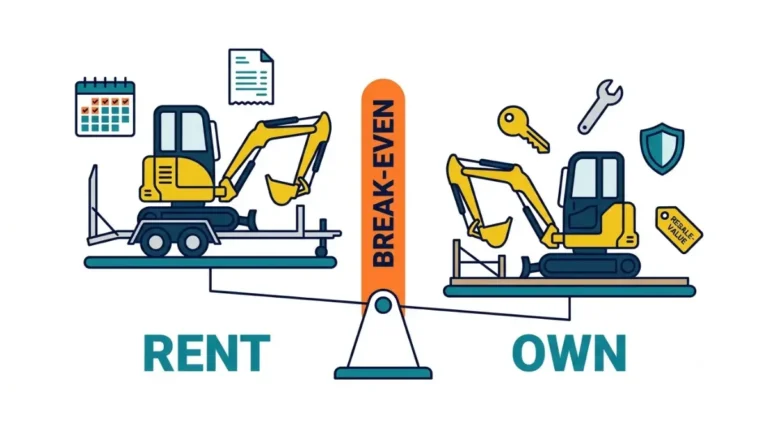
Then take your yearly hours to the rent-or-buy break-even for excavators before signing for either machine.
If you plan to hire the work out instead, what operators charge per hour for a mini excavator and skid steer and track loader hourly rates cover the operated side. When the 35 class is too shallow for the trench, the excavator size guide with rental and hourly costs by class picks up at the next size.