The Straight Math on Owning vs Operating Equipment Costs

Owning vs operating cost moves differently: diesel only touches the operating half, and each $0.50 a gallon adds about 5% to total machinery costs.
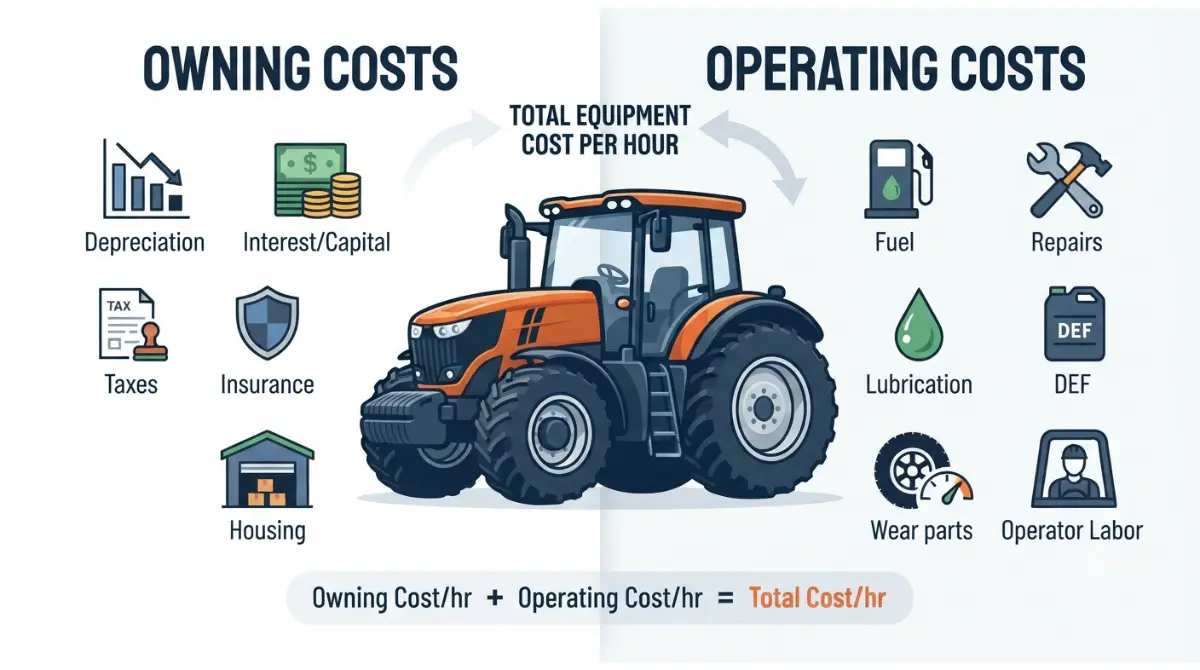
Table of Contents
Your rate is two numbers, not one
This guide covers diesel construction and farm machines of every class and emissions era, and only the DEF line is specific to Tier 4 Final engines. The worked numbers come from Iowa State University’s March 2026 example, a 300-PTO-hp diesel tractor.
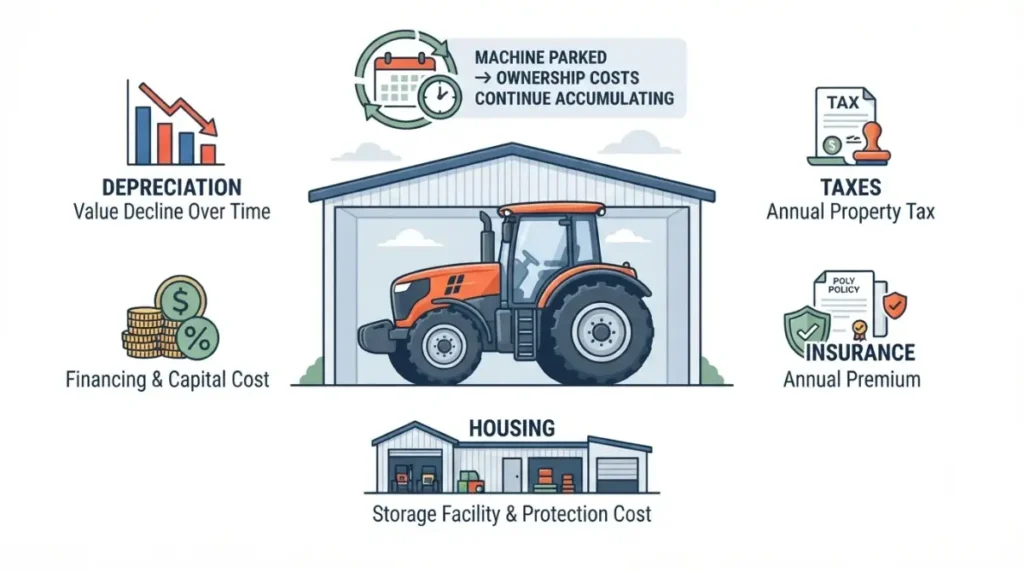
Owning costs hit whether the machine works or sits. Operating costs hit only when the hour meter turns.
What “owning” covers
Owning covers depreciation, interest on the money tied up, taxes, insurance and housing.
What “operating” covers
Operating covers repairs, fuel, lube, DEF and wear items, and depending on whose numbers you use, the operator.
If you’re pricing a bid this week, go straight to the worked example and the four mistakes. If you’re deciding whether to buy your first machine, the hours table in Section 5 matters most. The ranges in our equipment rates by machine guide are built from these two halves.
💵 About These Numbers: Figures come from Iowa State University’s Estimating Farm Machinery Costs (revised March 2026). That example assumes a $400,000 list price, $350,000 purchase price, 12-year life, 4% real interest, $3.40 diesel and $25/hr labor. The fuel update uses the USDA AMS August 2026 farm diesel average of $4.68. Your costs will vary with purchase price, annual hours, region and working conditions. This is orientation, not a valuation.
Owning costs: what you pay even when it’s parked
Owning costs are set the day you buy, and they keep running whether the machine works 50 hours a year or 1,000. Iowa State’s machinery cost method splits them into two groups.
Depreciation and interest (capital recovery)
Depreciation is what you paid minus what the machine will be worth when you sell it, which is its salvage value. ISU suggests an economic life of 10 to 12 years for most farm machines and 15 for tractors, unless you know you’ll trade sooner.
Interest is charged on the money tied up, whether borrowed or your own, at a “real” rate with inflation subtracted. ISU rolls both into one capital recovery figure. That is the amount you’d set aside each year to replace lost value and pay for the capital.
Taxes, insurance and housing
Where property taxes are minor, ISU lumps these together at about 1% of the machine’s average value per year. Insurance belongs here, because it’s owed whether or not the machine runs.
Operating costs: what the machine burns every working hour
Operating costs rise and fall with hours worked, so this is the half you can pull from a fuel log and a service history.
Fuel, lube and DEF
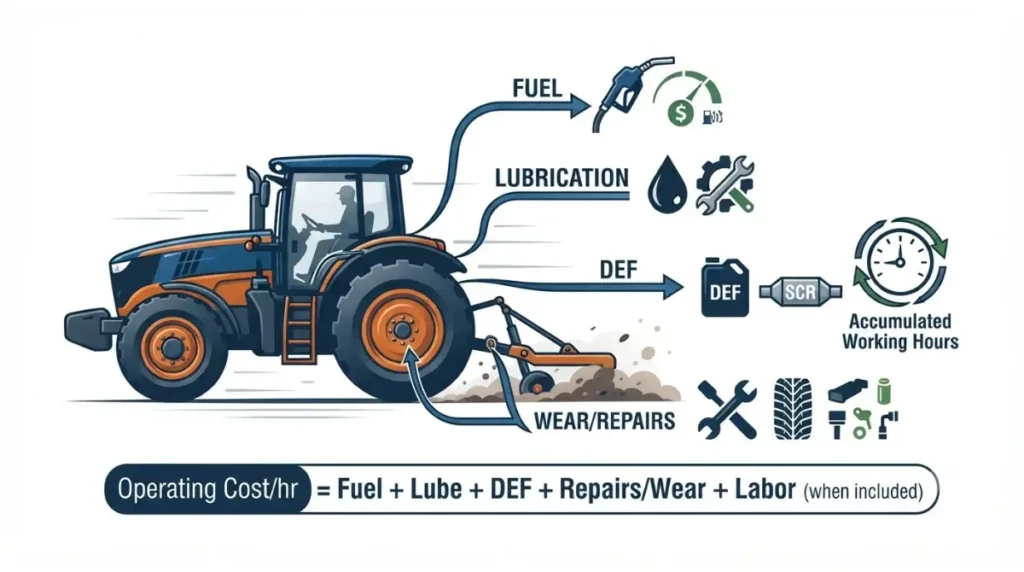
For diesel tractors, ISU estimates average fuel use at 0.044 gallons per hour for each maximum PTO horsepower. It puts lubrication at about 15% of the fuel bill. For field-by-field figures, ISU also publishes average fuel use by field operation.
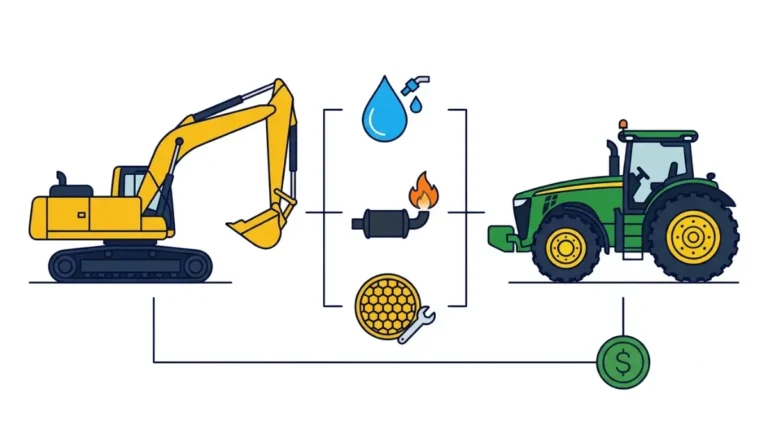
Tier 4 Final engines with SCR add a DEF line. Engine makers have quoted anywhere from about 1–3% (Deere) to 3–4% (Cummins) of fuel burned. Machines without SCR, including all pre-Tier 4 engines, have no DEF cost.
✅ Do This: Use the fuel and DEF burn from your own machine’s telematics or fuel records. The 0.044 figure is a tractor rule of thumb, and construction duty cycles vary widely. Your operator’s manual and serial range govern fluid specs and consumption.
Repairs, wear parts and the operator
Repair costs start low and climb faster as hours pile up, according to ISU’s ASABE-based repair data. The U.S. Army Corps of Engineers’ EP 1110-1-8 schedule also counts tire wear and tire repair as operating costs, and on tracked machines undercarriage wear plays the same role. Whether the operator belongs in this half is covered in Section 6.
A worked example: one tractor, both halves
Iowa State’s worked example puts a 300-hp diesel tractor at $166.42 an hour: $80.64 to own and $85.78 to operate.
ISU’s published split
The example assumes 400 hours a year, a 12-year life and a $350,000 purchase price.
The same tractor at 2026 diesel prices
| Cost line | Half | At $3.40 diesel (ISU) | At $4.68 diesel (our recalculation) |
|---|---|---|---|
| Capital recovery + TIH | Owning | $80.64 | $80.64 |
| Repairs | Operating | $6.67 | $6.67 |
| Fuel (13.2 gal/hr) | Operating | $44.88 | $61.78 |
| Lubrication | Operating | $6.73 | $9.27 |
| Operator labor | Operating | $27.50 | $27.50 |
| Total per hour | $166.42 | $185.86 |
Source: Iowa State University Ag Decision Maker A3-29 (March 2026). The $4.68 column is our arithmetic using ISU’s method.
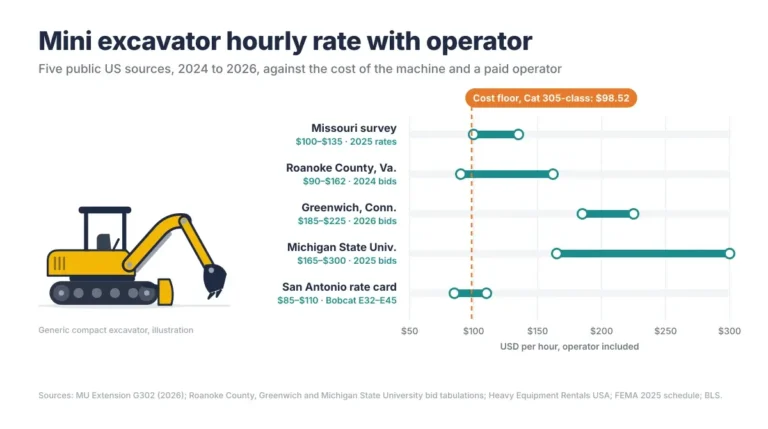
The higher fuel price moved only the operating half, from $85.78 to $105.22. ISU’s 2026 look at diesel and machinery costs estimates that every $0.50 per gallon adds about 5% to total machinery costs. The same split sits under what a mini excavator should rent for per hour. You can run your own machine in our Equipment Cost-Per-Hour Calculator.
Why hours worked change one half and not the other
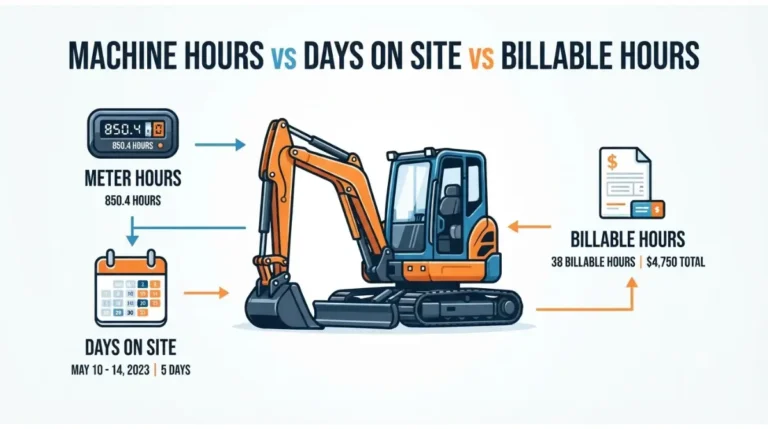
Owning costs are annual, so the hours a machine works decide how thin or thick they spread.
Same tractor at 200, 400 and 600 hours
| Annual hours | Owning $/hr | Operating $/hr ($3.40 diesel) | What It Means |
|---|---|---|---|
| 200 | ≈$160 | ≈$82 | Owning is two-thirds of the rate |
| 400 | $80.64 | $85.78 | ISU’s baseline, near 50/50 |
| 600 | ≈$54 | ≈$88 | Operating dominates |
Methodology: we recomputed ISU A3-29’s capital recovery method using its ASABE remaining-value factors for 150+ hp tractors at 12 years (29%, 28% and 27% of list price) and repair percentages interpolated from its repair table, holding every other assumption constant.
When the owning half says rent
Dropping from 600 to 200 hours roughly triples owning cost per hour, while operating cost moves about $6. If your honest annual hours are low, check the numbers in our Buy vs. Rent Calculator, because renting can be the cheaper answer. Tractor owners can compare against what to charge for tractor work.
Why published rates don’t match your math
Before you compare your rate to a published one, check what that source put in each half.
Is the operator in or out?
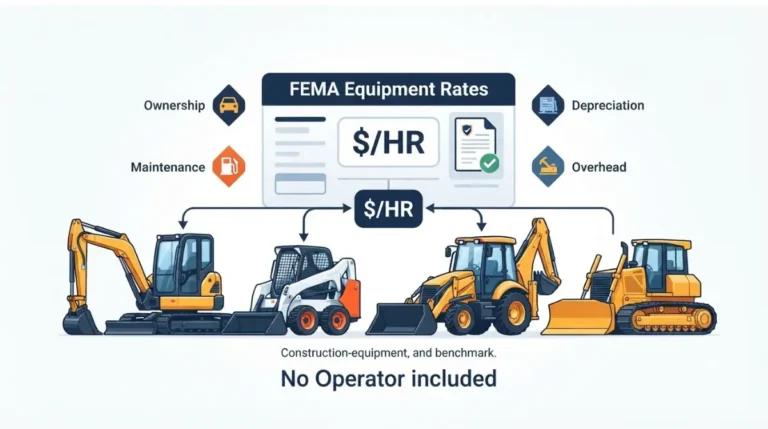
ISU counts operator labor as an operating cost, at the wage times 1.1 to 1.2, because labor hours run 10–20% past machine hours. EquipmentWatch’s Operating Rate leaves operator wages out. The Army Corps’ EP 1110-1-8 lists operating cost as fuel; filters, oil and grease; repairs; tire wear; and tire repair, with no operator.
Comparing a labor-in rate with a labor-out rate can make you look about $27 an hour off (ISU’s labor line) when you’re not.
Standby and idle time
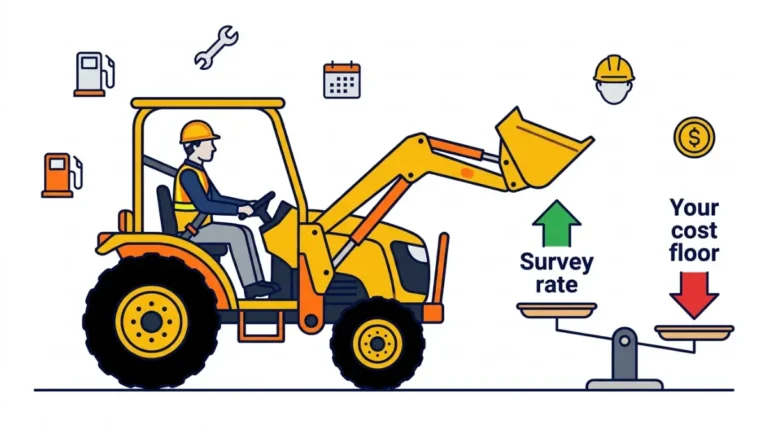
Owning costs keep adding up while a machine waits on site, which is why the Corps schedule has a separate standby rate calculation. At a minimum, price standby time to recover the owning half.
Four mistakes that underprice the owning half
Most underpriced rates come from shrinking the owning half, not the operating one.
Using the loan payment
A loan payment follows the lender’s schedule, not the value the machine actually loses. Once the loan is paid off, the owning cost hasn’t gone to zero.
Using tax depreciation
ISU warns that tax depreciation writes value down fast and shouldn’t be used to estimate true economic cost.
The other two mistakes are overestimating annual hours (see Section 5) and figuring salvage from your purchase price. ISU applies salvage factors to the current list price of a replacement machine. Hauling and mobilization are a separate charge not covered here.
Frequently asked questions
1. What costs are included in equipment ownership?
Equipment ownership costs are depreciation, interest on the money invested, property taxes, insurance and housing. They accrue whether or not the machine works.
2. What are equipment operating costs?
Equipment operating costs are repairs, fuel, lubrication, DEF on Tier 4 Final engines, and wear items. Iowa State also counts operator labor.
3. Is operator labor an operating cost?
It depends on the source. Iowa State includes operator labor as an operating cost; EquipmentWatch and the Army Corps schedule leave it out.
4. How do you estimate fuel cost per hour?
Iowa State estimates diesel tractor fuel at 0.044 gallons per hour for each maximum PTO horsepower, multiplied by your fuel price.
5. What’s a rule of thumb for lubrication cost?
Iowa State estimates lubrication cost at about 15% of the machine’s fuel cost per hour.
6. Does insurance count as an owning or operating cost?
Insurance is an owning cost. Iowa State lumps taxes, insurance and housing together at roughly 1% of average machine value per year.
7. Why does cost per hour go up when a machine sits?
Owning costs are annual. In ISU’s tractor example, dropping from 400 to 200 hours raises owning cost from $80.64 to about $160 an hour.
8. Should I use tax depreciation to set my rate?
No. Iowa State warns tax depreciation writes machine value down too fast to reflect true economic ownership cost per hour.
9. Does DEF count as an operating cost?
Yes, on Tier 4 Final engines with SCR. Reported DEF use runs about 1–4% of fuel burned, depending on the engine maker.
10. Is my loan payment my owning cost?
No. A loan payment follows the lender’s schedule, while real owning cost is the value the machine loses plus interest on the capital.
Run your own split
Your rate is your owning cost per hour plus your operating cost per hour, divided honestly across the hours you’ll actually work. Fuel prices move the operating half, and annual hours move the owning half. Plug your purchase price, realistic hours and fuel log into the calculator from Section 4 before your next bid, then check the result against local rental rates.