What to charge for tractor work on your compact tractor

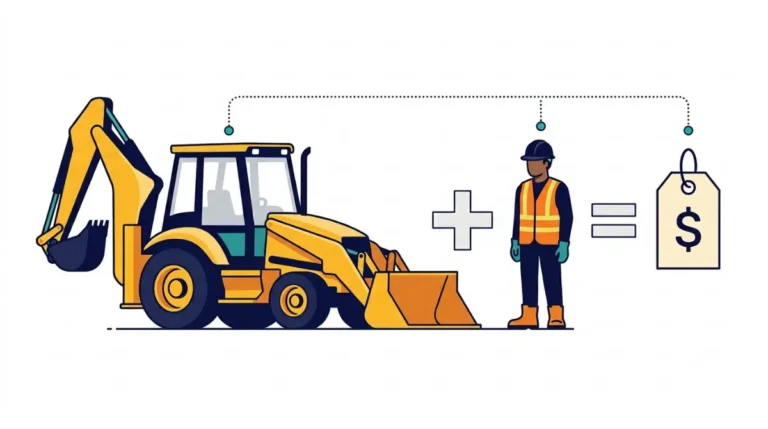
Compact tractor costs at 150 billed hours and $5.76 Illinois farm diesel: $64.70 to $76.34 an hour for 30 to 50 hp. Compare that floor with each job line.

Table of Contents
Rates and sources checked on November 3, 2026.
Job lines that suit a 25–60 hp tractor with a loader run from $56.65 an hour for mowing lawns to $114.05 for loader snow removal in Iowa’s 2026 custom rate survey, with the operator and fuel in the price. Worked out from Arkansas extension cost figures, a 30 hp tractor billed 150 hours yearly at October’s $5.76 Illinois farm diesel and a $28.79 operator wage costs about $64.70 an hour, so lawn mowing at the survey average loses money and loader work does not.
These figures cover sub-compact and compact utility tractors of any brand. Skid steers, excavators and dozers have their own numbers in hourly rates by machine class.
Survey lines a 25–60 hp tractor can bid against
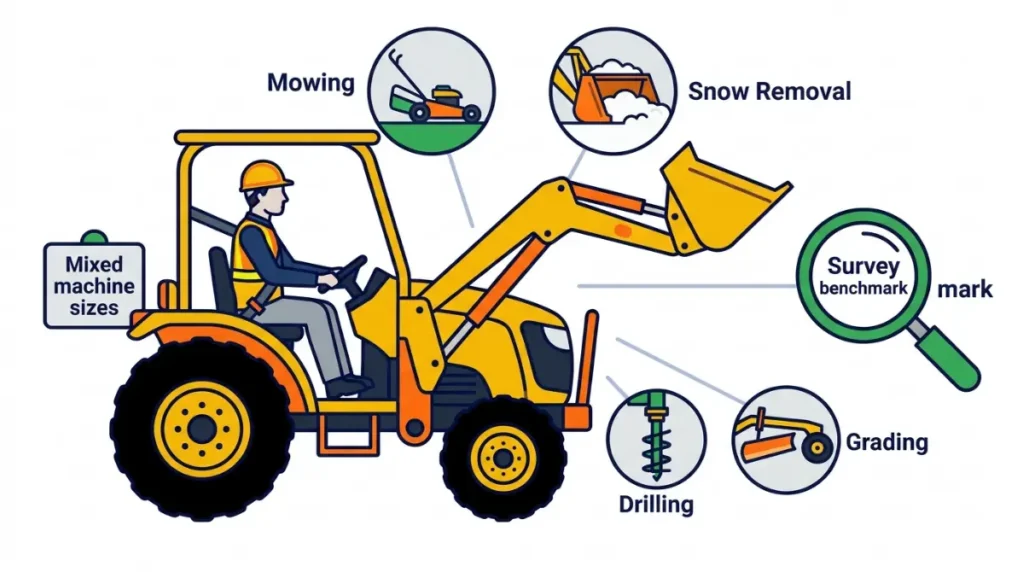
No extension survey prices compact tractors as a class of their own. The lines below are jobs a small loader tractor can do, priced by the farmers and custom operators who answered, on machines of whatever size they run.
With you in the seat
| Job (operated rate: operator, machine and fuel included) | Survey | Average, USD | Median, USD | Range, USD |
|---|---|---|---|---|
| Mowing lawns, per hour (30 responses) | Iowa, 2026 | 56.65 | 60.00 | 20.00–100.00 |
| Removing snow with a loader, per hour (34 responses) | Iowa, 2026 | 114.05 | 115.00 | 50.00–200.00 |
| Removing snow with a blade, per hour per foot of blade (7 responses) | Iowa, 2026 | 14.25 | 14.30 | 12.50–16.70 |
| Snow removal, per hour | Maryland and Delaware, 2025 | 138.72 | 125.00 | 50.00–250.00 |
| Bush hogging, per hour | Maryland and Delaware, 2025 | 84.30 | 60.00 | 17.50–150.00 |
| Posthole digging, per hole | Maryland and Delaware, 2025 | 4.67 | 5.00 | 4.00–5.00 |
Sources:
- 2026 Iowa Farm Custom Rate Survey, Iowa State University Extension, sent to 1,122 people in early February 2026.
- Custom Work Charges in Maryland and Delaware (FS-683), University of Maryland Extension. It is a fall 2024 survey of 61 custom operators and farmers on 2025 charges, and it does not publish response counts by row.
Behind a 5-ft rear blade, Iowa’s per-foot snow average works out to $71.25 an hour ($14.25 × 5). Behind a 6-ft blade it works out to $85.50 ($14.25 × 6).
Mowing pasture, CRP ground and brush is usually priced per acre, and it has its own page: brush hogging rates by job and region.
The tractor alone, no operator or fuel
A rent line prices the bare tractor. The customer runs it and buys the fuel.
| Survey and region (tractor only, under 100 hp) | Average, USD per hour | Most common, USD | Range, USD | Responses |
|---|---|---|---|---|
| Texas, statewide | 64.32 | 75.00 | 30.00–100.00 | 22 |
| Texas, North | 58.75 | Rates varied | 35.00–80.00 | 4 |
| Texas, South | 74.29 | 40.00 | 40.00–100.00 | 7 |
| Texas, East | 48.75 | 30.00 | 30.00–75.00 | 8 |
| Texas, West | 90.00 | Rates varied | 75.00–100.00 | 3 |
| Nebraska, statewide | 58.00 | 50.00 | 30.00–100.00 | 5 |
Sources:
- 2026 Texas Agricultural Custom Rates, Texas A&M AgriLife Extension, surveyed August through October 2025.
- 2026 Nebraska Agricultural Custom Rates, Nebraska Extension. It reflects conditions in late winter 2025 and early 2026 and prices rent per meter hour.
Note: The 2026 Nebraska row for “mowing grass (CRP or pasture), rate per hour” carries the same average, most common rate, range and response count as the dryland corn contract-farming row, district by district. Neither Nebraska mowing row appears on this page.
Your floor: a 30 hp and a 50 hp tractor worked out
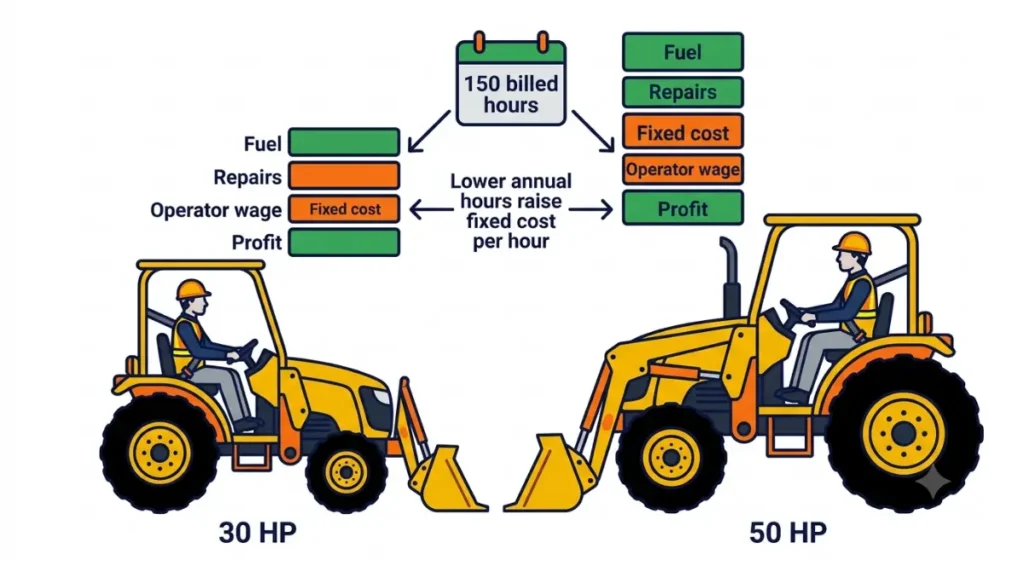
Arkansas extension economists cost tractors by the hour assuming 600 hours of annual use and 8.5% interest. They leave taxes and insurance out.
Their total column also carries $18.69 of labor. For the 30 hp roll-bar tractor with front-wheel assist, fuel plus repairs plus $18.69 equals the table’s total direct cost. So the build below keeps only the machine lines and adds its own wage.
Two inputs need resetting for side work.
Fuel rises by your gallons per hour times the price change. Arkansas’s burn is 1.5 gal per hour at 30 hp and 2.6 gal at 50 hp.
Fixed cost is a yearly sum. A tractor that bills 150 hours carries four times the fixed cost per hour of one that bills 600.
| Line, USD per hour (Arkansas FSA-21, revised August 2025, reworked) | 30 hp | 50 hp | Basis |
|---|---|---|---|
| Fuel, oil and lube at $2.86 diesel | 4.41 | 7.36 | Arkansas |
| Extra fuel at $5.76 diesel | 4.35 | 7.54 | Gallons per hour × $2.90 |
| Repairs and maintenance | 0.87 | 1.05 | Arkansas |
| Fixed cost spread over 150 hours | 26.28 | 31.60 | Arkansas fixed cost × 600 ÷ 150 |
| Operator wage | 28.79 | 28.79 | Nebraska average labor rate in custom rates |
| Floor at 150 billed hours | 64.70 | 76.34 | Sum of the five lines above |
| Floor at 600 billed hours | 44.99 | 52.64 | Arkansas fixed cost left at 6.57 and 7.90 |
| Floor at 150 billed hours plus 10–15% profit | 71.17–74.41 | 83.97–87.79 | Arkansas’s customary profit range |
Sources:
- Estimating Farm Machinery Costs (FSA-21), University of Arkansas Division of Agriculture, for the tractor lines.
- farmdoc daily, University of Illinois, October 20, 2026, for the diesel price.
- The 2026 Nebraska report, for the wage.
Every floor is worked out from those three sources.
The floor leaves out loader and implement ownership, the truck and trailer, insurance and property tax, since Arkansas prices the tractor alone. It also charges the whole fixed cost to paid work. If the tractor does your own chores too, split the fixed line between them.
At 600 hours, Arkansas’s machine lines add up to $11.85 an hour at 30 hp and $16.31 at 50 hp. Every rent average in the Texas and Nebraska table is roughly three times those figures or more.
Which jobs pay above that floor?
Two job lines in the operated table fall under the smaller tractor’s floor at 150 billed hours. One is Iowa lawn mowing, at both its average and its median. The other is Maryland and Delaware bush hogging at its median.
Loader snow removal sits far above both floors in both surveys. The Maryland and Delaware bush hogging average sits above both floors as well.
Blade width decides blade snow. Behind a 5-ft blade, Iowa’s per-foot rate beats the 30 hp floor and falls short of the 50 hp one. Behind a 6-ft blade it beats both.
Billed hours move every comparison more than horsepower does. At 600 billed hours, the 30 hp floor drops below Iowa’s lawn-mowing average, and that job then covers its cost.
Diesel since the surveys went out
The Illinois farm diesel price in the opening is the highest USDA’s Agricultural Marketing Service has reported for agricultural use in that state since the series began in September 2008, University of Illinois economists noted on October 20, 2026. The same series stood at $3.14 a gallon on February 20 and $3.90 on March 6.
Iowa’s, Texas’s and Maryland and Delaware’s surveys all went out before that jump. Nebraska’s reflects late winter 2025 and early 2026, when its respondents expected to pay $2.93 a gallon for farm-delivered diesel. Arkansas’s costs sit on the diesel price in the floor table’s first row.
At Arkansas’s fuel burn, each $1 a gallon adds $1.50 an hour to the smaller tractor and $2.60 to the larger. The Illinois economists set custom-work fuel surcharges with the same arithmetic, per acre: current price minus baseline price, times gallons used.
EIA’s weekly pump survey covers on-highway diesel with all taxes included. It put the U.S. average at $6.352 a gallon for the week of October 26, 2026. The price on your own farm-fuel ticket is the one to plug in.
Travel, minimums and swaps go on the invoice
Bill travel and trailer time as a separate line. Some survey answers include travel and some leave it out, which is one reason the Nebraska ranges run wide.
- Travel and trailer time, from leaving your yard to unloading at the job, and back
- A minimum charge for jobs shorter than your setup time
- Implement swaps on one job, such as the tiller off and the box blade on
- Ground with stumps, rock or buried wire, priced after you walk it
- A fuel line that states the diesel price your rate assumes
How mobilization fees and minimum charges are set covers the dollar side of the first two lines.
When does a hazard end the job?
If the job needs the loader raised on a slope, a PTO implement on rough ground, or holes dug where lines may run, the hazard either goes into the price or sends you home.
Loader work calls for a ROPS-equipped tractor, the seat belt on, loads carried as low as possible and no travel with the bucket raised. Those conditions come from Ohio State University Extension’s loader safety fact sheet.
Working a loader on slopes, lifting stumps or bales at full height and servicing PTO implements belong to your operator’s manual and the dealer’s service department. Before taking a bale or stump job, ask the service department what your loader’s rated lift is at full height for your serial number.
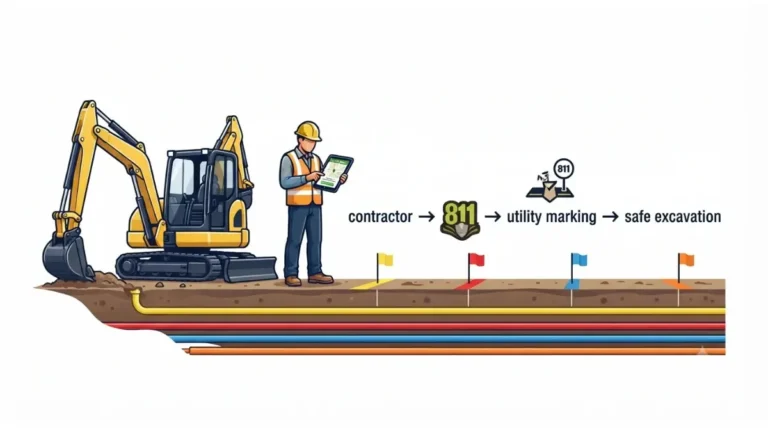
Post holes are digging, so call 811 before the auger goes in. The steps are in what 811 requires before you dig.
If you hire a helper, OSHA requires ROPS and seat belts on tractors built after October 25, 1976 that workers run. It also requires training before work starts and every year after, per OSHA’s tractor ROPS fact sheet.
Ask your insurance agent whether your farm or homeowner’s policy covers equipment work you are paid to do off your own property. Then turn any added premium into an insurance cost per billable hour.
Paid driveway or site grading can fall under a contractor license in some states. Your state’s licensing board decides, and how excavation licensing thresholds work lays out the checks.
Hazard: Raising a loaded bucket moves the tractor and loader’s center of gravity up and forward, and on a slope or in a turn the tractor can overturn. Keep the ROPS up and the seat belt fastened, and let no one stand or work under a raised loader.
Questions the surveys leave open
What should you charge to till a garden with a compact tractor?
None of the surveys cited here has a garden-tilling line. Bill it by the hour from your own floor, with a minimum that covers setup.
What about grading a gravel driveway with a box blade?
No survey line covers that job either, so the same hourly method applies. On a large paid job, check the licensing point above first.
What do operators charge per post hole?
The Maryland and Delaware line in the operated table prices digging by the hole. Call 811 before the auger goes in.
Is $1 per horsepower an hour a fair rule?
At 30 hp it gives $30 an hour, under half of the floor worked out above for that tractor.
Work out your own floor before the next quote
Four inputs move your number:
- your billed hours for the year
- the price on your last farm-fuel ticket
- the wage you pay yourself
- the blade or implement width the job needs
Put them in the 30 hp or 50 hp column of the floor table before you name a price. Then quote whichever is higher: your floor or the survey line for that job.