Tier 4 operating costs per hour: what DEF and the DPF add

Tier 4 Final DEF cost: each $1 a gallon adds 7.7 cents an hour on a Cat 320 and $1.76 on a Steiger 425, before a DPF reserve of 22 to 33 cents per $1,000.
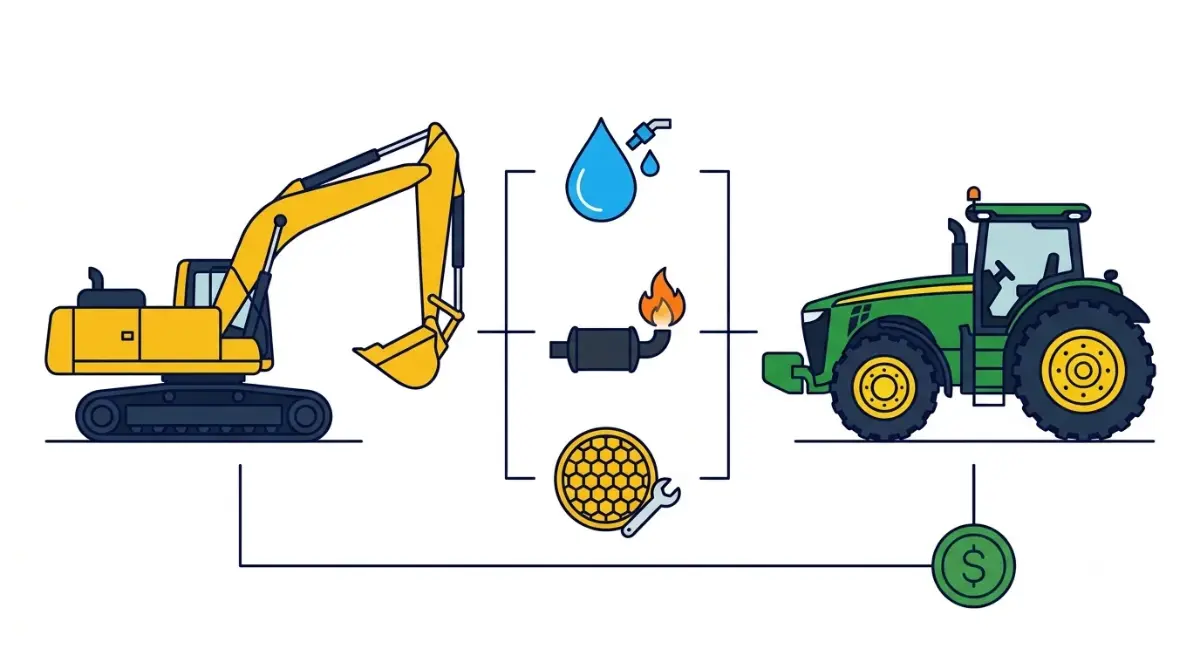
Table of Contents
Rates and sources checked on October 23, 2026.
Every $1 a gallon you pay for DEF adds 7.7 cents to a Cat 320 excavator’s working hour at medium load and $1.76 to a Case IH Steiger 425 Rowtrac’s hour at full PTO load, because Tier 4 Final engines with SCR burn DEF in proportion to their diesel. Regen fuel adds pennies an hour on the tractors Nebraska has tested, and DPF cleaning adds whatever your quote is, spread over the interval in your operator’s manual.
All dollar figures below use No. 2 farm diesel at $5.76 a gallon, the Illinois average in USDA’s Illinois Production Cost Report for October 16, 2026, where dealer asks ran $5.39 to $6.01. The input that moves your number most is your engine’s DEF share, which runs from 1.5% to 8.5% of diesel across the machines below.
DEF burn by machine class
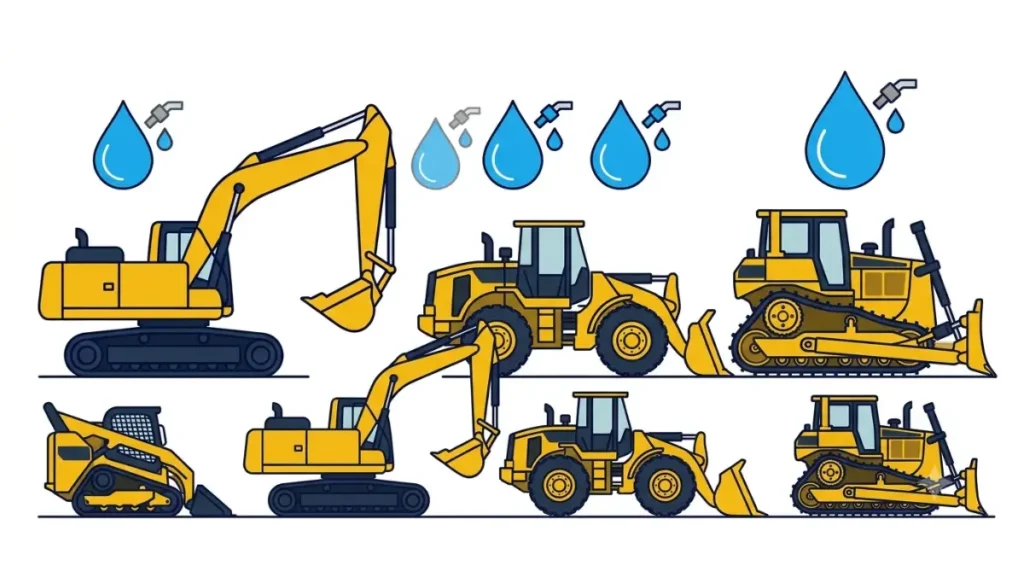
Cat’s 320 excavator, working a normal mix of digging and idling, burns DEF at a set share of its diesel, listed model by model in Caterpillar’s published telematics figures.
| Cat machine (model code as listed) | Diesel, gal/hr, North America (50% to 10% idle) | DEF, % of diesel | DEF, gal/hr (same range) |
|---|---|---|---|
| 313 excavator (313-07) | 1.64 to 2.57 | 2.5% | 0.04 to 0.06 |
| 320 excavator (320-07) | 2.42 to 3.72 | 2.5% | 0.06 to 0.09 |
| 336 excavator (336-07) | 3.90 to 6.19 | 2.5% | 0.10 to 0.15 |
| 352 excavator (352-07) | 6.19 to 9.85 | 2.5% | 0.15 to 0.25 |
| 950M wheel loader | 2.38 to 3.66 | 2.5% | 0.06 to 0.09 |
| 966 wheel loader (966-14) | 3.01 to 4.56 | 5% | 0.15 to 0.23 |
| D5 dozer (D5-17) | 3.18 to 5.06 | 5% | 0.16 to 0.25 |
| D6 dozer (D6-20) | 3.74 to 5.90 | 5% | 0.19 to 0.29 |
| D8 dozer (D8-21) | 6.54 to 10.64 | 5% | 0.33 to 0.53 |
| 299D3 compact track loader | 3.30 (one value listed) | 1.5% | 0.05 |
Source: Caterpillar Performance Handbook, fuel consumption chapter, America North edition dated December 9, 2022, in a copy hosted by a Cat dealer. Ranges run from Cat’s low column (50% idle) to its high column (10% idle). The handbook lists model codes without model years.
Every excavator row in the table sits at the same DEF share, though the 352-08 variants carry 5% in the same handbook. The D5 through D8 dozers run at double it, and wheel loaders split between the two, with the 950M at the excavator rate and the 966-14 at the dozer rate. The 300.9D through 310 mini excavators carry no DEF figure at all.
Outside Cat, Cummins puts its SCR engines at 3% to 5% of fuel on average, varying with environment and duty cycle. A machine with a Cummins engine can sit above every excavator row in the table.
What Nebraska’s tractor tests measured
Diesel and DEF consumption sit side by side at rated PTO power in the Nebraska Tractor Test Laboratory’s reports on SCR tractors, and many reports also record the fuel one active regeneration used and the maker’s declared hours between regens.
| Tractor and Nebraska test | Diesel, gal/hr at rated PTO power | DEF, gal/hr | DEF as % of diesel (worked) | Regen fuel, gal per working hour (worked) |
|---|---|---|---|---|
| John Deere 5090R, Test 2191 (2018) | 4.84 | 0.16 | 3.3% | 0.004 |
| John Deere 5125ML, Test 2211 (2019) | 6.61 | 0.29 | 4.4% | 0.003 |
| John Deere 8RX 370, Test 2227 (2020) | 17.45 | 0.51 | 2.9% | 0.020 |
| Case IH Steiger 425 Rowtrac, Test 2287 (2024) | 20.74 | 1.76 | 8.5% | 0.021 or less |
Sources: Nebraska Tractor Test Laboratory reports for the John Deere 5090R, John Deere 5125ML, John Deere 8RX 370 and Steiger 425 Rowtrac. DEF share is DEF gallons divided by diesel gallons. Regen fuel per hour is the fuel one active regen used (0.58, 0.43, 0.79 and 1.06 gallons) divided by the maker’s declared interval (150, 150, 40 and “over 50” hours).
The three Deere tractors land inside the Cummins band or just under it. The Steiger burned about two to three times the Deere share in the same kind of test, so a figure for your own make outweighs any average.
These are steady runs at rated power. Hours spent idling or at light load are a different duty cycle, which is why the Cat figures come at three idle levels.
How much fuel does a regen burn per hour?
Each active regeneration burns extra diesel to raise exhaust temperature, and the regen column above spreads that fuel across the declared interval. At the farm diesel price above, it comes to about 2 cents for each working hour on the 5125ML and 12 cents on the Steiger.
That interval is the maker’s declaration. On some reports, such as the John Deere 6130D test, the declaration is tied to rated speed and full PTO load under steady conditions. A machine that idles through half its day works nothing like that, and why an excavator keeps asking for a regen covers the causes of frequent regens.
Hazard: Regeneration makes the exhaust system very hot. Run a parked regen only where your operator’s manual allows, with the exhaust pointed away from crop residue, fuel and anything else that burns.
$0.22 an hour for every $1,000 of DPF service
Federal rules set a floor under how often a maker may schedule DPF cleaning: no more often than every 3,000 hours for engines under 130 kW (about 174 hp) and every 4,500 hours at 130 kW and above, unless EPA approves a shorter interval and the maker provides that service free, under 40 CFR 1039.125. That floor limits the maker’s schedule. Your manual sets the interval for your serial range.
The reserve is the service cost spread over the interval in hours. At 4,500 hours, each $1,000 of cleaning works out to 22 cents per working hour; at 3,000 hours it is 33 cents.
The cost side comes from a written quote. Ask your dealer’s service department to price DPF cleaning for your engine serial, with cleaning, labor and any sensor work listed separately, then multiply the quote, in thousands of dollars, by the per-hour figure that matches your engine.
A Cat 320 and a Steiger 425, worked
Start with two machines and that Illinois diesel price.
The 320 at medium load burns 3.07 gallons an hour in Cat’s middle column, or $17.68 of diesel (3.07 × $5.76). At the excavator DEF share, 3.07 × 0.025 = 0.077 gallon of DEF an hour, which is where the excavator figure at the top comes from. If the engine rates under 130 kW on the spec sheet for your serial, its DPF reserve uses the 3,000-hour figure. No regen fuel figure is published for it.
The Steiger in its Nebraska run burns $119.46 of diesel an hour (20.74 × $5.76). Its DEF gallons from the Nebraska table and the regen fuel worked above sit on top, and at 366 PTO hp its engine is well above 130 kW, so its DPF reserve uses the 4,500-hour figure.
Because DEF moves in proportion to diesel gallons, DEF spending as a share of diesel spending equals that percentage times the DEF price divided by the diesel price. As long as DEF costs less a gallon than diesel, it stays below each machine’s DEF share in the tables above.
All of these lines sit in the operating half of a rate, the split worked through in how owning and operating costs divide an hourly rate. From there they feed hourly rates by machine the same way fuel does.
Derates and the service call
The expensive Tier 4 hour is the one the machine won’t work. In a 2022 Cal Poly and University of Nebraska study of San Joaquin Valley, California, growers and repair shops, service managers put 30% to 35% of their calls down to emissions systems. They said running tractors at low rpm can trigger a derate or regen mode that needs a service call costing at least $200 to $300 to reset, and they reported average rates of $135 an hour for shop work and $150 for field service.
A machine stuck on a customer’s site also raises the billing question in how standby time is charged.
EPA proposed on July 9, 2026 to remove derates and speed restrictions from newly built highway and nonroad engines, and asked for comment on whether guidance should let makers do the same on machines already working (EPA fact sheet). Its August 2025 guidance had already asked makers to revise DEF software to reverse derates in existing equipment. A proposal changes nothing on your machine until EPA issues a final rule and your maker releases software for it.
Disabling the system to escape derates is prohibited under federal law and is the target of an EPA enforcement initiative on defeat devices.
Before you quote: ask your dealer’s service department whether your serial number has the maker’s current DEF derate software and what your emissions warranty covers. A job that can’t absorb a lost day needs that answer first.
Does Tier 4 Final burn less diesel than Tier 3?
Cummins told buyers in a 2013 DEF bulletin that moving from its Tier 3 engines to its SCR engines could cut fuel use 7% to 9%, and that against Tier 4 Interim, every 3 to 5 gallons of DEF would come with 2 to 4 fewer gallons of diesel. Those figures are the engine maker’s claims.
Priced at the Illinois diesel figure, the diesel saved pays for the DEF as long as DEF costs no more than $2.30 a gallon in the worst case Cummins gives (2 gallons saved, 5 used) and $7.68 in the best (4 saved, 3 used).
Independent data points the same direction. The same Cal Poly study analyzed Nebraska test reports from 1988 to 2021 and found tractors built to the final standard more fuel efficient on average than earlier tiers, with efficiency improving 0.77% a year since 2015.
Log a month of fills before you change your rate
Fill the diesel and DEF tanks to full and write down the hour meter, then repeat at every fill for a month. DEF tanks are usually sized for two to three diesel fills per DEF fill, so log long enough to refill the DEF tank at least once.
Divide each fluid’s gallons by the hours and multiply the DEF figure by the price on your supplier’s invoice. Then add your written DPF quote divided by your manual’s interval, and enter all three as operating cost. When diesel moves faster than your bids, the fuel surcharge clause carries the change instead of the base rate.