The Right Drone Spraying Rates Per Acre and Who Can Legally Spray

Drone spraying cost per acre sits just above manned aerial in Iowa’s 2026 survey. Here’s why, and when owning a drone actually pays.
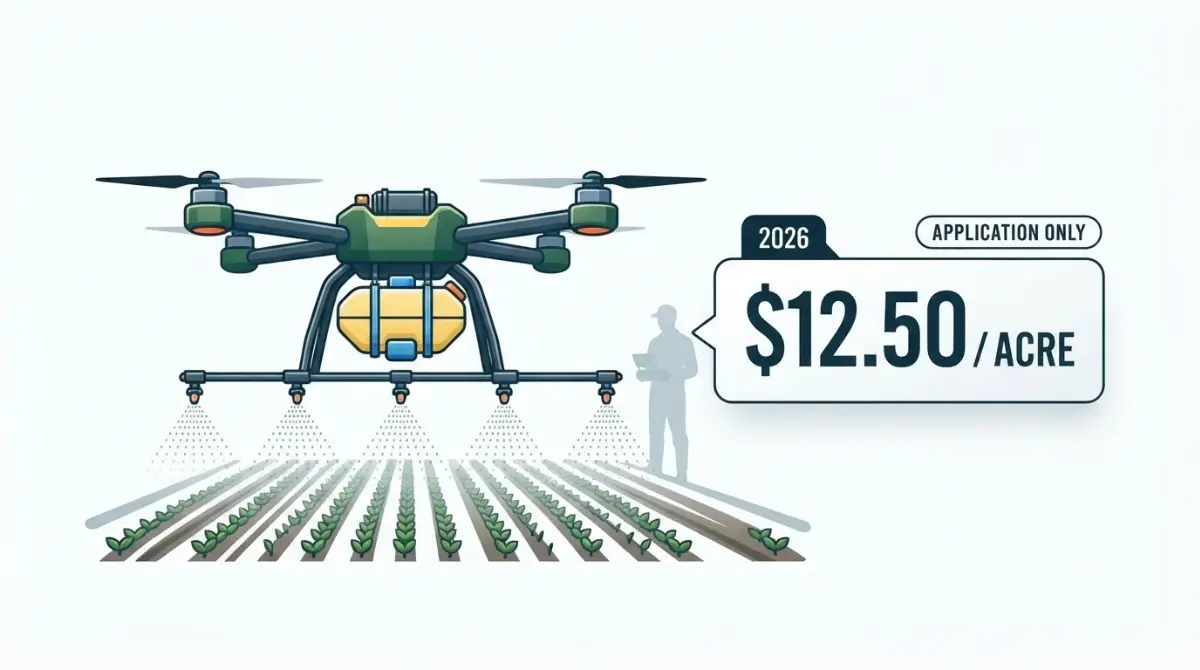
Table of Contents
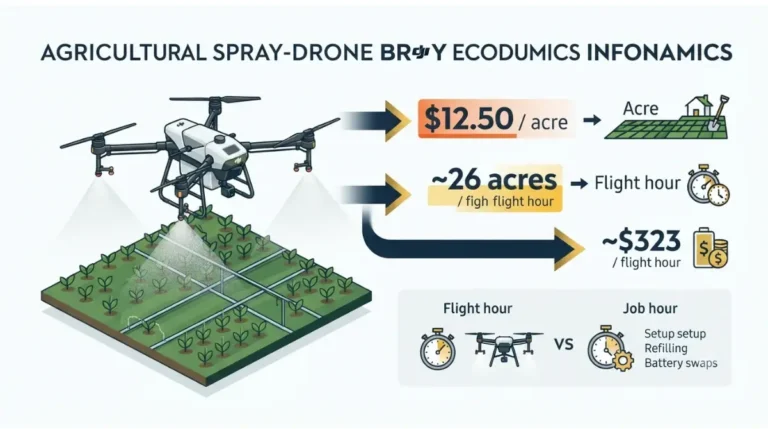
Custom drone spraying averaged $12.50 per acre in Iowa State University’s 2026 custom rate survey, application only, chemical not included. That covers US spray drones, small and heavy, at 2026 rates under current FAA rules. They’re battery-electric, so emissions tiers don’t apply.
Unlike the machines in our guide to equipment rates by machine, drone work is quoted per acre, not per hour. Start where your situation is:
- Hiring for this season? Check the rate table, then the pre-hire checklist.
- Weighing a purchase? Jump to the buy-vs-hire math.
- Starting a spray business? Read the cost drivers and both licensing sections.
ℹ️ Safety Note: Drone application involves pesticide handling and flight near people, livestock, and overhead power lines. Follow the pesticide label, the drone manufacturer’s manual, and your FAA-approved operating procedures, and leave application to certified, licensed operators.
📋 Compliance Note: FAA requirements below reflect 14 CFR Parts 107 and 137 and Section 44807 exemptions as of September 29, 2026; the proposed Part 108 rule is not in effect. State pesticide licensing varies. Verify with the FAA and your state department of agriculture before relying on this.
💵 About These Numbers: Rates come from Iowa State’s 2026 Iowa Farm Custom Rate Survey, fielded in February 2026. Ownership costs come from a University of Missouri Extension model published in 2025. Quotes vary by region, crop, field size, and gallons per acre; treat these as orientation, not a quote.
What drone spraying costs per acre in 2026
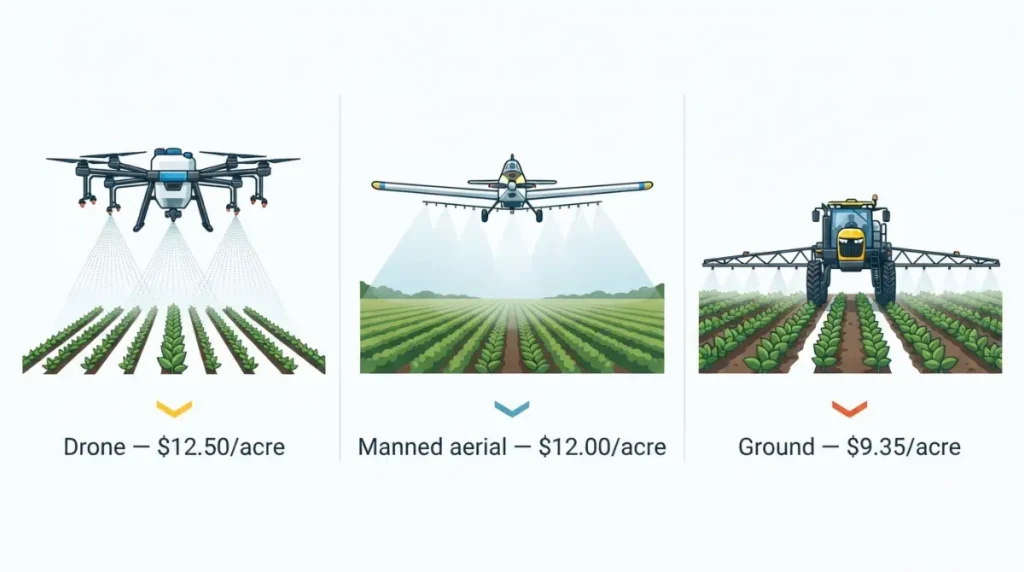
In Iowa State’s 2026 survey, drone spraying averaged $12.50 per acre, with a $12.00 median and an $8–$16 range, materials not included.
Drone vs. crop duster vs. ground rig
| Method | Average | Median | Range | What It Means |
|---|---|---|---|---|
| Drone | $12.50 | $12.00 | $8–$16 | Priced just above manned aircraft |
| Manned aerial | $12.00 | $11.60 | $9–$18 | Closest competitor at fungicide timing |
| Ground, self-propelled | $9.35 | $9.00 | $5–$18 | Cheapest where a rig can get in |
Source: Iowa State’s 2026 custom rate survey (Iowa State University Extension, fielded February 2026; 47 drone, 54 aerial, 121 ground responses).
This was the survey’s first year tracking drones. Drones priced slightly above manned aerial application and about $3 above a ground rig.
What the rate does and doesn’t include
Every figure is application only: you supply the chemical. These are Iowa numbers, and orchards and vineyards sit outside the survey, so local quotes will differ. For the ground side, see our custom planting and spraying rates per acre.
What pushes a drone spraying quote up or down
A drone quote reflects the cost of owning the equipment more than the cost of flying it.
Ownership costs set the floor
In University of Missouri Extension’s Agras T40 model, ownership made up $8.90 of a farmer’s $12.27 per-acre total. Depreciation and interest came to $6.58 an acre, and batteries $1.72.
🔍 Why It Happens: The drone, batteries, generator, and mixing gear cost the same whether you spray 300 acres or 3,000. Fewer acres means each acre carries more of that fixed cost.
Field size, gallons per acre, and minimums
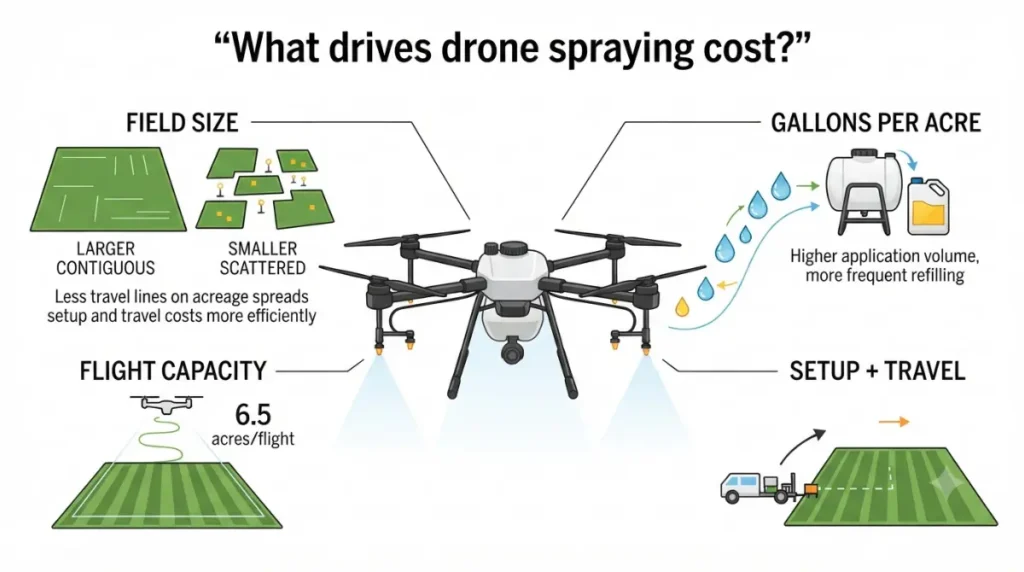
MU’s model assumed 6.5 acres per flight. Higher gallons per acre mean more refills and fewer acres per hour.
Is buying a spray drone cheaper than hiring one?
Under MU Extension’s assumptions, owning a drone falls below $12.50 an acre only once a farm sprays about 980 acres a year.
The 980-acre line
At 1,000 acres, MU put a farmer’s total cost at $12.27 an acre. A custom operator running two drones over 4,000 acres came in at $7.39. MU’s $12.50 threshold happens to equal Iowa’s 2026 drone average, though the sources cover different states and years.
📉 Cost Reality: MU estimated 980 acres takes about 38 flight hours. Covering 2,000 acres drops the cost to $8.32 an acre but needs about 77 hours, a stretch for one drone in a short spray window. Source: MU Extension’s drone ownership cost analysis (G1274, 2025).
Below roughly 980 acres, hiring usually wins.
Which drones you can still buy in the US
Since December 2025, new foreign-made drone models can’t get FCC authorization. Models authorized earlier can still be sold and flown, but the FCC can restrict them later. Confirm authorization and parts support before buying.
What Part 137 requires before a drone can spray
Any drone dispensing pesticide, fertilizer, or seed falls under Part 137, whatever its weight, including on your own land. Every operation needs:
- a Part 107 remote pilot certificate for each pilot
- FAA registration, with Remote ID for most drones
- an Agricultural Aircraft Operator Certificate, applied for on FAA Form 8710-3
Small vs. heavy drones: the 55-pound line
Drones of 55 pounds or more need a Section 44807 exemption, and their pilots need an FAA Class 3 medical. Under the FAA’s streamlined process, you get the exemption first, then submit Form 8710-3 with the exemption number. Smaller drones still need Part 107 exemptions, such as for carrying hazardous materials.
Where Part 108 stands
The proposed beyond-visual-line-of-sight rule is not in effect. Its final rule has been under White House review since July 10, 2026. Check the FAA’s Part 137 guidance for drones or your local Flight Standards District Office before relying on any change.
The state pesticide license most drone pilots forget
The FAA approves the flight; your state licenses the pesticide application.
Aerial category and who counts as the applicator
Nebraska treats drone pesticide use as aerial application and requires the Aerial Pest Control category for restricted-use products. The pilot counts as the applicator even without touching the product. Other states set their own rules; Nebraska’s drone pesticide licensing guide shows how one state lays it out.
Only aerially labeled products
Nebraska allows only pesticides approved for aerial application on a drone. The pesticide label is the law: no aerial use on the label, no drone.
What to check before you hire a drone applicator
A legal operator can show paperwork for every layer of the rules. Ask to see:
- the Part 137 operator certificate
- a Section 44807 exemption, if the drone weighs 55 lb or more
- each pilot’s Part 107 certificate
- a state applicator license with the required category
- proof of liability insurance
SDSU Extension’s spray drone licensing checklist covers the same stack.
Red flags in a cheap quote
A quote well under the survey’s $8 low deserves a closer look at credentials. No documents, no flight.
✅ Do This: Call your state department of agriculture’s pesticide program to confirm the applicator’s license is current and covers aerial application.
Drone spraying rates: FAQ
1. How much does drone spraying cost per acre?
Drone spraying averaged $12.50 per acre in Iowa State’s 2026 survey, ranging $8–$16, chemical not included.
2. Is drone spraying cheaper than a crop duster?
Not in Iowa’s 2026 survey: drone spraying averaged $12.50 per acre versus $12.00 for manned aerial application.
3. Is drone spraying cheaper than ground spraying?
No. Self-propelled ground spraying averaged $9.35 per acre in the same survey, about $3 below drone spraying.
4. Do drone spraying rates include chemical?
No. Iowa State’s drone spraying rates are application only; the farmer supplies and pays for the chemical.
5. Is buying a spray drone worth it?
Under MU Extension’s assumptions, owning drops below $12.50 per acre at about 980 acres sprayed per year.
6. Do I need Part 137 to spray my own farm?
Yes. Part 137 applies to any drone dispensing pesticide, fertilizer, or seed, including on land you own.
7. What is a 44807 exemption?
It’s the FAA exemption spray drones of 55 pounds or more need, obtained before applying for the Part 137 certificate.
8. Do I need a pesticide license to fly a spray drone?
In Nebraska, yes: the drone pilot counts as the applicator and needs a license. Confirm your state’s rules with its department of agriculture.
9. Can I still buy DJI Agras drones in the US?
Previously FCC-authorized models can still be sold and flown, but new foreign-made drone models can’t get FCC authorization.
10. Is Part 108 in effect for drone spraying?
No. As of September 29, 2026, Part 108 is not in effect; its final rule remains under review.
The bottom line on drone spraying rates
A fair drone spraying rate in Iowa ran $8–$16 an acre in 2026, averaging $12.50. Under about 980 acres a year, hiring usually beats owning. Whoever flies, see the Part 137 certificate and state license first. Pricing other per-acre work? Compare custom combining rates per acre.