Is Sharing Prices With Competitors Illegal for Equipment Owners?

Sharing prices with competitors is not automatically illegal, but a 1969 Supreme Court case shows how swapping recent quotes crossed the line.
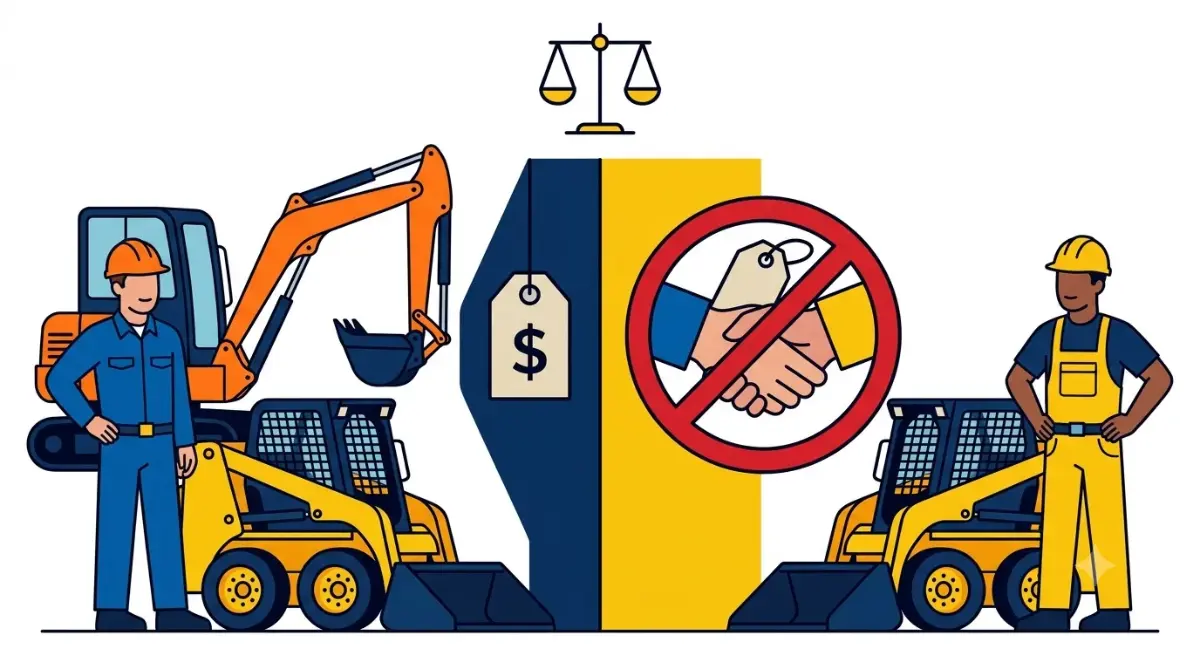
Table of Contents
The short answer for equipment owners
Is sharing prices with competitors illegal? Not automatically: under US federal antitrust law (Sherman Act §1), price fixing is illegal outright, while exchanging price information is judged on the facts.
This covers hourly equipment rates for any machine class; model year and emissions era don’t matter. The numbers are in our guide to equipment rates by machine, and this page covers who you may talk to about them.
Owner-operators and contractors: the stop-or-proceed check is the core. Farm custom-hire operators: start with the penalties and setting your own rate.
📋 Compliance Note: This page covers federal law only; state laws may add rules. The FTC and DOJ withdrew their competitor-collaboration guidelines on December 11, 2024, and we found no replacement as of October 10, 2026, so no agency safe harbor exists for information exchange. This is general information, not legal advice; ask an antitrust attorney about your situation.
Where price fixing starts under federal law
Federal law’s bright line sits at agreement.
What counts as price fixing
Price fixing is an agreement among competitors to raise, fix, or maintain prices; the prices need not match. It is illegal per se (automatically), so a court won’t weigh whether the price was reasonable, per the DOJ’s price-fixing primer. For hourly rates, think an agreed minimum, a no-discount pledge, or a shared formula.
Bid rigging is agreeing in advance who wins a bid. The primer adds that the Sherman Act covers any agreement among competitors and cites prosecutions affecting construction and agriculture.
What it can cost you
Price fixing is a felony: fines up to $100 million for corporations, and up to $1 million, 10 years in prison, or both for individuals. Civil claims can add up to triple damages (DOJ primer, revised February 2021). Those are ceilings, not typical outcomes, but they explain the check below.
When a simple rate conversation turns risky
Talking prices with competitors can cause trouble even without the word “agree.”

A simple call can count
In the Container Corp. decision (1969), competing manufacturers answered each other’s requests for their latest prices, expecting the favor returned. The Supreme Court held that this reciprocal swap was concerted action (joint conduct) that stabilized prices in an industry with few sellers and a near-identical product. The ruling did not make exchanges illegal per se; courts judge them case by case.
Associations and informal gatherings
The DOJ’s primer lists references to industry-wide price schedules as a warning sign and says collusion is likelier among competitors who know each other through trade associations. Keep rate talk out of association meetings and yard-side chats.
What the 2026 equipment-rental ruling does and doesn’t mean
The defendants are large rental companies, not owner-operators.
What the court decided
In the court’s September 28 opinion (N.D. Ill., MDL 3152), a federal court denied the defendants’ motions to dismiss, except RB Global, dismissed without prejudice. Six contracting businesses allege Rouse Rental Insights pooled rental companies’ pricing data and returned price ranges that fed quoting systems, with defendants pricing within range about 90% of the time. The court accepted the allegations as true at this stage.
⚠️ Watch Out: These are allegations, not findings. The court has not decided whether any benchmark is illegal.
What it did not decide
Defendants say their benchmarks are aggregated, anonymized, historical, and optional; the court said discovery may test that. The lesson: a third party that pools competitors’ data and returns prices is the arrangement under challenge.
Run this check before you answer a competitor
Stop at the first “yes” below.
The five checks
- Is someone proposing you agree on a price, minimum, discount rule, or customers? Stop: illegal per se, per the DOJ.
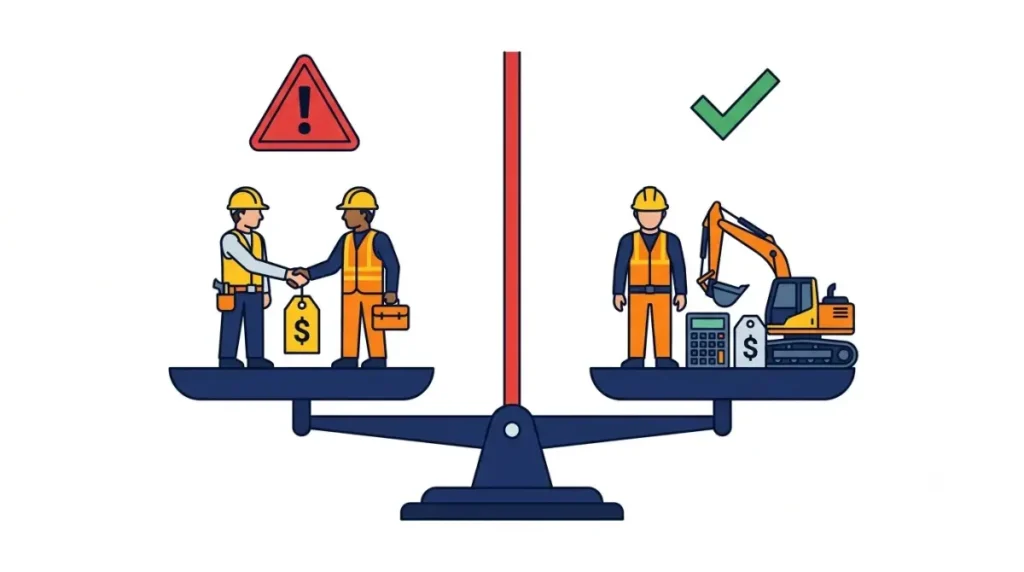
- Are you asked for, or about to give, a specific current or recent quote? Stop: Container Corp. treated a reciprocal swap of recent prices as concerted action.
- Is the information nonpublic, forward-looking, or firm-specific? Stop and ask counsel: courts weigh industry structure and the information’s nature.
- Does a platform pool competitors’ data and return rates to you? Ask counsel first: this is the arrangement alleged in the rental case.
- Still unsure? Stop and ask an antitrust attorney.
Where you stop
A “yes” at checks 1 to 4 means don’t answer. “No” to all five is not a green light: this is an issue-spotting aid, not a safe harbor.
The sequence runs from conduct the DOJ treats as automatically illegal to conduct judged case by case. It draws on the DOJ primer, FTC dealings-with-competitors guidance, Container Corp., and the September 28 opinion; it is not attorney-reviewed.
How to set your hourly rate on your own
The lawful alternative is to build your rate from your own numbers.
Start from your own cost per hour
Work out your cost floor first (ownership, fuel, repairs, labor, billable hours) with our Equipment Cost-Per-Hour Calculator and owning versus operating cost. Our mini excavator hourly rate page walks through one machine’s rate.
Inputs that are yours
Set your rate on your own, and keep your reasoning your own. Our rate guide draws on published sources: FEMA’s equipment schedule, a state university custom-rate survey, and federal wage data. Published references differ from private swaps between rivals, but we can’t call any source safe; ask counsel which fit.
If a competitor brings up rates, do this
A short, plain response beats a clever one.
Don’t answer with a number
Don’t give a figure or hint at which way your prices are heading, and end the conversation.
Who to call
✅ Do This: Write down what was said, when, and by whom, then call an antitrust attorney before you reply to anything.
The DOJ also accepts reports of suspected collusion, and its primer explains how. This is general guidance, not legal advice, and following it doesn’t guarantee protection.
Price-fixing questions equipment owners ask
1. Is sharing prices with competitors illegal?
Not automatically. Agreeing on prices is illegal outright; exchanging price information is judged on the facts. Ask an antitrust attorney.
2. Can two owner-operators agree to charge the same hourly rate?
No. Agreeing with competitors to fix, raise, or maintain rates is price fixing, which the DOJ treats as illegal per se.
3. What are the penalties for price fixing?
Per the DOJ: up to $100 million for corporations; up to $1 million, 10 years, or both for individuals, plus civil claims.
4. Can I ask a competitor what they charge?
Avoid it. In Container Corp., reciprocal requests for recent prices counted as concerted action; ask counsel first.
5. Can contractors discuss rates at trade association events?
Avoid rate talk there. The DOJ flags association price schedules as a warning sign; ask counsel before discussing rates.
6. Is using a rental-rate benchmarking service illegal?
Undecided. A court let claims proceed against rental firms using one, with no liability found; ask counsel first.
7. What is the difference between price fixing and bid rigging?
Price fixing agrees on prices; bid rigging agrees in advance who wins a bid, per the DOJ.
8. What should I do if a competitor brings up prices?
Don’t answer with a number, end the conversation, write down what was said, and call an antitrust attorney.
9. Do small businesses need to worry about price-fixing law?
Yes. The Sherman Act covers any agreement among competitors, and the DOJ notes prosecutions in construction and agriculture; ask counsel.
10. Is price fixing legal if the agreed rate is fair?
No. Agreeing on prices is illegal per se, so arguing the agreed rate was reasonable is not a defense.
Set your price yourself
Agreement is the line, and the first “yes” in the check is your cue to stop. Build your rate from your own costs, with public references such as FEMA’s equipment rate benchmark as one input rather than a rulebook. For any specific arrangement with other operators, an antitrust attorney is the right call.