Straight Answers on Pricing an Excavator Mobilization Fee

An excavator mobilization fee has no single number: Minnesota’s cap rose about a third since 2014, and real examples vary widely.
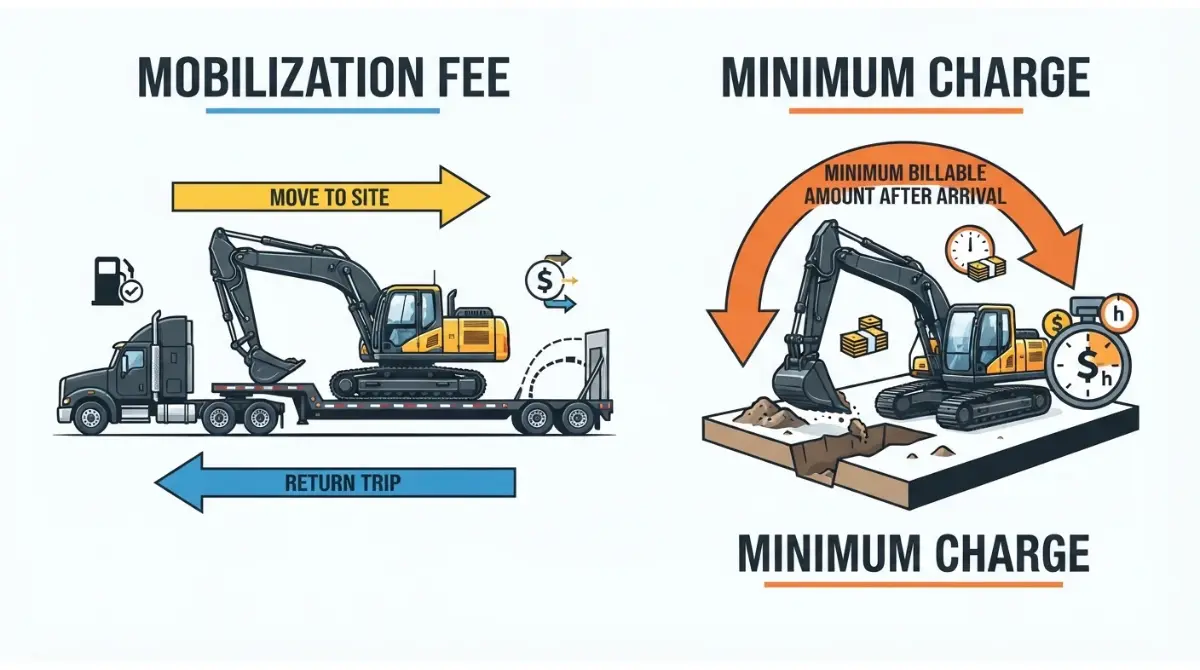
Table of Contents
Mobilization fee vs. minimum charge: what each one covers
Excavator pricing here means US owner-operator work with mini to mid-size machines (roughly 1–30 ton), 2026 practice; emissions tier doesn’t change any of it. A mobilization fee charges for moving the machine to the job and back. A minimum charge is the least you’ll bill once you arrive.
Small-job meaning vs. contract pay-item meaning
On big contracts, mobilization often means an upfront setup payment whose refundability depends on the termination clause. On a one-day dig it just means the move, which is the meaning used here.
Where this article stops
Pricing a job or checking a quote? Farm work too. This sits inside our equipment rates by machine framework. Trailers, permits and securement are hauling topics; this page prices the move only.
📋 Compliance Note: Moving equipment on public roads can trigger oversize, overweight, CDL and escort rules, and states differ. This article prices the move only; verify requirements with your state DOT.
💵 About These Numbers: Figures below come from a state rule, published price pages and rental guides retrieved September 2026. Prices swing by region, machine, access and fuel; treat them as orientation, not a valuation.
What a mobilization fee actually pays for
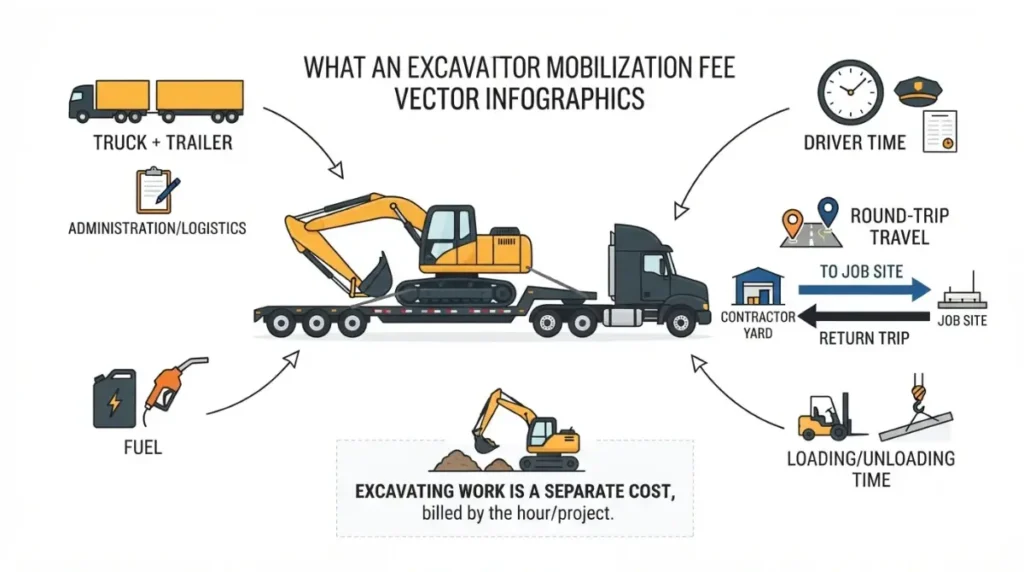
A mobilization fee pays for time and miles, not for the machine digging.
Truck, trailer, driver and fuel
Your hauling rig costs money every mile: fuel, driver time and wear. Count the round trip, because the empty drive back still costs fuel and driver time.
Non-driving time: loading, unloading, paperwork
Time at each end counts too. Loading, unloading and paperwork are hours you spend before and after the machine earns anything.
Costs people forget: tight access and second moves
If the big trailer can’t reach the site, you may need a smaller rig or a second move, so ask about access before you quote.
🔍 Why It Happens: A short job feels expensive because the move is a fixed cost, the same whether you dig for one hour or eight.
What published mobilization rates actually show
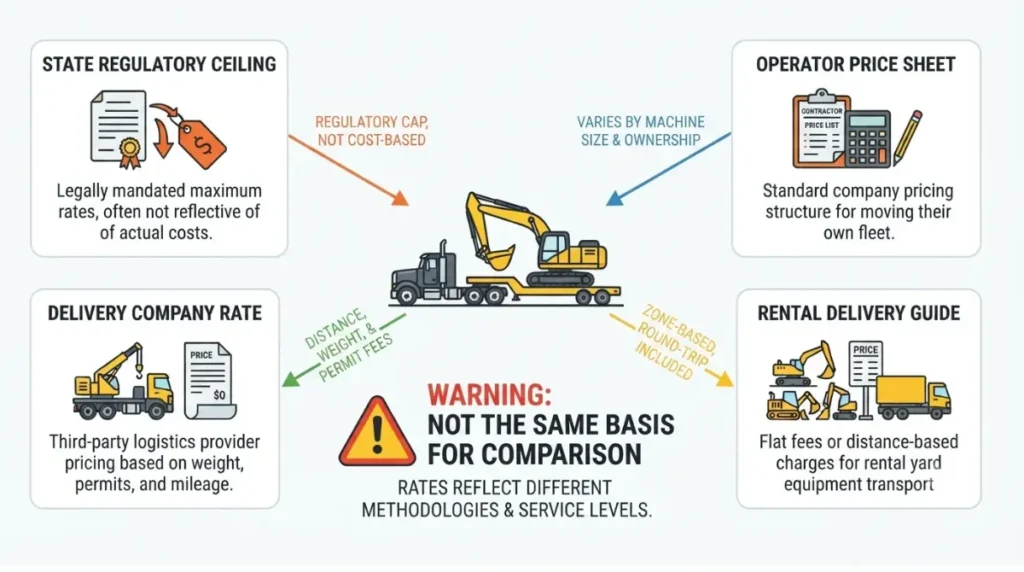
Published figures differ because each measures something different.
The regulator ceiling: Minnesota’s rule
Minnesota Rule 2890.2600 treats a charge above the bid or the rule’s cap as prima facie unreasonable; for a dozer, loader, backhoe or excavator moving up to 50 miles one way, the cap is $290 each at 70–250 hp and $436 above 250 hp.
📉 Cost Reality: The 2014 caps were $218 and $327, so the ceiling rose about a third by 2025. It is a state ceiling, not a market rate. Source: Minnesota Rule 2890.2600, 2014 and 2025 versions.
Operator price sheets and yard delivery fees
| Source | Figure | Date |
|---|---|---|
| Operator price sheet (location not stated) | $750 per job, 5-ton; $1,000, 15-ton | Aug 2024 |
| Contractor write-up quoting a delivery company | $40 first 10 miles, then $4 per mile | Aug 2025 |
| Rental guide, mini excavators | $100–$300 delivery and pickup, round trip | Jul 2026 |
Sources: operator rate page; contractor write-up; rental retailer guide.
Why there is no single national number
Basis, year, distance and machine size all move the fee, so averaging these rows would mislead. See our mini excavator hourly rate guide for context.
How to calculate your mobilization fee, step by step
Add round-trip hours times truck-and-driver cost, round-trip miles times per-mile cost and any pass-throughs, then margin.
The five inputs
- Round-trip miles
- Total hours: driving, loading, unloading, paperwork
- Truck-and-driver cost per hour, from your own books
- Per-mile operating cost: fuel, tires, wear
- Pass-throughs: tolls, plus permits or escorts if any
A worked example (illustrative, not a real quote)
Placeholder inputs, not market data: 2.5 hours at $70 is $175; 60 round-trip miles at $1.20 is $72; the $247 subtotal plus 15% margin is about $284.
Round trip, not one way
Use round-trip miles, because the empty drive back still costs fuel and driver time. Our owning versus operating cost guide shows how to build your hourly cost.
Flat fee, per mile, or built into the hourly rate?
Pick the structure that matches how far you usually travel.
Flat fee for local moves
Some contractors charge a modest delivery fee, or fold travel into the hourly rate for nearby work, which only works if your minimum covers the move. Missouri DOT vendor forms (2016–17 contract period) ask for flat round-trip fees by mileage band.
Per-mile above a threshold
Past your local radius, per-mile pricing tracks real cost, as in the delivery-company example above.
Permits, tolls and escorts as pass-throughs
Charge these at cost, listed separately, since they vary by route. FHWA’s permit page says the federal government doesn’t issue oversize or overweight permits; that’s a state option, so ask your state DOT or a licensed hauler what your route needs.
How to set your minimum charge for small jobs
A minimum charge is the least you bill for a job, however short.
Hour minimum vs. dollar minimum vs. day minimum
One equipment retailer’s guide says many operators set a $200–$400 minimum or two to four hours; a home-cost guide says most bill at least a day.
Minimum plus mobilization: don’t double-count
Decide once whether your minimum includes the move, and say so in the quote.
Where short jobs lose money
A hypothetical 90-minute dig with a 2.5-hour move loses money if you bill only dig time. Some clients resist minimums; if you can’t hold one, bill time including travel. Farm or acreage work: see what to charge for tractor work.
Where quotes go wrong, and how to write it down
Quote errors are usually vagueness, not math.
What a written quote should state
State the machine, whether miles are round trip, what the minimum covers, pass-throughs at cost, and cancellation terms. Say who pays if tight access forces a second move. Refundability turns on the written termination language, so have a local attorney check yours.
When the honest answer is to rent or decline
If most of your jobs are short and local, the move eats your margin: raise the price, decline, or rent instead. One cost-calculator site says under 400 hours a year, renting may beat owning.
FAQ
1. What is an excavator mobilization fee?
An excavator mobilization fee is the charge for moving the machine to the job site and back, covering truck, driver, fuel and time.
2. How much is a typical excavator mobilization fee?
An excavator mobilization fee has no single figure: Minnesota caps 70+ hp moves up to 50 miles one way at $290–$436; other examples run $100–$1,000.
3. How do you calculate a mobilization fee?
Calculate an excavator mobilization fee: round-trip hours times hourly cost, plus miles times per-mile cost, plus pass-throughs, then margin.
4. Is a mobilization fee charged each way?
Not necessarily: build your excavator mobilization fee on round-trip miles, since the empty drive back costs fuel and driver time.
5. Is the mobilization fee refundable?
Refundability depends on your written cancellation terms, so state the mobilization fee’s refund rules in the quote and have a local attorney check them.
6. What is a minimum charge?
A minimum charge is the least you bill for any job, however short, so travel and setup time never go unpaid.
7. What is a normal minimum for a mini excavator?
One equipment retailer’s guide reports many operators set a $200–$400 minimum or a two- to four-hour minimum for mini excavator work.
8. Flat fee or built into the hourly rate?
Flat fee for local moves, per-mile beyond your radius; folding travel into the hourly rate works only if your minimum covers the move.
9. Do permit and escort costs go in the fee?
Charge permits, tolls and escorts at cost as separate pass-throughs, since they vary by route; ask your state DOT what your route requires.
10. Can I skip the fee for nearby jobs?
Yes, if you fold travel into your hourly rate and your minimum covers the move; otherwise a short local job loses money.
Set the fee, set the minimum, put it in writing
Build the fee on round-trip cost, label every benchmark by its basis, and set a minimum so short jobs pay for themselves. Remember the ranges above are orientation, so your own hourly and per-mile costs decide the final figure. Then put both numbers in a written quote before the machine moves. Run your own numbers in the worksheet below.