Can You Afford a Used Mini Excavator for Side Work? Clear Test

Afford an excavator for side work? Lenders quote 6%–22% APR, and each point moves your payment per hour. Check yours before you sign.
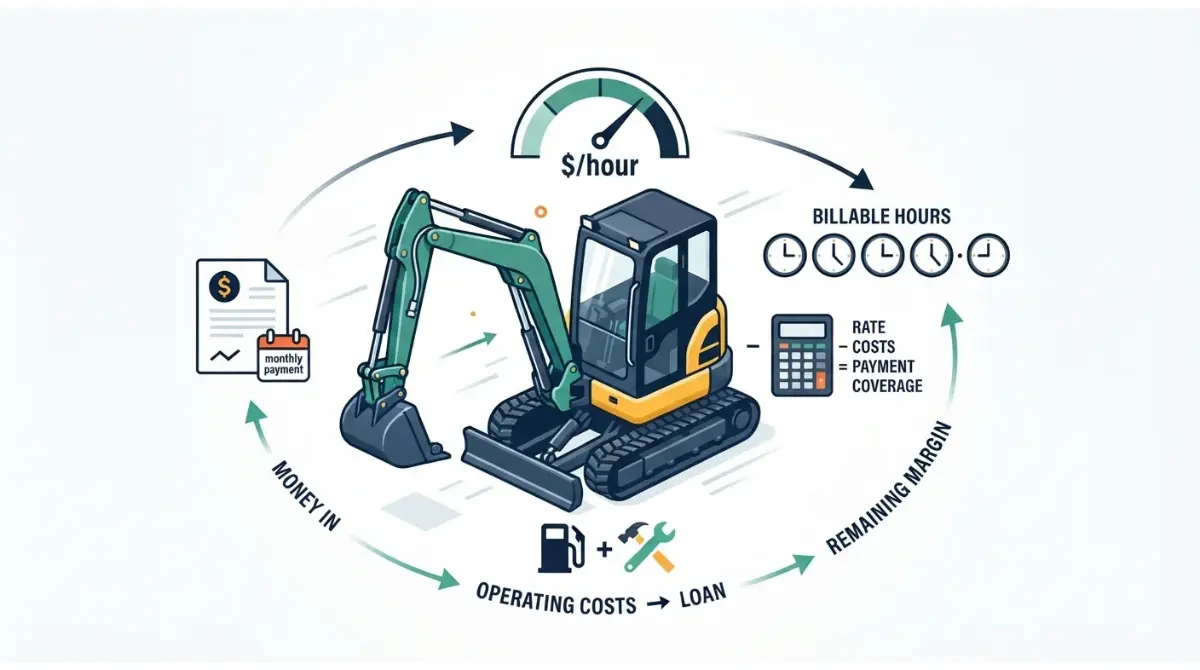
Table of Contents
This covers mini (compact) excavators, new and used, for US buyers financing a machine for part-time paid work. Price and loan figures run June 2025–May 2026; tax figures are for 2026, engines are Tier 4-era, and this is not tax or lending advice.
The test: what you charge per hour, minus running costs, has to cover the loan payment spread over the hours you really bill. Our guide to hourly equipment rates by machine covers the rate side.
Pricing a machine now? See the payment table; digging a few days a year, skip to renting.
💵 About These Numbers: Used prices: EquipmentWatch averages, June 2025–May 2026. Loan terms: a broker’s guide, September 2026. Rentals: DOZR, March 2026. Taxes: tax year 2026. Quotes vary by model, hours, region and credit; orientation, not a quote.
What a mini excavator costs to finance
Used mini excavator listings averaged $46,000 to $47,000 between June 2025 and May 2026, per EquipmentWatch (via Equipment World).
Used prices and age
That covers 264,724 listings of every size, so a smaller or older machine sits below it.
Rates, terms and down payments
APR is a loan’s yearly cost, fees included. One broker’s 2026 guide (Bay Street Lending) reports 6% to 22%, and 10% to 20% down on used machines.
Banks generally cap a machine’s age near seven to ten years at loan end. A broker earns by placing loans, so get two or more quotes.
When your rate won’t cover the loan payment
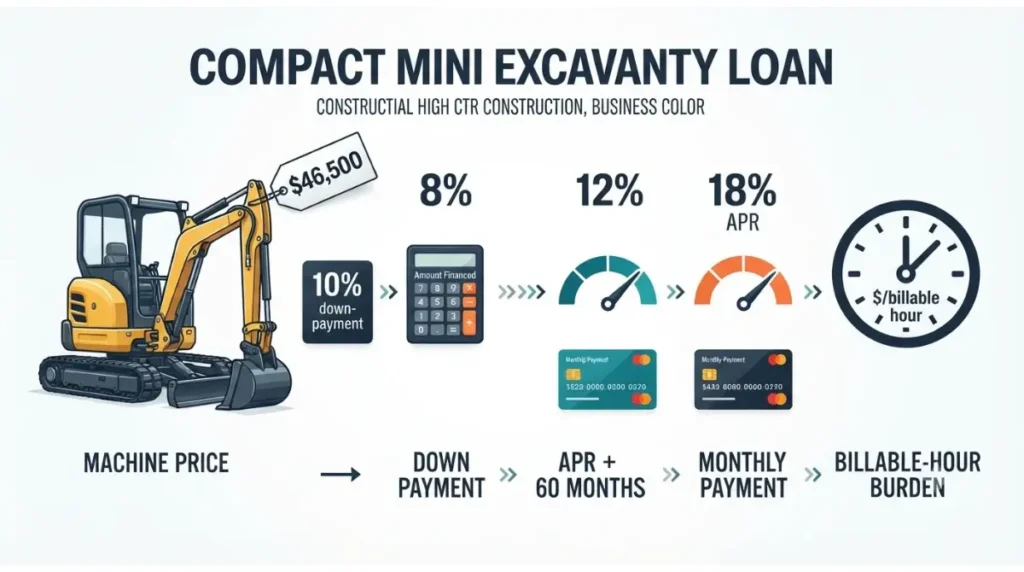
On a 60-month loan with 10% down, a used mini excavator at the market-average price costs roughly $850 to $1,060 a month, depending on the rate.
The payment at three interest rates
We assumed $46,500 (EquipmentWatch’s midpoint) with 10% down, then divided a year of payments by billed hours.
| APR | Per month | 50 h | 100 h | 200 h |
|---|---|---|---|---|
| 8% | $848.57 | $203.66 | $101.83 | $50.91 |
| 12% | $930.93 | $223.42 | $111.71 | $55.86 |
| 18% | $1,062.71 | $255.05 | $127.53 | $63.76 |
Source: our arithmetic from EquipmentWatch and Bay Street Lending’s 6%–22% APR band; hourly columns show payment per billed hour. An illustration, not a quote.
Payment per billable hour
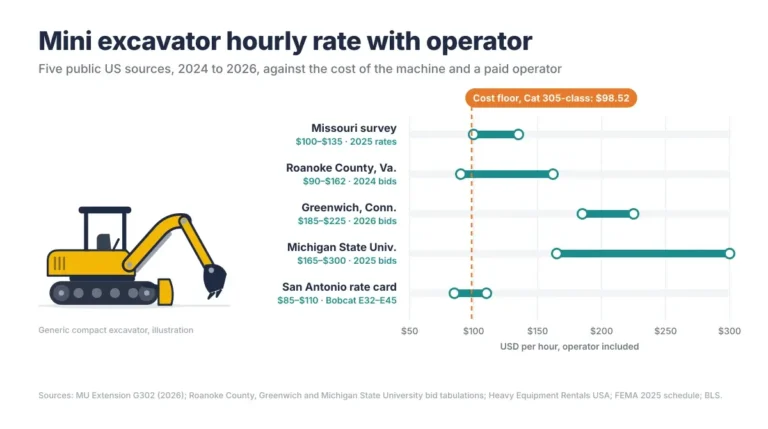
At 12% and 100 billed hours, the payment per hour is about $112. Our mini excavator hourly rate guide puts operated work at roughly $75 to $150 an hour, and that rate must also pay you, your truck and your overhead.
What the table leaves out
A cash test, not true ownership cost: it skips insurance, fuel, repairs, tracks and your time.
The costs the payment doesn’t include
The loan payment is the first bill, not the last.
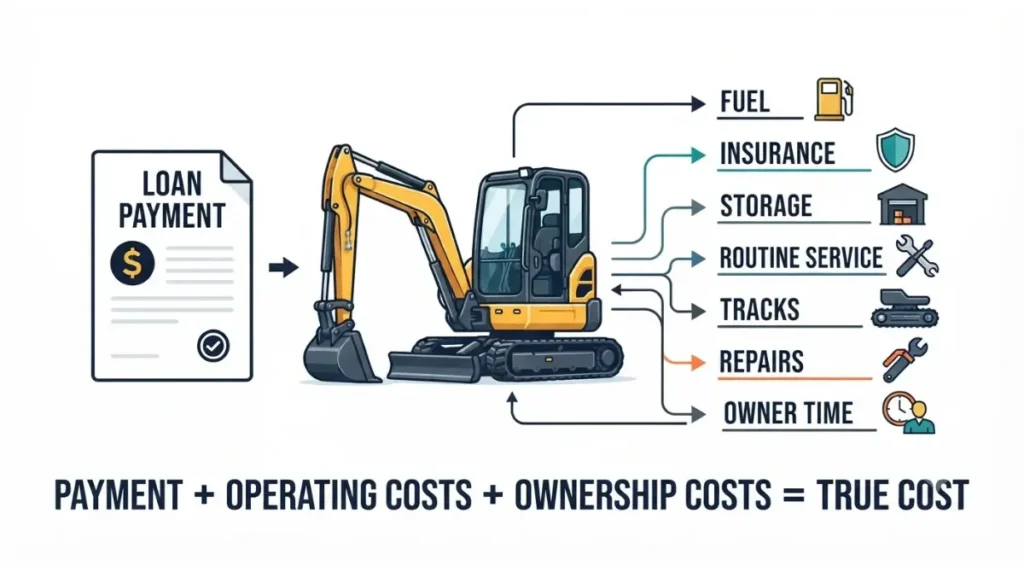
Costs you pay every year
Insurance and storage recur even in a slow year; fuel and routine service follow the hours. Your model’s operator’s manual sets service intervals.
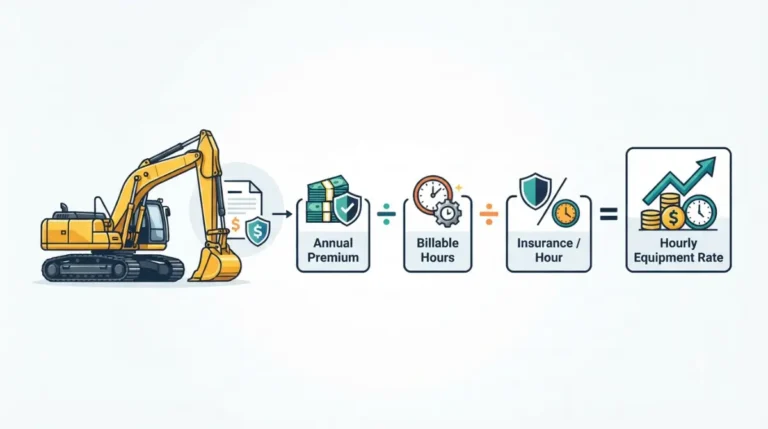
📉 Cost Reality: Published estimates run from about 0.5% of machine value a year (Iowa State, March 2026) to 1%–3% (Grit Insurance, June 2026), per our insurance cost guide: roughly $230 to $1,400 on a $46,500 machine. Directional, not quotes.
Costs that arrive in lumps
Track replacement, hydraulic repairs and major service arrive as single bills; get a dealer’s price first.
Your own time
A rate built from payments alone understates true ownership cost.
How many hours it takes to beat renting
Owning beats renting once yearly hours pass a break-even point.
The break-even test
Divide annual fixed cost by the gap between the rental rate and your running cost per hour. That is our arithmetic; Iowa State Extension’s machinery cost worksheet shows the fixed-versus-operating split.
What renting costs in 2026
DOZR, a rental marketplace, quoted mini excavators at $150 to $400 a day and $1,200 to $3,200 a month in March 2026 (1.5- to 4-ton, fuel extra). At 12%, a year of payments (about $11,171) equals roughly four months of 3-ton rental at $2,800, or seven of 2-ton at $1,500; sizes differ, so it is a yardstick.
When hiring it out wins
Below your break-even hours, rent or hire an operator instead.
What a tax write-off does and doesn’t do
A deduction lowers your tax bill, not your payment.
Section 179 in 2026
For tax years beginning in 2026, the Section 179 limit is $2,560,000, phasing out above $4,090,000 of equipment placed in service (IRS Revenue Procedure 2025-32), and it cannot exceed your taxable business income (IRS Form 4562 instructions).
Bonus depreciation and used machines
Congress restored 100% bonus depreciation for qualified property acquired and placed in service after January 19, 2025 (IRS Publication 946); certain used property qualifies (Form 4562 instructions).
Why it doesn’t lower your payment
A side business with modest income can use only a slice of that ceiling. Ask a CPA how much your income absorbs, whether Section 179 or bonus fits, and whether a December delivery counts.
Buy, rent, or hire it out: the decision rules
Run the payment-per-hour test: if your rate minus running cost doesn’t cover it at realistic hours, rent or hire out.
Buy if…
Your rate, minus running cost, covers the payment per hour at hours booked jobs show, and you’ve checked state requirements in our contractor license guide.
Rent if…
Hours are uncertain or below break-even.
Hire it out if…
You dig a few days a year; paying for the job costs less than a payment that runs all year.
If the numbers don’t work at your honest hours, don’t buy.
Questions about affording an excavator
1. Is a mini excavator worth it for side work?
Only if your rate, minus running costs, covers the payment at hours you can document.
2. How much does a used mini excavator cost?
Used mini excavators averaged $46,000 to $47,000 in listings from June 2025 to May 2026, per EquipmentWatch.
3. What is the monthly payment on a mini excavator?
At 60 months and 10% down, monthly payments run about $849 at 8%, $931 at 12% and $1,063 at 18%.
4. What interest rate should I expect?
One broker’s 2026 guide reports 6% to 22% APR on construction equipment loans; get two or more quotes.
5. Can I finance a used mini excavator?
Yes. One broker reports 10% to 20% down on used machines, with bank age caps near seven to ten years.
6. How many hours until owning beats renting?
Owning wins when yearly hours exceed annual fixed cost divided by the gap between rental rate and running cost per hour.
7. Is it cheaper to rent or buy?
Renting is cheaper at low hours: a year of payments at 12% equals about four to seven months of rental.
8. Can I write off an excavator?
Section 179 and bonus depreciation can partly write off an excavator, but Section 179 is capped by business income; ask a CPA.
9. Does a write-off lower my payment?
No. A write-off lowers your tax bill, not your excavator payment, so your rate must still cover the payment.
10. How much is a mini excavator rental per day?
DOZR’s March 2026 quotes put mini excavator rental at roughly $150 to $400 a day; fuel is extra.
Run it with your own numbers
Run the payment-per-hour test with your own price, rate and hours before you sign. Get a real lender quote and a CPA’s view on the tax side. If the numbers only work at hours you hope for, rent first.