Drone Equipment Cost Per Hour, Made Clear for a T40 Spray Rig

Drone equipment cost per hour starts with acres: MU’s T40 model sprays 26 acres per flight hour. Here’s what that does to your rate.
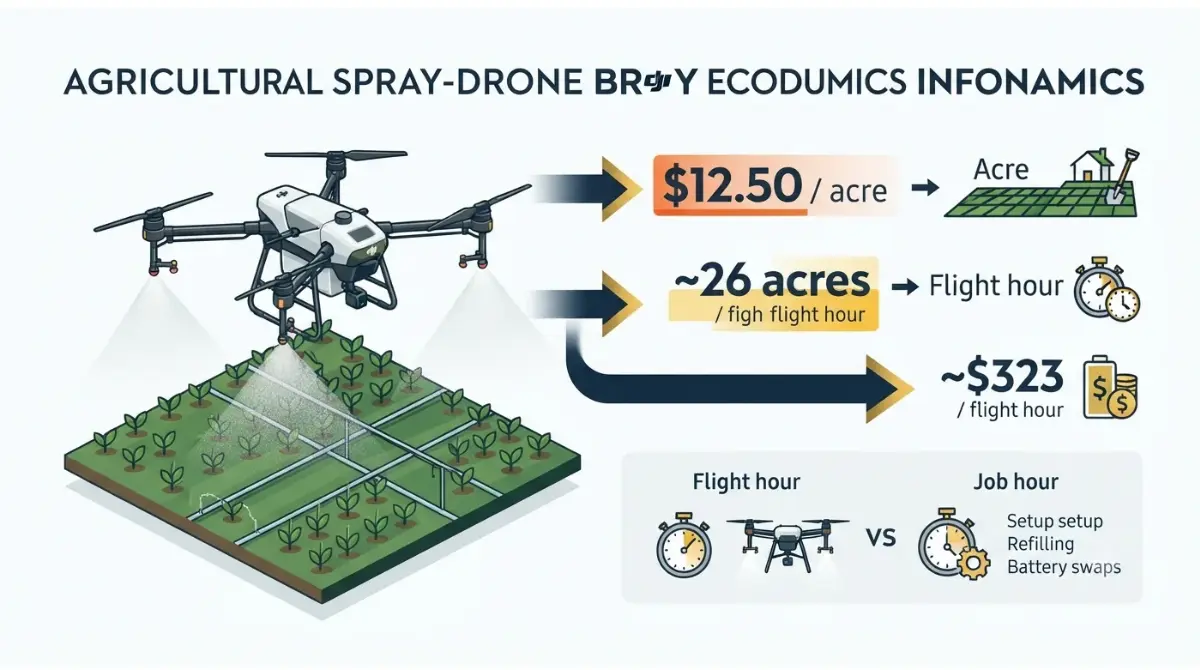
Table of Contents
This rate sheet covers agricultural spray drones in the DJI Agras T40 class, using 2025–2026 US cost and custom-rate data. The aircraft are battery-electric, so Tier 4 emissions rules don’t apply to them. Customers pay you by the acre, but your costs pile up by the hour, and this page connects the two.
Who this rate sheet is for
- Running custom application? Go straight to the rate sheet section.
- Deciding whether to buy or keep hiring? Start at own-vs-hire.
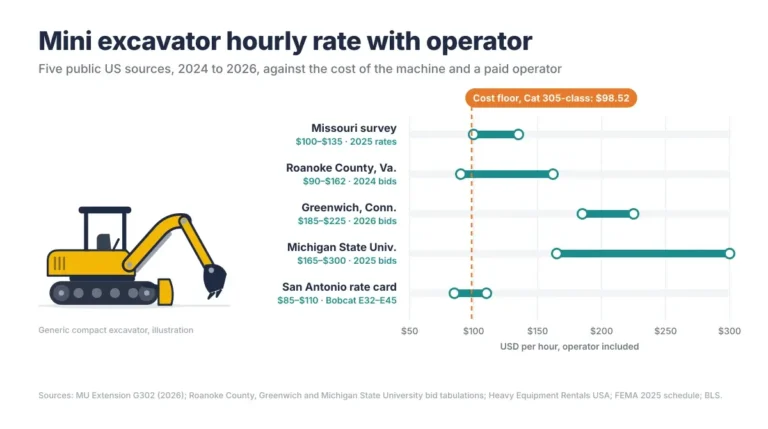
- Pricing other machines too? Our guide to hourly rates for every machine in your fleet covers them.
What it doesn’t cover
Photo, survey, and inspection drones are priced by the job and the deliverable, not by machine hours. They sit outside these numbers.
ℹ️ Safety Note: Spray drones apply pesticides, and the product label is the law for rates, PPE, and drift restrictions. Follow the label, your state’s applicator licensing rules, and your drone’s operating manual, and get hands-on training before flying a loaded aircraft.
📋 Compliance Note: FAA Part 137 governs dispensing any substance from an aircraft, drones included. The FCC added foreign-produced drones and critical components to its Covered List on December 22, 2025. Both areas are changing, so verify current requirements with the FAA and your state department of agriculture before relying on this.
💵 About These Numbers: Costs come from University of Missouri Extension guide G1274 (2025 assumptions: T40 drone, 8% interest, $3.31 diesel). Rates come from Iowa State’s 2026 custom rate survey, collected in February 2026 from Iowa respondents. Treat them as orientation, not a quote.
Why spray drones bill by the acre but cost by the hour
The conversion unit is acres per flight hour. In University of Missouri Extension’s T40 model, spraying 980 acres takes 37.69 flight hours, which works out to about 26 acres per flight hour.
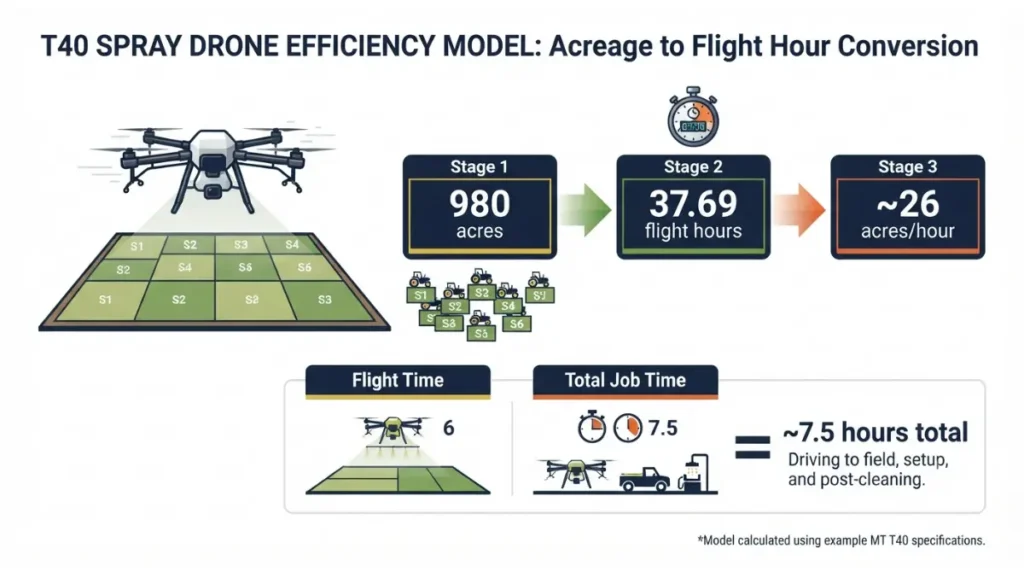
🔍 Why It Happens: MU assumes 6.5 acres per flight and 24 loads a day for one drone. That is 156 acres over six hours of applying. Change the load, and the hourly number changes with it.
Flight hours vs. hours on the job
Flight time is not the whole workday. MU’s farmer model adds one hour of driving and half an hour of drone cleaning to six hours of applying, so you’re on the clock 7.5 hours for 6 in the air.
What changes acres per hour
Three things cut acres per hour: higher gallons per acre, small or irregular fields, and long refill distances. Your own drone’s documentation sets tank and swath limits, so use it rather than this example. It’s the same logic we used to build the mini excavator rate: cost follows hours, and price follows the unit the customer understands.
What owning a spray drone rig costs before it flies
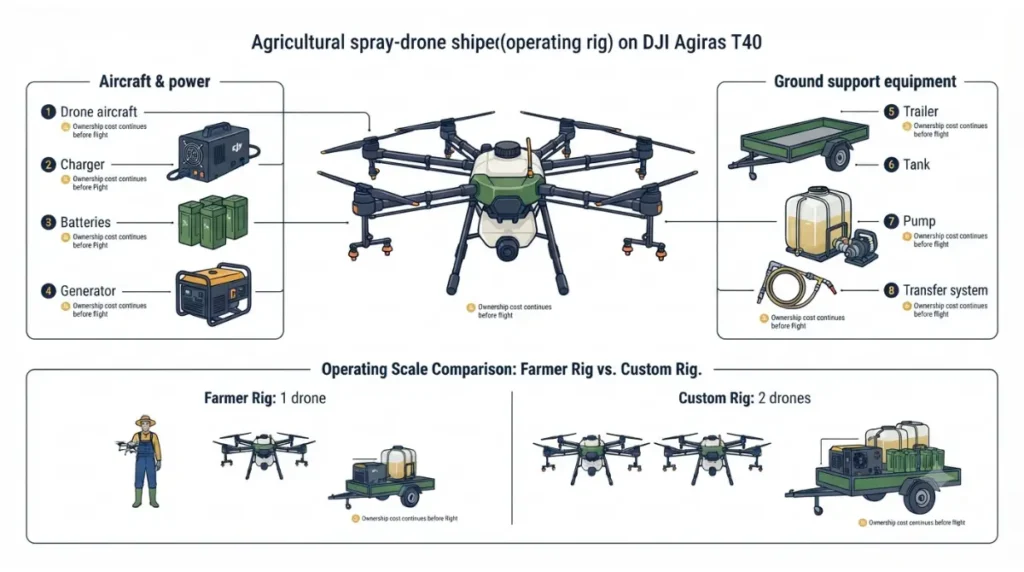
Ownership cost is the biggest line on the sheet, and you pay it whether the drone flies or sits.
Setup cost: farmer vs. custom rig
MU’s farmer rig is one T40 drone, a charger, three batteries, a generator, a trailer, and a tank-pump-transfer system. The custom rig runs two drones and five batteries. Package prices are listed in Table 1 of the University of Missouri Extension drone ownership study; price your own quote against it.
Depreciation, interest and batteries
📉 Cost Reality: In MU Extension G1274 (2025), ownership costs run $8.90 per acre for a farmer at 1,000 acres and $4.75 for a custom operator at 4,000 acres. Depreciation and interest (excluding batteries) account for $6.58 and $3.84 of that.
Batteries add $1.72 an acre in the farmer model, assuming 1,000 charge cycles or five years, whichever comes first. Interest matters too: MU found that cutting the rate from 8% to 6.5% drops the farmer’s total from $12.27 to $11.55 an acre.
The per-hour running costs most operators forget
Operating costs are smaller, but they grow with every acre you fly.
Generator fuel and maintenance
MU budgets maintenance and repairs at $2.06 an acre for a farmer and $1.32 for a custom operator; the drone’s own share is $1 an acre. The generator burns 1.10 gallons of diesel per hour at MU’s $3.31 price. Swap in today’s diesel price.
Labor, including cleaning time
MU uses $21 an hour for farm labor and $30 for a two-person custom crew. Total operating cost comes to $3.37 an acre for farmers and $2.64 for custom operators.
💡 Field Note: Labor is only about $1.05 an acre in MU’s farmer model. But it’s paid for driving and cleaning hours too, which is why per-job-hour cost matters.
Your drone rate sheet: from $12.43 an acre to ~$323 an hour
At MU’s 980-acre farmer scenario, a T40 costs about $323 per flight hour to own and run, or about $259 per hour on the job.
| Line | Farmer, 980 ac | Custom (2 drones), 4,000 ac | What It Means |
|---|---|---|---|
| Total annual cost | ~$12,181 | $29,563 | Your cost floor |
| Flight hours | 37.69 | ~76.9 | Time in the air |
| Cost per flight hour | ~$323 | ~$384 | Air-time cost |
| Cost per job hour | ~$259 | ~$263 | Includes driving and cleaning |
| Revenue per flight hour at $12.50/ac | ~$325 | ~$650 | Near-zero farmer margin |
Source: CabAndCargo arithmetic from MU Extension G1274 (Tables 2–3, 980-acre scenario) and the Iowa State 2026 custom rate survey average.
How the numbers were derived:
- Farmer cost per flight hour: $12.43 × 980 acres, divided by 37.69 flight hours.
- Custom flight hours: 4,000 acres divided by 52 acres per applying hour (52 loads × 6.5 acres over 6.5 hours).
- Job hours: applying days multiplied by MU’s hours per day for applying, driving, and cleaning.
- Status: these are our calculations, not MU findings.
Fill in your own numbers
Divide your total annual cost by the acres you’ll really fly; that is your per-acre floor.
What the market pays, and when owning a drone pays off
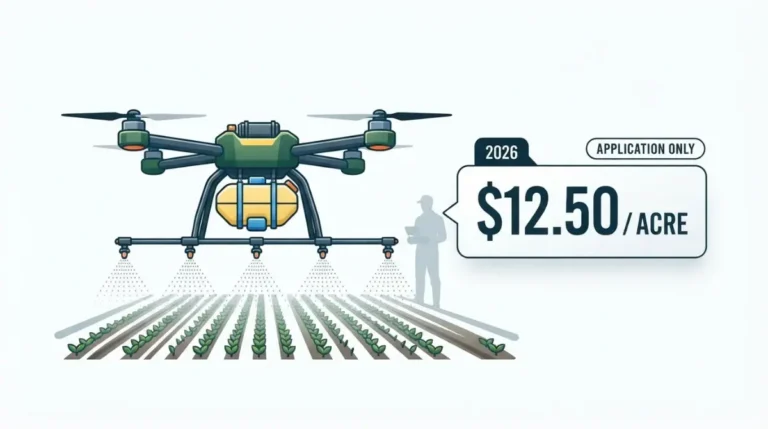
Drone spraying averaged $12.50 per acre in Iowa State’s 2026 custom rate survey, materials not included. The median was $12.00, the range $8–$16, from 47 responses.
2026 custom drone rates
Manned aerial spraying averaged $12.00 in the same survey, and MU cited about $16 as a typical drone rate in 2025. The data is Iowa-only; see our drone spraying rates per acre for more context. The full tables are in Iowa State’s 2026 custom rate survey.
Breakeven acres: farmer vs. custom operator
- Farm operation: costs drop below $12.50 an acre at 980 acres or more a year, under MU’s assumptions.
- Custom operator: costs drop below a $7.50 target at 3,900 acres or more.
- Under roughly 1,000 acres a year: hiring a custom applicator usually costs less than owning.
Compliance costs that belong on your rate sheet
Certification time and parts supply are real costs, even though no calculator shows them.
Part 137 and the 55-lb exemption
The FAA puts drones under 55 lb including payload under Part 107, with exemptions, and heavier ones under Parts 91 and 137. A full T40 tank of 10.6 gallons weighs roughly 88 lb at water weight, so a loaded T40 is well over 55 lb. The 44807 exemption step can take up to 120 days, per NMSU; see the FAA’s requirements for dispensing chemicals by drone.
FCC Covered List: parts and replacement risk
As of early 2026, new foreign drone models generally can’t get FCC authorization, while previously authorized models remain usable and sellable.
✅ Do This: Ask your dealer whether the exact model, its replacement batteries, and its controller are FCC-authorized, as UC ANR’s Covered List guidance recommends. Confirm your certification path with the FAA and your state department of agriculture.
Drone equipment cost per hour: FAQ
1. What does drone spraying cost per acre?
Iowa State’s 2026 survey averaged $12.50 per acre for drone spraying, materials not included, from 47 Iowa responses.
2. How many acres per hour does a spray drone cover?
MU Extension’s T40 model covers about 26 acres per flight hour, with 980 acres taking 37.69 flight hours.
3. What is a spray drone’s cost per hour?
Our math from MU data puts drone equipment cost per hour near $323 per flight hour, or $259 per job hour.
4. What drives spray drone ownership cost?
Depreciation and interest lead, at $6.58 per acre for MU’s farmer model, followed by batteries at $1.72.
5. How long do spray drone batteries last?
MU assumes 1,000 charge cycles or five years, whichever comes first, when costing spray drone batteries.
6. How many acres justify owning a spray drone?
MU puts farm breakeven at about 980 acres a year; custom operators need roughly 3,900 acres to hit $7.50.
7. What labor rate does the drone cost model use?
MU uses $21 per hour for farmers and $30 per hour for a two-person custom crew.
8. Do I need Part 137 to spray with a drone?
Yes. FAA Part 137 governs dispensing substances from any aircraft, drones included. Confirm your path with the FAA and your state department of agriculture.
9. Does a loaded spray drone exceed 55 pounds?
A full 10.6-gallon T40 tank weighs roughly 88 pounds, so loaded T40-class drones need the 44807 exemption. Confirm requirements with the FAA.
10. Can I still buy a DJI Agras drone?
As of early 2026, previously FCC-authorized models remain sellable, while new foreign models generally cannot get authorization. Ask your dealer about the exact model and its parts.
Build your sheet from your own purchase price, loan rate, and realistic acres. At 2026 Iowa rates, a single drone spraying under 1,000 acres barely covers its costs, so hiring is often the smarter move. Questions or corrections: write to contact@cabandcargo.com.