Straight Math on Equipment Operator Insurance Cost per Hour

Published equipment operator insurance cost figures disagree by roughly 4×. Here’s how to pick a range and turn it into dollars per billable hour.
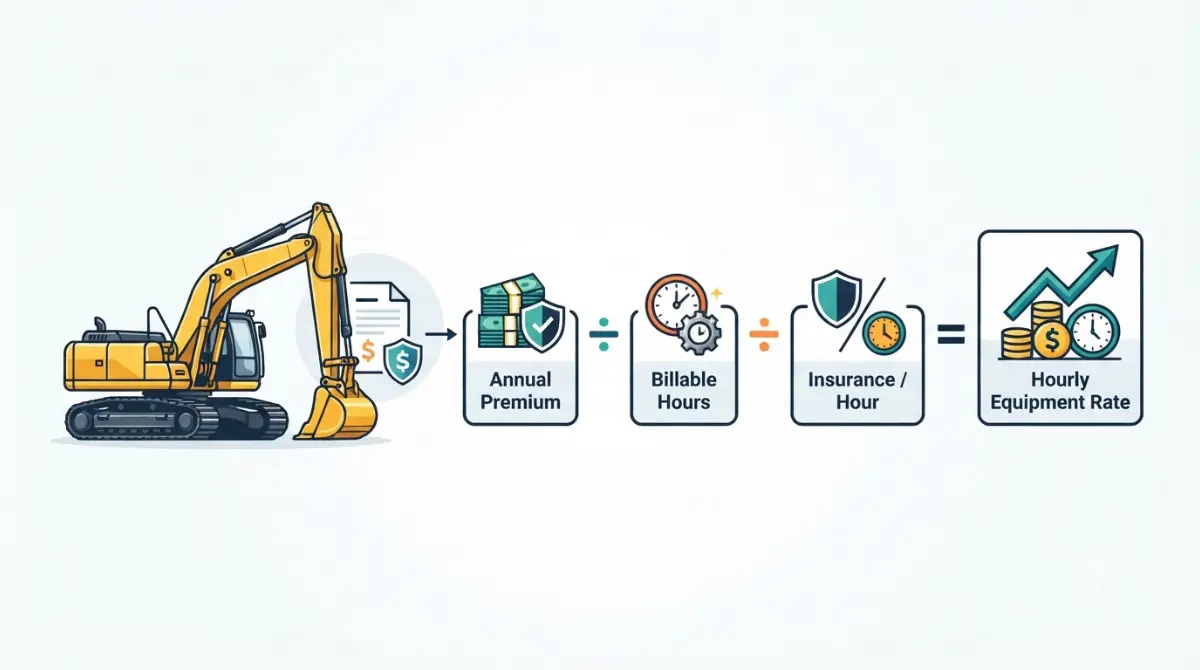
Table of Contents
Where insurance hides in your hourly rate
This guide prices insurance on machines you own and bill by the hour: excavators, loaders, dozers and farm tractors, using 2026 US figures. It leaves out truck-and-trailer hauling coverage and an employed operator’s own policy. It fits any model year or emissions tier.
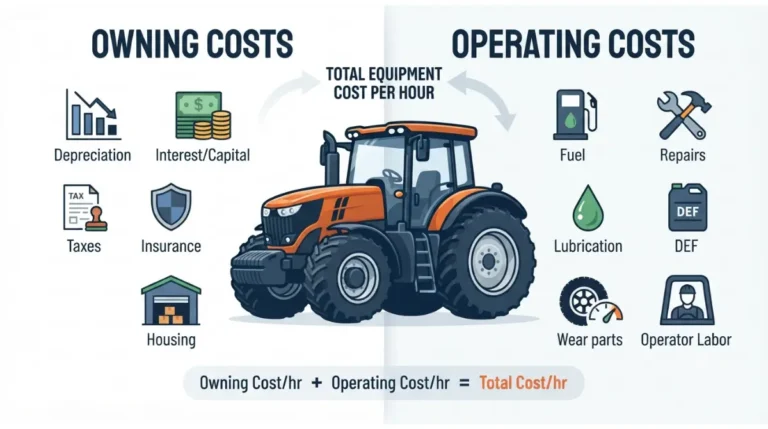
Our hourly equipment rate guide counts insurance in three places: owning cost, overhead and labor burden. Put a policy in the wrong one and you count it twice or miss it.
Quoting a job? Use the per-hour table. Buying a first machine? Read the cost ranges. Holding a quote? Use the question list.
💵 About These Numbers: Figures come from Grit (June 10, 2026), Kovalev (February 9, 2026), Insureon (July 28, 2026) and Iowa State (March 2026), checked October 5, 2026. Premiums vary with value, storage, deductible, claims history and state. Orientation, not a quote or insurance advice.
Why public rate books leave insurance out
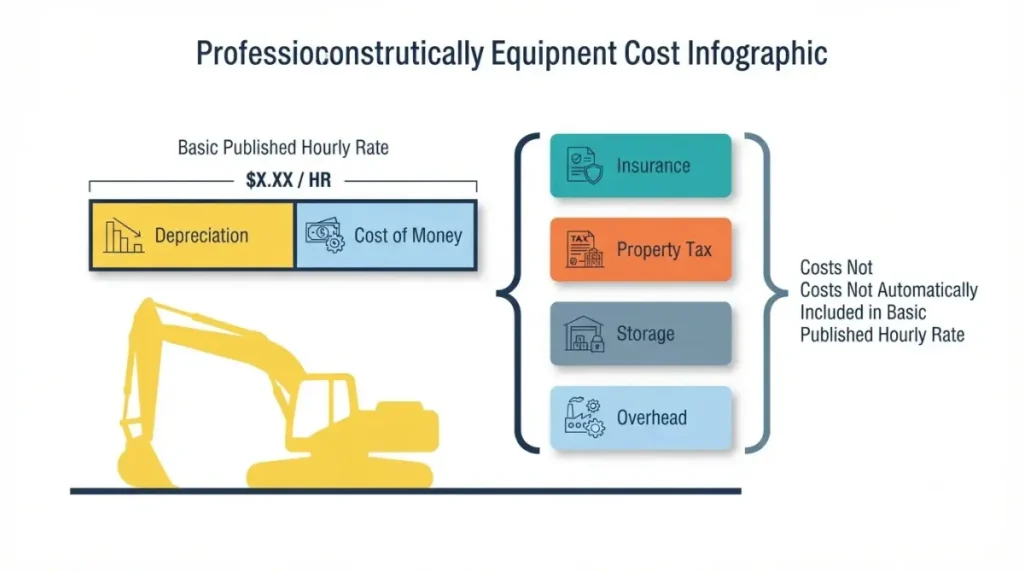
Does a Corps of Engineers equipment rate include insurance? No. The Army Corps’ rate pamphlet treats insurance as an indirect cost and leaves it out of its hourly rates.
What the Corps pamphlet counts
The 2021 edition (EP 1110-1-8) builds each hourly ownership rate from depreciation and cost of money only. License fees, property taxes, storage and insurance are left to the contractor’s overhead, so a schedule rate used as a cost floor is missing them.
What to check in any rate source
FEMA says its rates cover ownership and operation costs except operator labor, and its component list names overhead but not insurance. Ask what that overhead covers, then add what’s missing.
What each policy costs, as a range
Published inland marine premiums for machines disagree by roughly 4×, so treat them as a range, not a quote.
Machine coverage: percent of value
| Source | Machine | Annual premium | What It Means |
|---|---|---|---|
| Grit, June 2026 | $250,000 excavator | $2,500–$7,500 | 1–3% of value |
| Kovalev, Feb. 2026 | $150,000 excavator | about $1,090 | about 0.7% |
Grit calls its figures directional. Storage, deductible, claims history, location and coverage basis all move the rate.
Farm machinery runs lower
Iowa State’s machinery cost guide (March 2026) puts Iowa farm machinery insurance near 0.5% of average value.
From annual premium to cost per billable hour
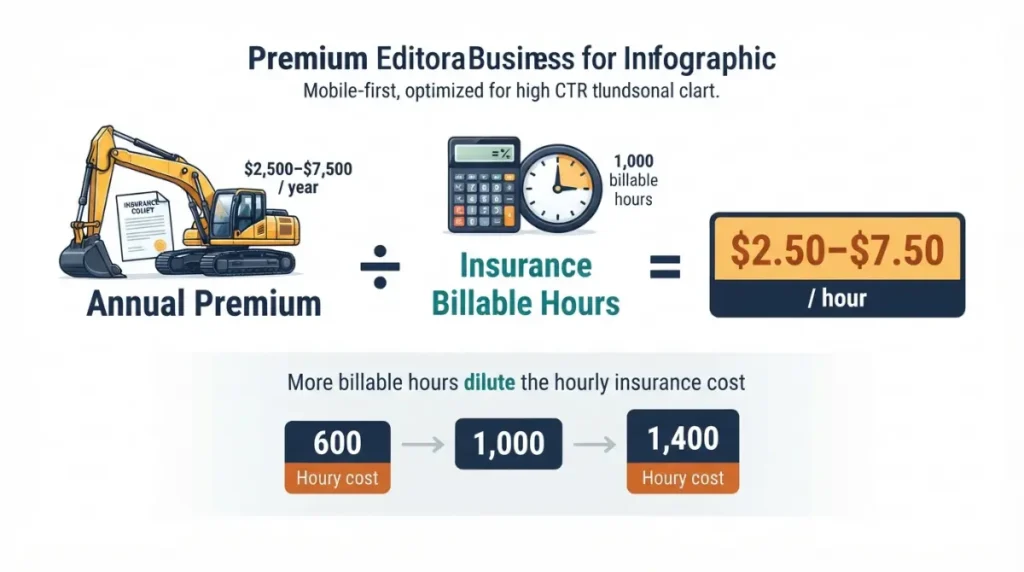
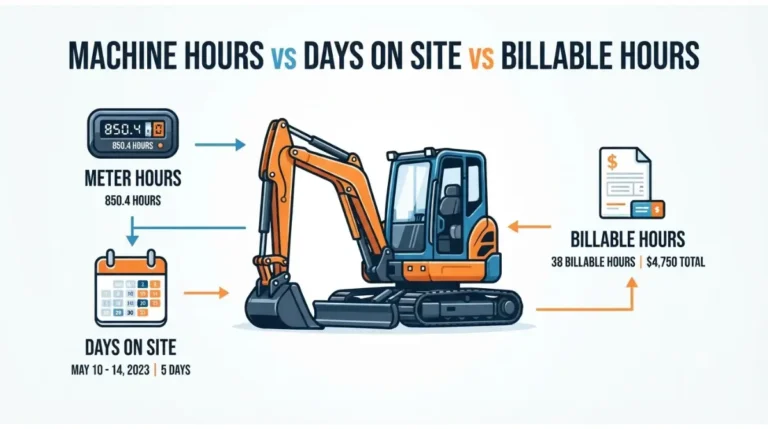
How do you add insurance to an equipment hourly rate? Divide the annual premium by the hours you can actually bill.
The formula and the table
Cost per hour = annual premium ÷ billable hours. Here is the $250,000 excavator at Grit’s 1–3% range:
| Billable hours a year | Insurance per hour | What It Means |
|---|---|---|
| 600 | $4.17–$12.50 | Few hours carry the premium |
| 1,000 | $2.50–$7.50 | Middle case |
| 1,400 | $1.79–$5.36 | A busy machine dilutes it |
Source: Grit Insurance (June 10, 2026), checked October 5, 2026. Per-hour values are our arithmetic, not quotes.
A small-machine check
Kovalev lists about $250 a year on a $25,000 skid steer: $0.25 an hour at 1,000 hours. Our mini excavator hourly rate guide covers a smaller machine’s full rate.
✅ Do This: Swap in your written quote and your invoiced hours.
Put each policy in the right bucket
Is insurance an owning cost or overhead? Both, depending on the policy.
Which bucket each policy goes in
| Policy | Bucket | How to spread it |
|---|---|---|
| Machine physical damage | Owning cost | Premium ÷ that machine’s billable hours |
| General liability, umbrella | Overhead | Premium ÷ all machines’ billable hours |
| Workers’ compensation | Labor burden | Inside the operator’s loaded hourly cost |
Liability and umbrella
Insureon’s excavation medians are $1,438 a year for general liability and $1,111 for umbrella. Our owning versus operating cost breakdown shows where the machine’s own premium sits.
⚠️ Watch Out: Counting workers’ comp in both labor burden and the machine rate charges the customer twice.
📋 Compliance Note: Workers’ compensation depends on state law, including for owner-only businesses. Check your state agency before deciding what you must carry.
Paid-off machine, idle days and the payout gap
Insurance bills by the calendar, not the hour meter, so the premium runs when the machine sits. Our standby rate guide covers idle-day billing.
Replacement cost vs. actual cash value
Actual cash value pays what the used machine is worth today. In Grit’s example, a five-year-old excavator bought at $250,000 and now worth $150,000 pays $150,000, leaving the owner $100,000 short of a new one.
📉 Cost Reality: Grit (June 10, 2026) says replacement cost runs roughly 10–20% more in premium.
Fund the deductible
Grit says a $5,000 deductible instead of $1,000 can save 10–15%. Put whichever you pick in your repair reserve. On an old, low-value machine the premium may not be worth carrying; that is your call with an agent, and lenders and clients can require coverage.
What to ask before you accept a quote
What should you ask an agent about equipment insurance? Five questions turn a quote into a usable number.
Value basis and deductible
- Is the machine covered at replacement cost or actual cash value, and at what value?
- What is the deductible per claim?
Scheduling, additions and roads
- Is each machine scheduled? Insureon says items over $2,500 may need to be; Grit puts the line near $25,000.
- How do I add mid-year purchases? Grit says owners often forget to report them.
- Is liability covered if the machine is driven on a public road? Grit warns it can fall between policies.
If you bill attachments separately, ask whether they are scheduled too; our attachment pricing guide covers billing.
Equipment operator insurance cost questions
1. How much does equipment operator insurance cost per year?
Published machine-coverage ranges run about 0.7% to 3% of insured value, or $2,500–$7,500 on Grit’s $250,000 excavator.
2. How do I calculate equipment operator insurance cost per hour?
Divide the annual premium by billable hours: $2,500–$7,500 over 1,000 hours is $2.50–$7.50 an hour.
3. Is equipment insurance an owning cost or overhead?
The machine’s own policy is owning cost; general liability and umbrella are overhead, spread across all machines’ hours.
4. Do government rate schedules include equipment operator insurance?
The Army Corps pamphlet leaves it out as an indirect cost. FEMA’s component list names overhead, not insurance.
5. Does workers’ comp belong in the machine rate?
No. Count it in the operator’s labor burden; counting it in both places charges twice.
6. Should a paid-off machine’s insurance stay in the rate?
Yes, if you still carry coverage; the premium keeps billing on idle days.
7. What separates replacement cost from actual cash value?
Replacement cost buys a new equivalent; actual cash value pays depreciated worth, a $100,000 gap in Grit’s example.
8. Do I insure each machine separately?
Often. Agencies set the scheduling line from $2,500 (Insureon) to about $25,000 (Grit), so ask your agent.
9. Does farm machinery cost less to insure?
Iowa State puts Iowa farm machinery insurance near 0.5% of average value, below the construction ranges above.
10. How does a deductible change equipment operator insurance cost?
A higher one lowers the premium; Grit says $5,000 instead of $1,000 can save 10–15%.
Put the number in your rate
Insurance is three lines, not one: the machine’s premium in owning cost, liability in overhead, workers’ comp in labor. Start with the sourced range, then swap in a written quote from a licensed agent and your real billable hours. The calculator and worksheet in our rate guide finish the math.