Excavator size guide by class, with rental and hourly costs

Excavator classes by weight start with a naming trap: Cat’s 320 GC lists 48,500 lb, or 24.25 US short tons. Depths and costs follow class by class.
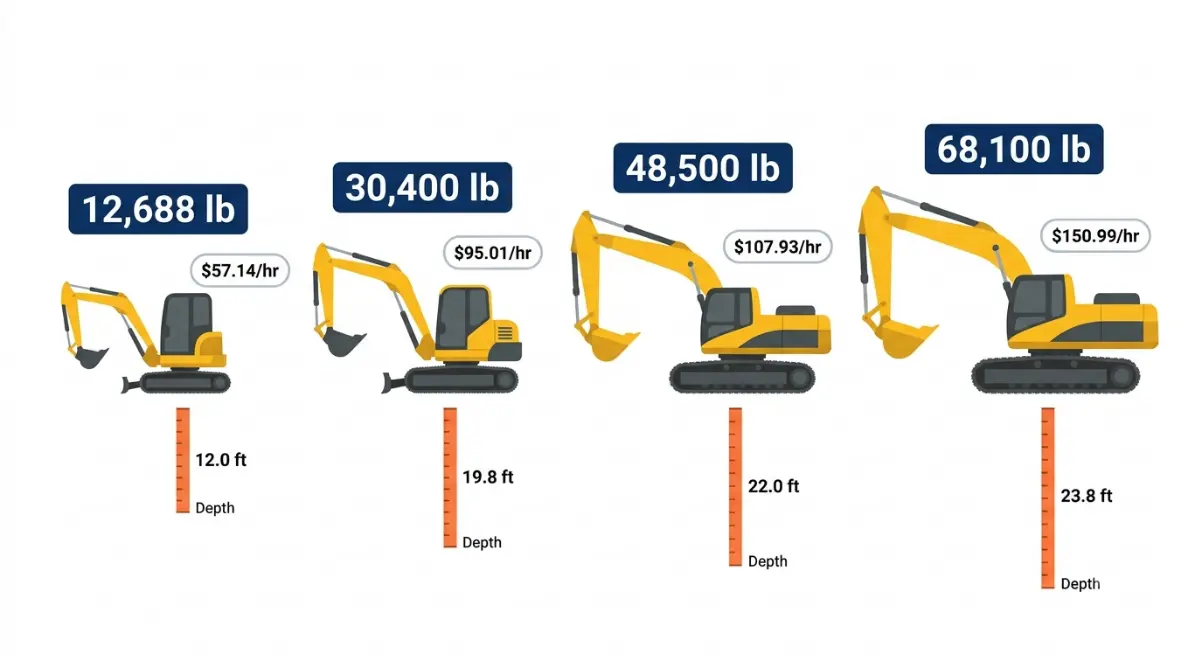
Table of Contents
Rates and sources checked on October 23, 2026.
Tracked excavators in the common contractor range weigh from 12,688 lb for a Cat 305 CR to 68,100 lb for a Cat 330 GC, and FEMA’s 2025 Schedule of Equipment Rates puts the cost to own and run those machines at $57.14 to $150.99 an hour, with no operator. To rent instead, the excavator bids Maine DOT opened in March 2025 ran from $2,500 a month for an 8,807 lb machine to $9,500 a month for a 79,807 lb one, delivered and without an operator.
Those two sets of numbers measure different things. FEMA’s rate includes fuel and repair costs, while the Maine bid tab prices the machine alone and is silent on fuel and wear. The class you need comes first, because it decides which row of each table is yours.
Excavator size classes by operating weight
Operating weight is the machine as configured to work, and it’s the figure makers and rental yards sort excavators by. Cat’s current US models give four reference points from about 12,700 to 68,100 lb.
| Cat model, Tier 4 Final | Operating weight, lb (kg) | Net power, hp | Max dig depth | Applies to |
|---|---|---|---|---|
| 305 CR | 12,688 (5,754) | 45 | 144.5 in (12 ft 0.5 in) | Weight with cab; depth from Cat’s build page for the canopy, straight-blade unit |
| 313 GC | 30,400 (13,800) | 73 | 19.8 ft (6,040 mm) | 15 ft 3 in reach boom, 9 ft 8 in stick |
| 320 GC | 48,500 (22,000) | 146 | 22 ft (6,720 mm) | Configuration not stated on Cat’s page |
| 330 GC | 68,100 (30,900) | 201 | 23.8 ft (7,260 mm) | Configuration not stated on Cat’s page |
Source: Cat US product pages for the 305 CR, 313 GC, 320 GC and 330 GC, and Cat’s 305 CR build page.
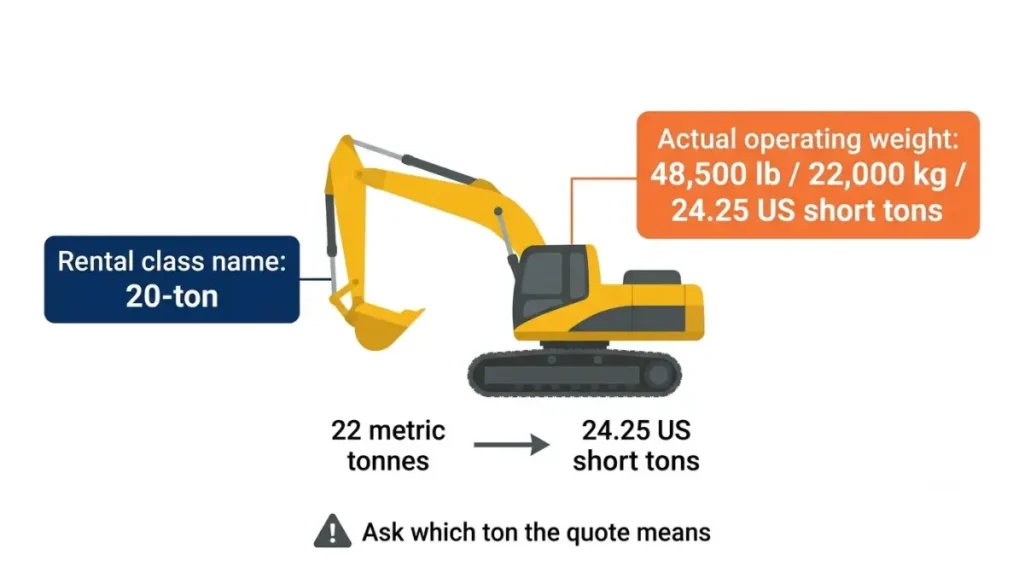
A “20-ton” machine in a rental quote is a class name, and the weight behind it moves. Cat’s 320 GC comes to 22 metric tonnes on Cat’s own kilogram figure, which is 24.25 US short tons. Ask which weight a quote means before you compare two of them.
Boom, stick, counterweight, cab and track shoes all change weight and depth, so the spec sheet for your machine’s configuration and serial number governs over any figure here.
What size excavator does your dig depth call for?
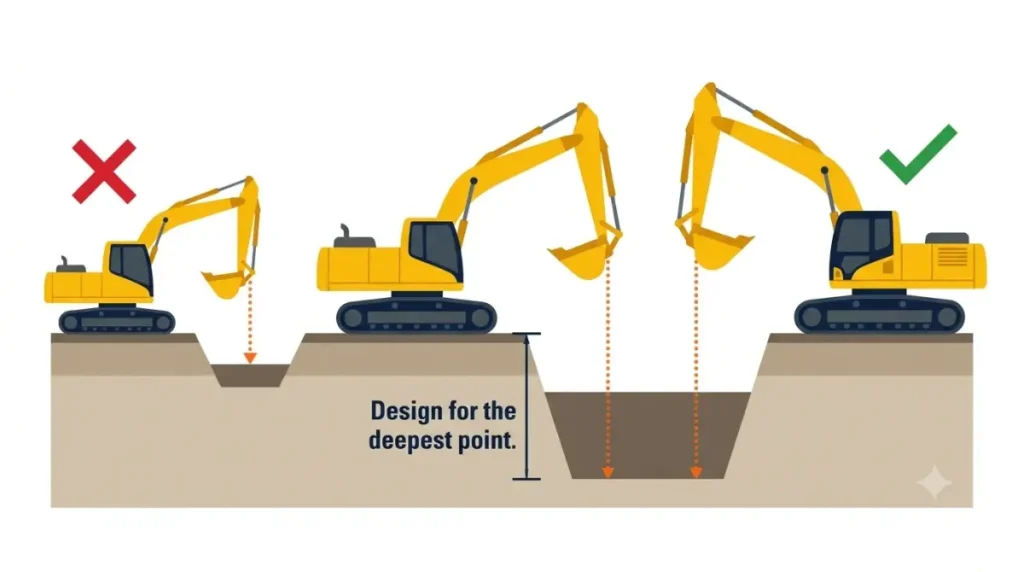
Pick the lightest class whose listed depth reaches below the deepest point on your job. Cat’s own figures show how quickly the depth gained per pound falls off: going from the 313 GC to the 320 GC adds about 2.2 ft of depth for 18,100 lb more machine, and stepping up again to the 330 GC adds 1.8 ft for another 19,600 lb.
Depth is one input among several. Gate width and the heaviest thing you’ll lift also push the class up or down, and neither shows in a depth column.
This page gives no lifting or trench-wall technique. Lift limits come from the load chart for your machine and configuration, and a trench belongs to the competent person OSHA’s excavation standard, 29 CFR 1926.651, requires to inspect it before work starts each day and after every rainstorm.
Hazard: A bucket tooth through a buried gas or electric line can kill the operator or anyone standing near the cut, whatever the machine’s size. OSHA requires the estimated location of underground utilities to be determined before an excavation is opened, so call 811 and wait for the marks before any class of machine breaks ground. See who files the 811 locate request before digging.
Rental rates by class from Maine DOT’s 2025 bids
One bidder priced seven Doosan excavators for all five Maine DOT regions, delivered, operator not included, in the bid opening on March 5, 2025.
| Doosan model (2021–2023), coupler and two buckets | Operating weight, lb | Day, USD | Week, USD | Month, USD |
|---|---|---|---|---|
| 2023 DX35Z-7 | 8,807 | 425 | 975 | 2,500 |
| 2022 DX50Z-7 | 11,000 | 475 | 1,250 | 3,050 |
| 2023 DX89R-7 | 21,025 | 575 | 1,400 | 3,600 |
| 2023 DX140LCR-7 | 33,951 | 650 | 1,600 | 4,750 |
| 2023 DX225LC-7 | 52,690 | 850 | 2,300 | 6,200 |
| 2021 DX300-7 | 69,446 | 1,250 | 2,800 | 8,000 |
| 2023 DX350LCR-7 | 79,807 | 1,500 | 3,300 | 9,500 |
Source: Maine DOT bid tabulation PH20250212EXO, equipment rental without operator, delivered by contractor, all regions, bids opened March 5, 2025. The four smallest units were bid with a thumb and dozer blade.
A second bidder priced a John Deere and Hitachi line for the same five regions, from $350 a day for an 8,000 lb unit to $1,700 a day for an 80,000 lb JD 345/350. Near 50,000 lb the two lines sit within $50 a day of each other.
Every price on the tab was offered to one public buyer in one state. A homeowner renting a single week, or a contractor in Ohio, starts from a different counter, and the tab can’t say how different.
What does delivery add to a bid?
Some bidders priced the same machine twice, once delivered by the contractor and once picked up by Maine DOT. On a 2020 JCB 220X bid in Region 1 (46,300 to 65,000 lb), the delivered price ran $778 higher at both the weekly and the monthly rate, with the week at $3,528 delivered against $2,750 picked up. The tab gives no breakdown of that charge.
FEMA prices each class by the hour, operator excluded
Depreciation, overhead, maintenance, field repairs, fuel, lubricants and tires all sit inside each FEMA equipment rate, as FEMA’s Schedule of Equipment Rates listing on Data.gov sets out. The operator’s wages are outside it, standby time isn’t eligible, and the 2025 rates apply to disasters the President declared on or after July 1, 2025.
| FEMA cost code | Model as FEMA lists it | FEMA hp band | USD per hour, 2025 schedule, no operator, bucket included |
|---|---|---|---|
| 8280 | Caterpillar 305 CR | to 45 | 57.14 |
| 8281 | Caterpillar 313 GC | to 90 | 95.01 |
| 8282 | Caterpillar 320 GC | to 150 | 107.93 |
| 8283 | Caterpillar 330 GC | to 201 | 150.99 |
Source: FEMA 2025 Schedule of Equipment Rates, hydraulic excavator rows.
The hourly cost climbs slower than the weight. On Cat’s weights from the class table, the 330 GC is 5.4 times heavier than the 305 CR and costs 2.6 times as much an hour, which works out to $4.50 an hour per 1,000 lb of operating weight for the 305 CR and $2.22 for the 330 GC.
FEMA doesn’t split its rates by emissions era, and Cat lists all four current models as Tier 4 Final. The schedule exists to reimburse applicants after a declared disaster, which is why it’s dated and public; for how it works as a pricing yardstick, see FEMA equipment rates as a benchmark.
Is a month of rental cheaper per hour than owning?
Divide a monthly bid by 176 hours, which assumes 22 working days of 8 hours, and it turns into a rental-only hourly figure.
| Doosan model, Maine DOT bid | Monthly bid ÷ 176, USD per hour, rental only | Cat model in FEMA’s table within 4,500 lb |
|---|---|---|
| DX35Z-7 | 14.20 | 305 CR |
| DX50Z-7 | 17.33 | 305 CR |
| DX89R-7 | 20.45 | None within 4,500 lb |
| DX140LCR-7 | 26.99 | 313 GC |
| DX225LC-7 | 35.23 | 320 GC |
| DX300-7 | 45.45 | 330 GC |
| DX350LCR-7 | 53.98 | None within 4,500 lb |
Worked out from the Maine DOT monthly bids above; the 176-hour month is this page’s assumption, so swap in your own hours.
Set each paired rental figure against FEMA’s rate for the matching Cat and the rental comes to 25% to 33% of the owning-and-operating hour. That share leaves out what FEMA’s rate carries. Fuel, repairs and tires sit inside the FEMA hour, the Maine tab is silent on all three, and your diesel and whatever wear the rental contract bills you come on top.
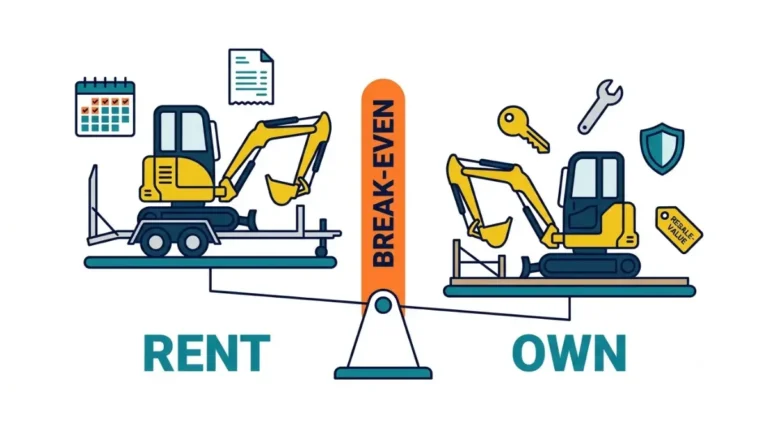
The 176 hours do as much work as the price. Bill 88 hours in that month and the same DX225LC-7 bid comes to $70.45 an hour, double the figure in the table. Where renting stops beating owning for your yearly hours is the question the rent-vs-buy break-even for excavators works through.
Charges outside a posted class rate
Delivery is the extra the bid tab shows most plainly, through the JCB gap between delivered and picked-up prices. Moving a machine to the job and back, and the smallest job a contractor will bill, are priced in excavator mobilization fees and minimum charges. If you’re weighing a used machine against these rental rates, used 20-tonne-class excavator prices by hours starts where renting leaves off.
Check your dig depth and yearly hours before you call a yard
Two inputs settle most of this page before any quote: the deepest point you need to reach and the machine hours you expect to run in a year. Depth picks the class from Cat’s figures. Hours decide whether a monthly rental or an owned machine’s FEMA-style cost sits closer to what you’ll pay; if you’re pricing operated work for someone else, mini excavator hourly rates with an operator covers the other side of the counter.