A Clear Look at Excavator Undercarriage Replacement Cost by Size

Excavator undercarriage quotes split wide: one 2026 guide lists mid-size jobs at $13,000–$26,200 in its table and $20,000–$35,000 in its opening.
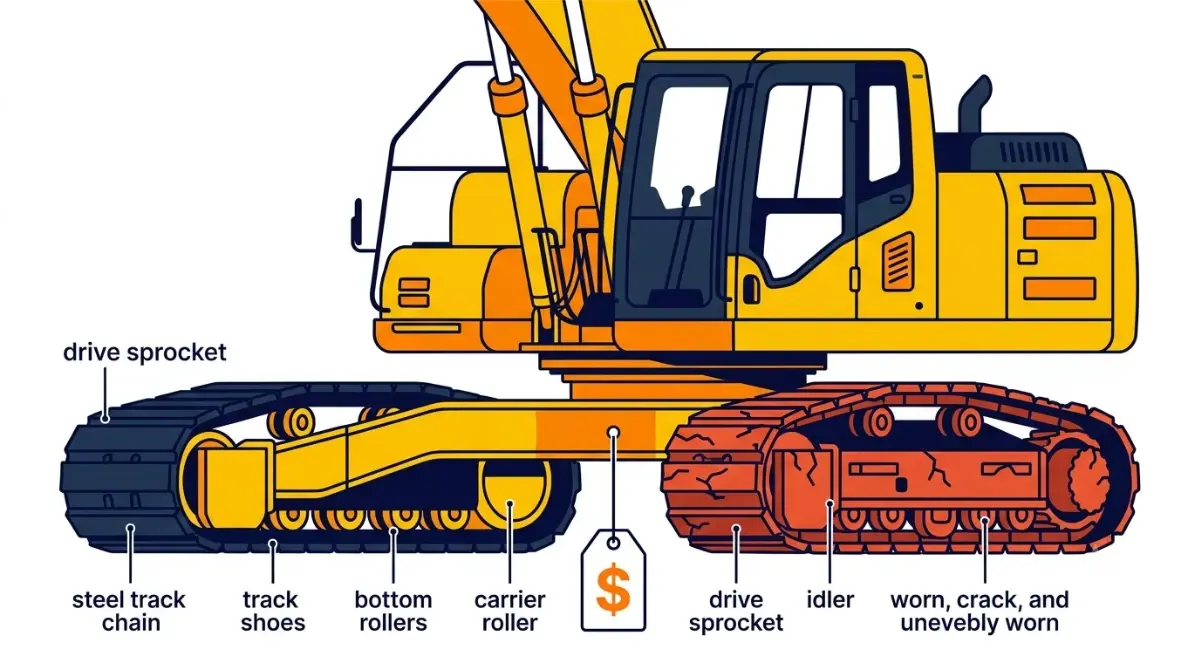
Table of Contents
Excavator undercarriage replacement cost: the short answer
A full excavator undercarriage replacement costs about $3,500–$7,900 on a mini and $24,700–$51,300 on a large machine, per EquipBook’s June 2026 guide.
What this guide covers
Tracked excavators of 1–40 metric tons, steel track and rubber-track minis, any model year, US shop prices. Emissions tier (pre-Tier 4, Interim or Final) doesn’t change the bill. Caterpillar’s undercarriage guidance puts undercarriage at an average 50% of owning and operating cost; Cat sells undercarriage.
Start here: quote in hand, buying used, or planning ahead
- Quote in hand: check the size table, then the tracks-only rules.
- Buying used: read the worth-it section first.
- Planning ahead: see why quotes differ.
💵 About These Numbers: Prices come from EquipBook guides published June 26 and July 30, 2026, and its model pages, accessed October 16, 2026; EquipBook states no method. Quotes vary with region, parts brand, ground and damage found.
ℹ️ Safety Note: Track adjusters hold grease under high pressure that can cause an injection injury. Follow your operator’s manual and have a qualified technician do track tension work.
What a full undercarriage job includes
A full job replaces every wearing part under the machine at once.
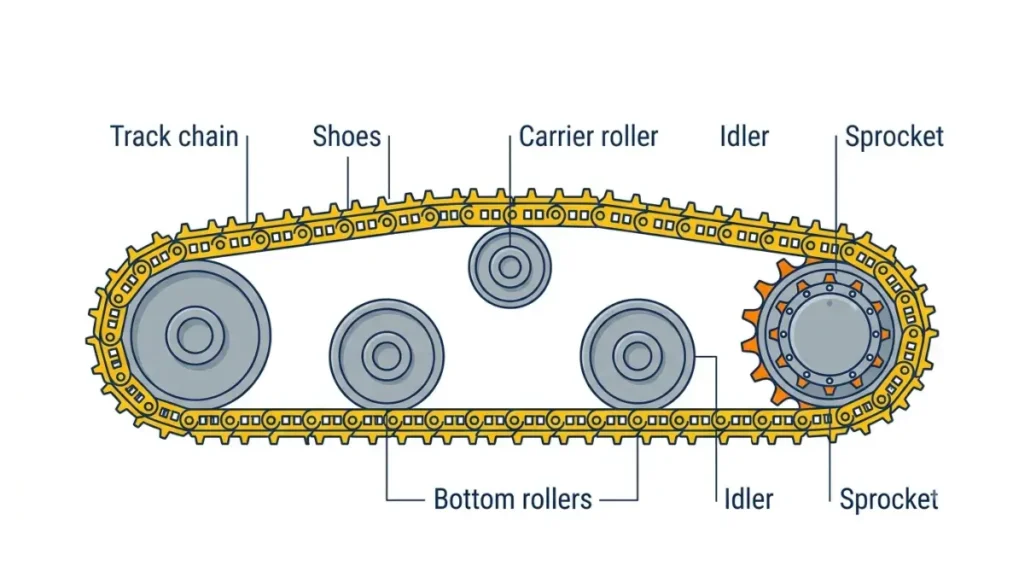
The parts that wear: chain, shoes, rollers, idlers, sprockets
- Track chain and shoes: links, pins, bushings and the plates that grip.
- Rollers: bottom rollers carry the weight; carrier rollers hold the top run.
- Idlers and sprockets: idlers guide the front; sprockets drive the rear.
Steel track vs rubber track minis
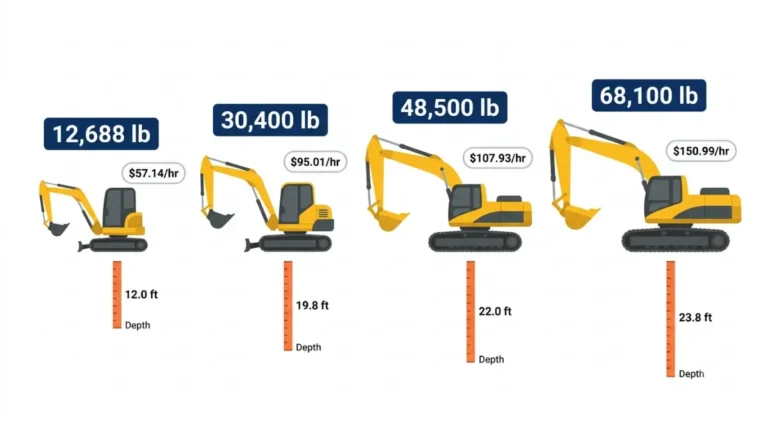
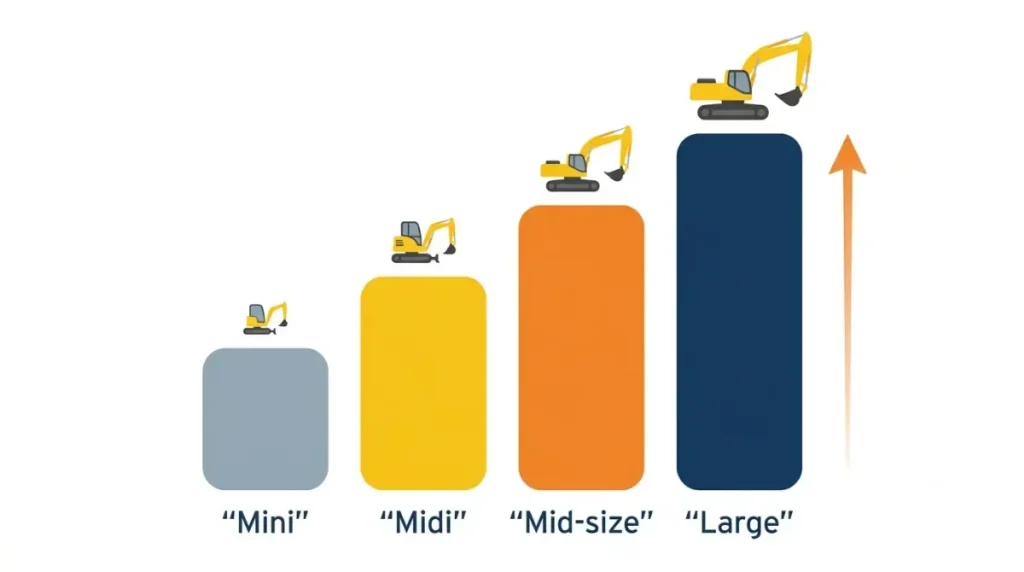
Most minis run rubber tracks; Caterpillar lists them for its 300–310 models. Bigger machines run steel chain, where the money sits. Prices below follow the four excavator size bands from our size guide; your parts book and serial range list your exact components.
Undercarriage replacement cost by excavator size
A full undercarriage replacement runs $3,500–$7,900 on a mini and $13,000–$26,200 on a mid-size machine in EquipBook’s June 2026 table.
Full replacement cost by size band
| Size band | Labor hours | Labor at $125–$175/hr* | Parts | Total |
|---|---|---|---|---|
| Mini, under 6 t | 8–14 | $1,000–$2,450 | $2,500–$5,500 | $3,500–$7,900 |
| Midi, 6–13 t | 12–18 | $1,500–$3,150 | $5,000–$10,000 | $6,500–$13,200 |
| Mid-size, 13–25 t | 16–24 | $2,000–$4,200 | $11,000–$22,000 | $13,000–$26,200 |
| Large, 25–45 t | 22–36 | $2,750–$6,300 | $22,000–$45,000 | $24,700–$51,300 |
Source: EquipBook, June 26, 2026. *Our arithmetic: its hours × its stated Southeast rate. Its large band runs to 45 t.
Labor vs parts: the arithmetic
At the top of each range, labor is about a third of a mini job and an eighth of a large one. On big machines, the parts brand moves the quote more than the shop rate.
Why one source gives two answers
📉 Cost Reality: EquipBook’s table gives mid-size machines $13,000–$26,200, but the same page’s opening says $20,000–$35,000. Its Volvo EC220E page gives $8,550–$52,000 and calls itself a static estimate. Source: EquipBook, June 2026 guide and model page, accessed October 16, 2026.
Method: we mapped EquipBook’s ranges onto our size bands and computed labor from its hours and rate. We averaged nothing and observed no repairs.
Tracks only or full undercarriage: what you save
Tracks only runs roughly 50–60% of a full job in EquipBook’s June guide, while rollers and idlers still have life.
When tracks-only makes sense
EquipBook treats tracks-only as reasonable when rollers and idlers measure 60% or better. Its July mini guide puts an installed rubber track set at $1,200–$3,800 for 3.5–8 ton machines.
When to do it all at once
The June guide recommends full replacement once any major component drops below 30% of its life.
🔍 Why It Happens: New chain on worn sprockets wears faster, and a second teardown a few hundred hours later can erase the partial job’s savings.
Those are one publisher’s rules of thumb; your manual’s wear limits for your serial range govern.
✅ Do This: Get a written measurement of each component against the manufacturer’s limits before choosing full or partial.
Why two undercarriage quotes for the same machine differ
Two shops can quote one machine thousands apart, mostly over parts.
OEM vs aftermarket parts
EquipBook says quality aftermarket undercarriage costs 20–35% less than OEM. A cheaper set that wears out proportionally faster costs the same per hour, so compare installed cost divided by expected hours.
Ground, habits and the hours you’ll actually get
EquipBook reports limestone work wears undercarriage 30–50% faster than clay, and spin turns add wear. We found no verified hour-life figure, so get the shop’s expected hours in writing.
Is a new undercarriage worth it on your excavator?
Compare the quote to the machine’s value and to other repairs coming due.
Compare the bill to what the machine is worth
EquipBook’s example: a $20,000 undercarriage on a $45,000, 5,000-hour machine is usually worth it; on an $18,000, 9,000-hour machine with an engine due, it’s harder. If the quote nears resale value, check used 20-ton excavator prices; selling as-is may cost less.
Cat’s excavator undercarriage page claims its service agreements add up to 20% more life; ask a dealer to price that against your hours.
Buying used: measure before you bid
What hours do and don’t tell you on a used excavator explains why the meter isn’t enough. Get a written measurement and subtract near-limit parts from your offer. If the seller refuses, walk away.
Track tension work belongs to a technician
Track adjusters hold high-pressure grease, so don’t save labor here.
Why track adjusters are dangerous
Escaping grease can penetrate skin, and an injection injury can need surgery or kill. Our guide on why track adjusters should be left to a technician covers the safety bulletins.
What to ask the shop instead
🔧 Stop Here: Don’t loosen any track adjuster fitting yourself. Ask the dealer service department or a qualified equipment technician to set tension per your operator’s manual and confirm the relief path is clear.
Excavator undercarriage replacement cost: quick answers
1. What does an excavator undercarriage cost?
Excavator undercarriage replacement cost runs about $3,500–$7,900 for a mini and $24,700–$51,300 for a large machine (EquipBook, 2026).
2. What does a mini excavator undercarriage cost?
A full mini excavator undercarriage runs $3,500–$7,900 installed; a rubber track set alone runs $1,200–$3,800, per EquipBook.
3. What about a 20-ton excavator undercarriage?
A 20-ton excavator undercarriage sits in EquipBook’s $13,000–$26,200 mid-size band, though its opening says $20,000–$35,000.
4. Is replacing only the tracks cheaper?
Replacing only the tracks costs roughly 50–60% of a full job, if rollers and idlers measure 60% or better.
5. When should an undercarriage be replaced?
One guide says replace the full undercarriage when any major component drops below 30% life, per your manual’s limits.
6. How much operating cost is undercarriage?
Caterpillar says undercarriage averages 50% of owning and operating cost; Cat sells undercarriage, so treat it as a manufacturer figure.
7. Are aftermarket undercarriage parts worth it?
Aftermarket undercarriage parts cost 20–35% less than OEM in one guide; compare installed cost divided by expected hours.
8. How long does an undercarriage last?
We found no verified hour-life figure for excavator undercarriage; get a written measurement and expected hours from your shop.
9. Is a new undercarriage worth it on an old excavator?
A new undercarriage is worth it when the quote sits well below resale value and no major repair is due.
10. Can I adjust track tension myself?
No. Excavator track adjusters hold high-pressure grease that can cause a serious injection injury. Have a qualified technician adjust tension per your manual.
Before you sign an undercarriage quote
Get a written measurement of each component against the manufacturer’s limits. Check the quote against your size band and ask which parts brand it assumes. Then compare the total to resale value before approving.