Common Excavator DPF Regen Problems on Tier 4 Machines

Excavator DPF regens burn soot, never ash. The Komatsu PC290LC-11 pairs its KDPF with SCR; a Cat 320 asks nothing of the operator at all.
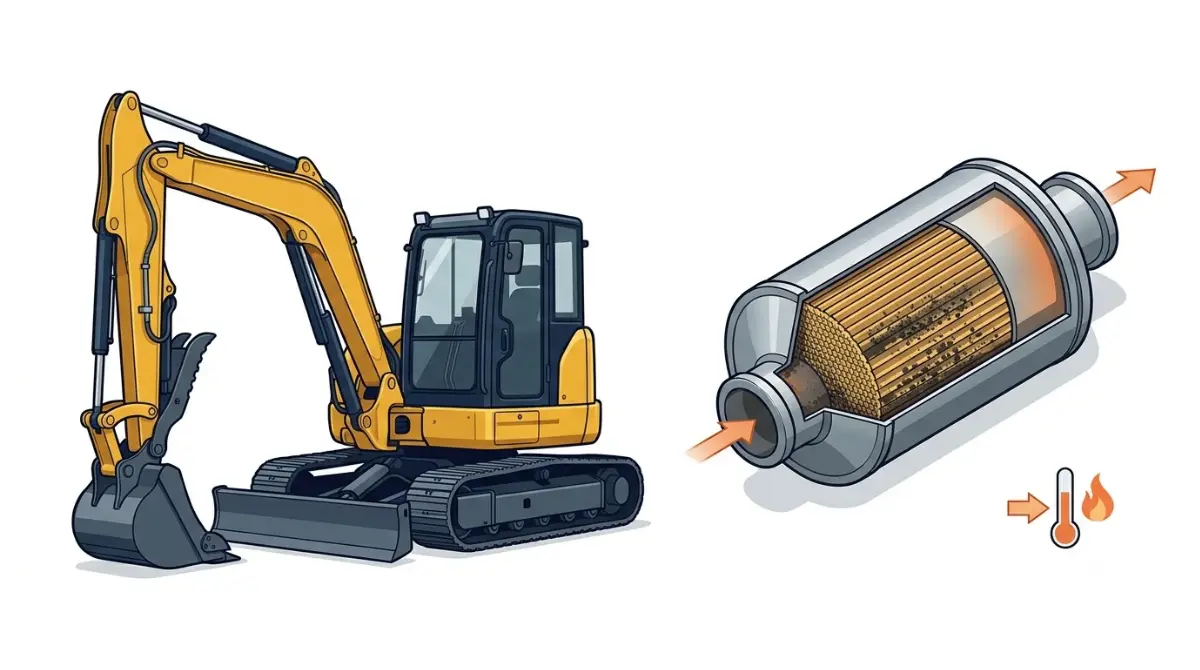
Table of Contents
Sources checked on October 28, 2026.
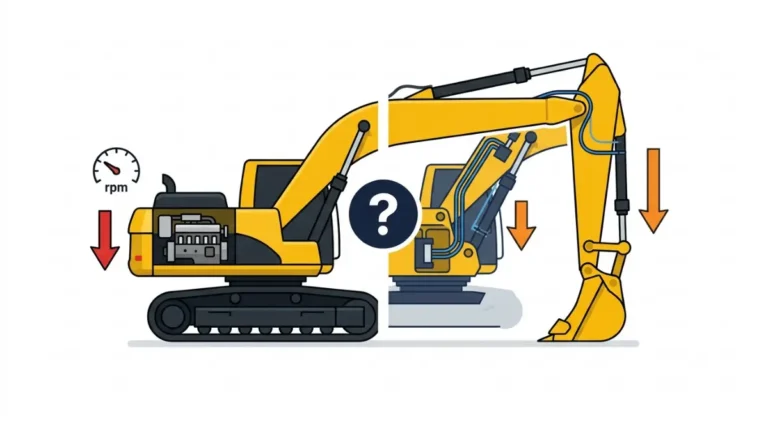
A Tier 4 excavator that keeps asking for a regen is reacting to how much soot reaches its filter and how hot the exhaust runs: long idling, light digging and regens that were inhibited or cut short all add to the load, and ash from burned oil stays in the filter no matter how many regens run. A regen that won’t finish or a stop-engine lamp is dealer work, so first confirm your machine has a diesel particulate filter (DPF) at all, because some Tier 4 Final compacts have none.
Does your excavator even have a DPF?
Deere’s 17G, 26G and 30G compacts meet Final Tier 4 with no aftertreatment device on the engine, so there is nothing on them to regenerate. Bigger engines are a different story, and the maker’s own literature says which hardware yours carries.
| Applies to (model, emissions era) | Engine (power where the maker lists it) | Exhaust hardware in the maker’s literature | What it means for regens |
|---|---|---|---|
| Deere 17G, 26G, 30G, Final Tier 4 | Yanmar 3TNV74F, 3TNV80F, 3TNV88F-EPHB; 14.5, 20.0 and 23 hp net (10.8, 14.9, 17.4 kW) | No aftertreatment devices | No regen system to troubleshoot |
| Deere 35G, Final Tier 4 | Yanmar 3TNV88F; 23.3 hp net (17.4 kW) | Muffler only; aftertreatment is listed for the 50G and 60G | No regen system to troubleshoot |
| Deere 50G, Final Tier 4 | Yanmar 4TNV88C; 35.9 hp net (26.8 kW) | Aftertreatment device, type not named in the spec sheet | The operator’s manual shows its regen controls |
| Kubota KX040-4, Tier 4 | Kubota D1803-CR-TE4; 40.4 hp gross | DPF muffler with automatic regeneration and an inhibit switch | Regenerates on its own while you work |
| Komatsu PC290LC-11, serial A27001 and up | Komatsu 6D107E-3 | Komatsu particulate filter (KDPF) plus SCR | Regenerates; the manual sets the operator’s part |
| Cat 320 (Next Generation), Tier 4 Final | Cat C4.4; 172 hp net (128.5 kW) | Aftertreatment described as needing no operator input or downtime | No regen step for the operator |
Sources: Deere G-Series compact brochure DKAGZTSCCE, 35G spec sheet, 50G spec sheet and Spanish-language G-Series brochure; Kubota USA KX040-4 brochure and Kubota Australia KX040-4 spec page; Komatsu PC290LC-11 operation and maintenance manual, copy hosted on ManualsLib; Cat 320 product page and 320 brochure AEXQ2329-06.
The split tracks federal particulate limits. According to EPA’s nonroad diesel standards table, Tier 4 Final allows 0.40 g/kWh of particulate matter below 19 kW (25 hp) and 0.03 g/kWh from 19 to 56 kW (75 hp). Every machine in the table at or above that line carries exhaust aftertreatment.
With no filter, a warning lamp is a fault code to read. A Cat 320 that loses power belongs with DEF and SCR derates on the Cat 320, and how emissions tiers line up with excavator size classes is in the size guide.
Same regen modes, different names by brand
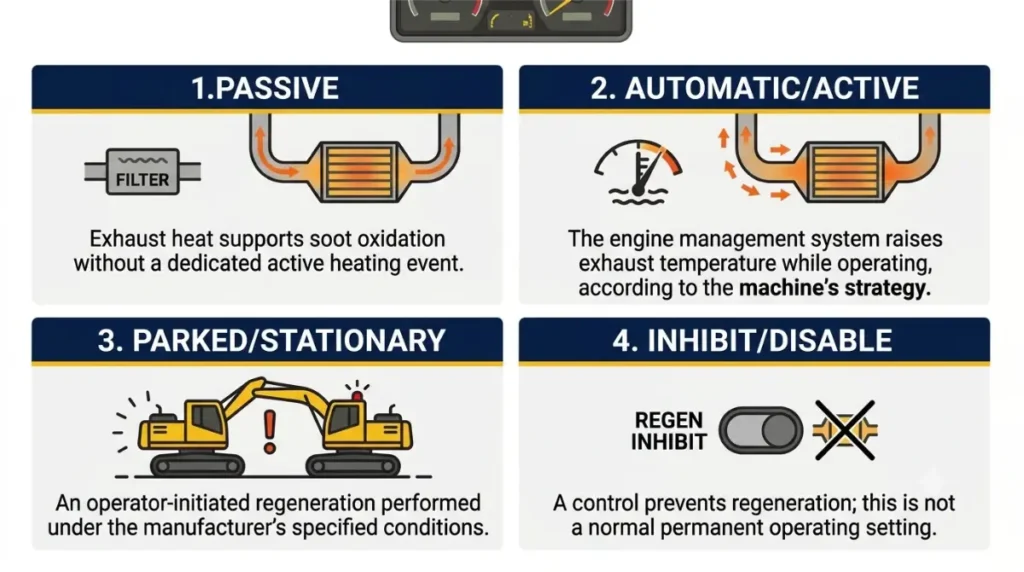
The lamp or message on your display tells you which of four states the exhaust system is in.
| State, with the names used in maker literature | What happens | Your part |
|---|---|---|
| Passive | Exhaust runs hot enough to burn soot with no added fuel | Nothing |
| Automatic or active (Kubota: automatic regeneration) | The engine adds heat while you keep working | Keep working with the inhibit switch off |
| Parked or stationary (Komatsu: manual stationary regeneration) | You start the burn with the machine parked | Follow the conditions in your manual and stay with the machine |
| Inhibit or disable (Komatsu: KDPF regeneration disable) | Automatic regens are blocked | Only where hot exhaust is a fire risk |
Sources: EPA’s DPF operation and maintenance bulletin, Kubota USA’s KX040-4 brochure, the Komatsu PC290LC-10 manual’s contents, and Cummins Tier 4 engine operating tips, Bulletin 4087187.
That last row is where many repeat requests begin. Cummins says the inhibit switch belongs only where high exhaust temperature is a hazard, and that overusing it ends with the filter needing service or replacement. Kubota fits the KX040-4’s switch for work in fire-prone areas.
Light days and cut-short regens fill the filter faster
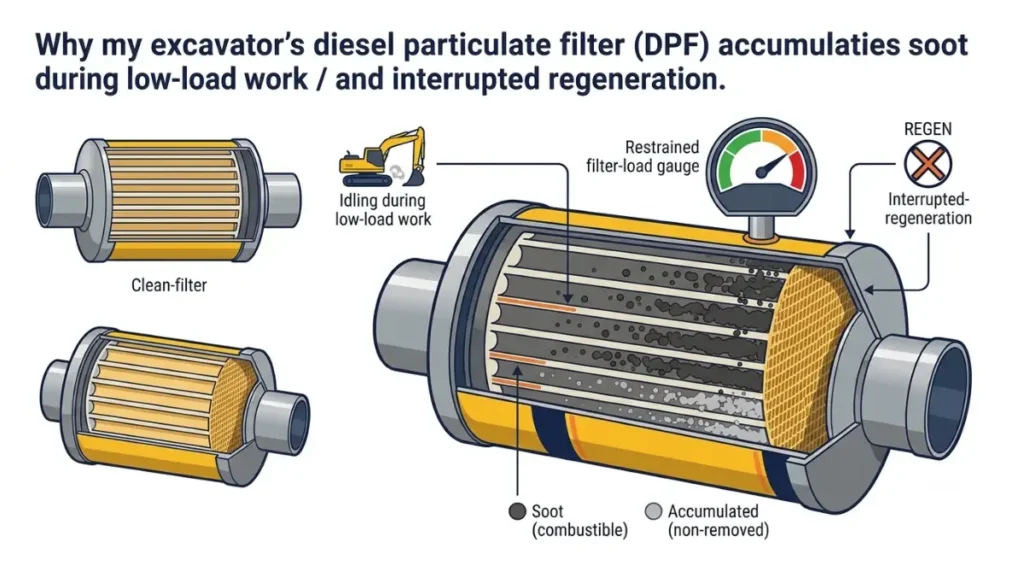
Passive regeneration needs exhaust hot enough to burn soot without help. How often a filter regenerates is set by the engine’s duty cycle and soot output, among other factors, in the EPA bulletin above. Long idling between trucks and light work at low throttle give the exhaust fewer chances to reach that heat, which hands more of the job to active and parked regens.
Interrupted and inhibited regens add to it. On Cummins Tier 4 engines, the DPF lamp comes on when the filter starts to overfill because the system could not run an automatic regen.
Ash is the part no regen fixes. Burning soot leaves ash from lube oil and fuel additives behind, and it only comes out when the filter is cleaned. The cleaning interval and its cost per hour are worked out in what DPF cleaning and replacement add to Tier 4 operating costs.
A failing injector or rising oil consumption can hide behind a DPF, and a filter that needs cleaning more often than it used to calls for engine diagnostics under the same EPA bulletin. Cummins requires low-ash API CJ-4 oil in its Tier 4 engines to protect the ash interval.
The check order, cheapest step first
Stop after step 5. Everything past it needs dealer software or work inside a hot exhaust system.
- Read the exact lamp or message and note whether it is steady or flashing. On Cummins Tier 4 engines a flashing DPF lamp means the filter is nearly full and power may drop.
- Make sure the inhibit or disable switch is off.
- If an automatic regen is running, keep working at the engine speed the operator’s manual asks for until it finishes.
- If the display asks for a parked or stationary regen, run it only under the conditions your manual lists, with the machine parked where it says.
- Write down engine hours, the date of the last completed regen, the oil level and the oil grade in the engine.
Hazard: A parked regen pushes exhaust hot enough to ignite dry grass or brush near the outlet, so park with the outlet aimed at bare ground. Exhaust surfaces stay hot for 3 to 5 minutes after a stationary regen ends on Cummins Tier 4 engines, and the PC290LC-11 manual covers regeneration heat in its fire-prevention pages.
Forcing a regen with diagnostic software, resetting soot or ash readings, clearing sensor lines, and pulling or cleaning the filter are jobs for a dealer technician with the maker’s service tools.
When does the dealer take over?
Three signs end the owner’s part: a regen that will not finish, power that stays cut after it, and a stop-engine lamp. A stop-engine lamp on a Cummins Tier 4 engine means shutting down as soon as it is safe and calling for service before the filter is damaged.
Codes come first. Help reading them is in Cat CID and FMI fault codes and Komatsu excavator error codes. When you call, ask the dealer service department what the stored soot and ash readings show, and whether your serial number has a pending engine software update.
Before you sign: Ask whether the repair falls inside the emissions warranty. Federal rules set a minimum of 3,000 hours or five years, whichever comes first, for variable-speed engines of 19 kW (25 hp) and up, and a claim can be denied where improper maintenance or use caused the problem (40 CFR 1039.120). Get the findings and the price in writing first.
Removing or disabling a DPF is prohibited for nonroad engines under 40 CFR 1068.101(b), as EPA’s tampering enforcement alert explains. EPA’s tampering policy applies that ban for the machine’s whole life, warranty or not. Tampering can also void manufacturer warranties and insurance agreements, per EPA’s 2019 tampering briefing.
Log the stage, hours and last regen, then call
Before booking the service visit, write down five things: the exact message or lamp, engine hours, the date of the last completed regen, how much of the day the machine idles, and the oil grade in the engine. Give the service department those five facts with your serial number.