Cat Excavator Fault Codes: What Each Number Tells You

Cat code meanings sit in paid troubleshooting guides, while the operator manuals that set Warning Category 3 as a shutdown are free in SIS2GO.
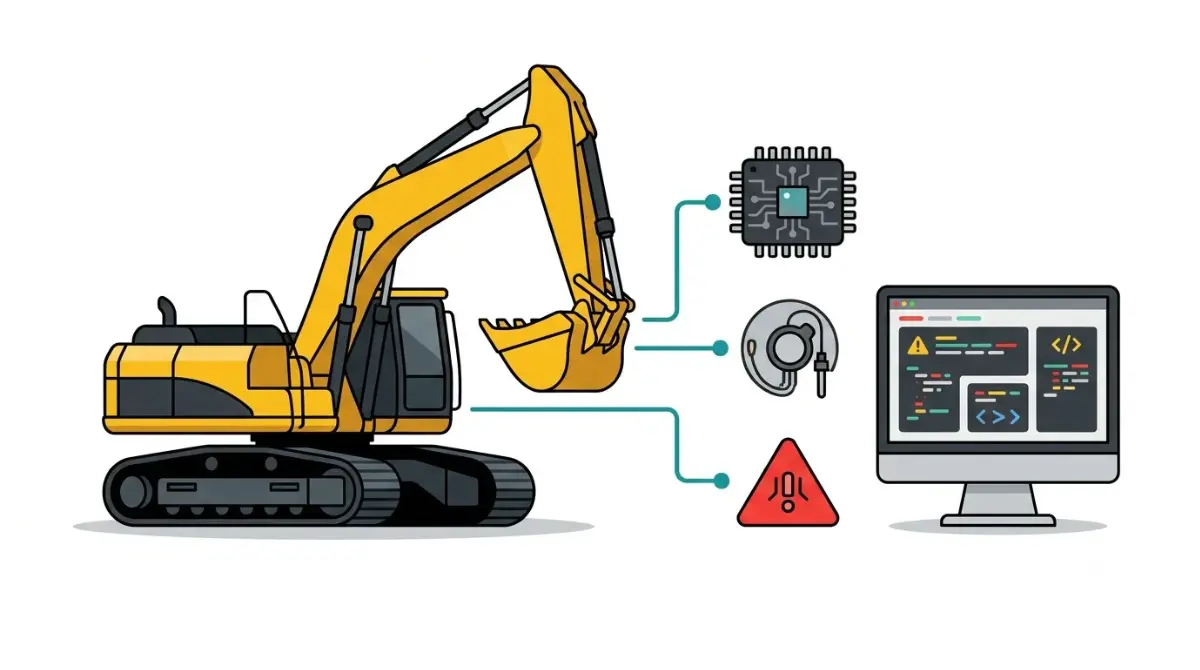
Table of Contents
Codes and sources checked on October 27, 2026.
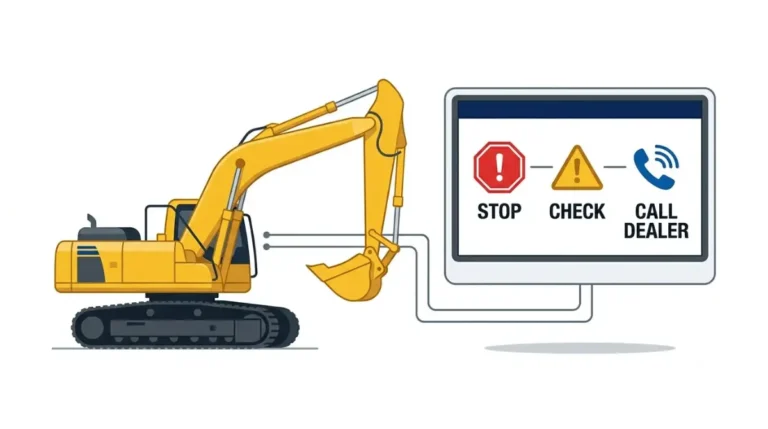
A Cat excavator diagnostic code names three things: the control module that logged the fault, the component or circuit involved, and the way the signal failed. Whether the machine keeps working is set by the warning category on the monitor, and Cat’s manuals put Warning Category 3 at an immediate engine shutdown.
This applies to Cat’s medium hydraulic excavators in the 320 to 336 families, from the D-series through the F-series, Next Gen and GC models. Cat files each manual by serial prefix, such as HEX 1-UP for one production run of the 320, so every code lookup starts with the prefix on your identification plate.
Which format is on your screen?
Look at what sits in front of the last number. Cat machines report in three forms, and each one is looked up in a different list.
| Format on the monitor | What the first number names | Where its meaning is listed |
|---|---|---|
| MID: CID – FMI | The control module (MID), then the component (CID) | Cat’s diagnostic code list for that module and serial prefix |
| SPN – FMI | A parameter number from the SAE J1939 standard, shared across engine makers | Cat’s diagnostic code list; J1939 numbers also appear in other makers’ literature |
| E-code with a level | An event: the machine ran outside a set limit | Cat’s event code list, with the warning level |
Cat’s code lists sit in its troubleshooting guides, sold through the SIS2GO app’s subscription tier. J1939 parameter numbers are from a J1939 fault code reference filed with NHTSA.
SPN numbers are industry-wide. In that J1939 reference, SPN 168 is battery potential and SPN 639 is the primary J1939 network, the data line the modules use to talk to each other.
A CID is Cat’s own numbering, so its meaning comes from Cat’s list for the machine in front of you.
Module, component, failure mode
Read the code from left to right. The MID identifies which electronic control module logged the code, and the CID identifies the component or circuit that module was watching. The FMI comes last and describes how the signal failed.
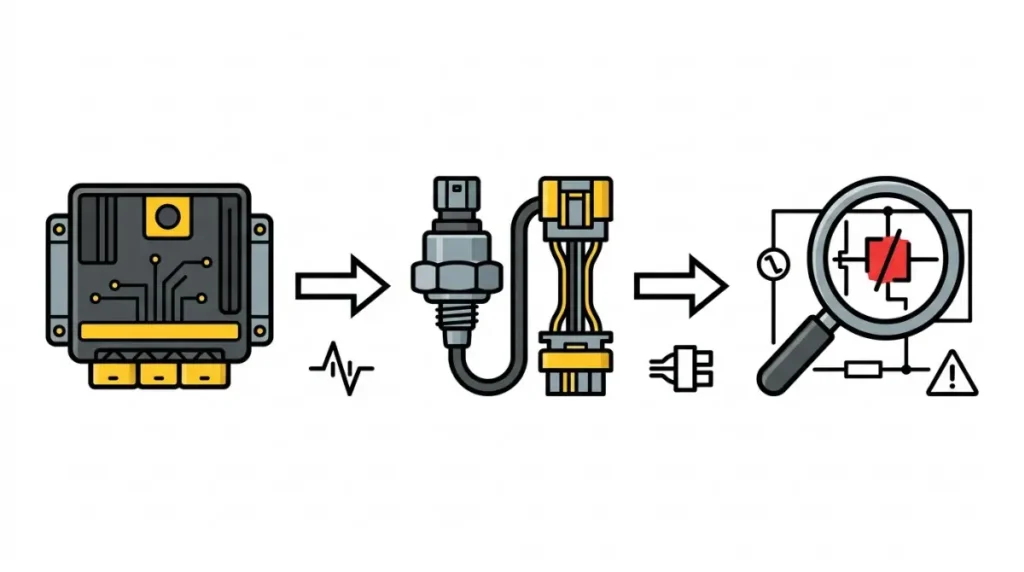
FMI numbers describe the signal
In the J1939 definitions, FMI 3 is voltage above normal or shorted to a high source, and FMI 4 is voltage below normal or shorted to a low source. FMI 5 is current below normal or an open circuit, and FMI 6 is current above normal or a grounded circuit. FMI 9 is an abnormal update rate: data from another module or a smart sensor did not arrive as often as the engine control module (ECM) expected.
Each of those describes what the module measured on a wire. A voltage or current fault can sit in the wiring or connector as easily as in the sensor, which makes ordering the part the CID names an expensive guess. FMI 9 points at the link between modules.
The guide for your serial prefix
Cat’s troubleshooting guide for your prefix gives the FMI definitions as your machine uses them, along with the test procedure tied to each code.
Warning Category 3 means shut the engine down
Two Cat Operation and Maintenance Manuals send the operator to their Monitoring System section for limiting conditions. One is for the 325F L (SEBU9320-10, June 2019). The other covers the 320 and 323, with 320 serial prefixes including HEX, KFE, MYK and YCP. Both describe Category 3 the same way: the engine is shut down immediately. Cat makes Operation and Maintenance Manuals free in the no-charge tier of its SIS2GO app.
The FMI number carries no shutdown instruction of its own. Your manual defines Categories 1 and 2 for your serial prefix.
Hazard: At Category 3, stop where it is safe, lower the bucket to the ground and shut the engine down as your manual’s Monitoring System section describes. A raised boom and stick are held up by hydraulic oil under pressure, and they can move if a line or fitting is disturbed while they are in the air.
Where Cat lists what your code means
A code list on a parts seller’s site is not tied to a serial prefix. Cat’s documents are, and the route you take decides what you pay.
| Route | What you get | Cost | Who uses it |
|---|---|---|---|
| SIS2GO app, no-charge tier | OMMs (operator manuals) and parts books | Free download and account | Owner |
| SIS2GO subscription | Troubleshooting guides, step-by-step repairs, hydraulic schematics | Monthly or annual subscription in the app | Owner or shop |
| SIS 2.0 | Full Cat service information; includes access to SIS2GO’s service manual content | Subscription sold by Cat dealers | Shop or fleet |
| Remote Troubleshoot | Diagnostic tests run on a connected machine while it works | Dealer service, offered by territory | Cat dealer technician |
Sources: Cat’s SIS2GO article, the SIS2GO listing in the Microsoft Store and Cat’s Remote Troubleshoot page. None of the three lists a subscription price.
The free tier covers the Monitoring System and the warning categories. The code-by-code meanings sit in the troubleshooting guides, which Cat sells through the subscription.
At the dealer, the code is read with Cat ET. Cat’s course overview for Cat ET describes it as the software needed to diagnose and service electronically controlled Cat machines. Remote Troubleshoot runs a dealer session on a connected machine, which must be powered on and can keep working during the session.
Five things to write down before a code is reset
Resetting a logged code removes it from the list a technician reads first. Write these down while it is still on the screen:
- The full code exactly as the monitor shows it, every digit and separator.
- Whether it is listed as active or logged.
- The warning category, if one is shown.
- Machine hours, what the machine was doing, and whether it was cold or at working temperature.
- The serial prefix from the identification plate.
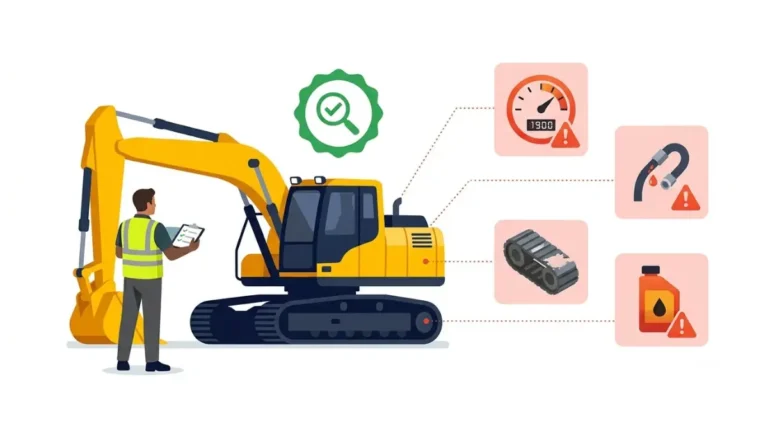
With the machine shut down and the bucket on the ground, an owner can look over three things, looking only: the battery terminals, the ground connections, and the connector at the component the CID names. OSHA’s equipment rule requires buckets and similar equipment to be fully lowered or blocked when being repaired, with controls in neutral, the motor stopped and brakes set.
Pressure testing, loosening any hydraulic fitting, work under a raised boom and anything on the exhaust aftertreatment belong to a Cat dealer technician. Ask the technician to pull active and logged codes and events, and to name the troubleshooting procedure they followed.
Deleting or bypassing emissions controls to stop a code is prohibited tampering under the Clean Air Act, including on nonroad engines.
A code that comes back after a reset
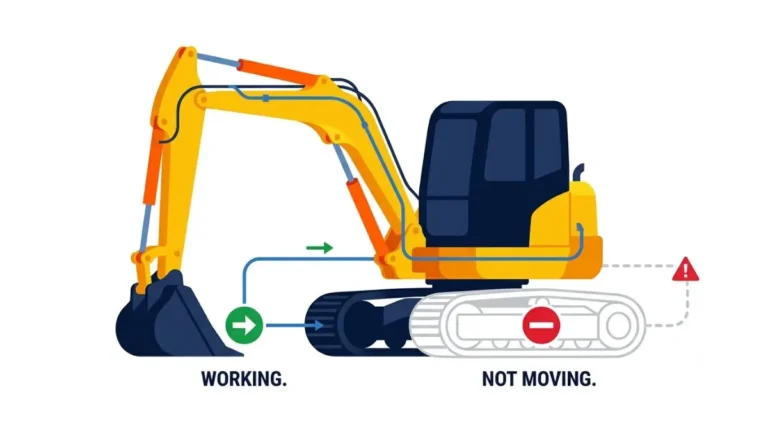
A code that returns as active means the condition that set it is still present, or comes and goes. Swapping the part the CID names on a repeat is the costly move. A log of each return, with hours and what the machine was doing, gives the dealer the pattern.
Derates and slow hydraulics on 320-series machines have their own check order in Cat 320 excavator problems by generation. Aftertreatment codes are covered in why excavator DPF regens keep coming back.
Logged history matters when you buy, too. Ask the seller for the machine’s logged codes and events, pulled by a Cat dealer, and set them beside the used excavator inspection checks to run before you bid.
Call the Cat dealer with the serial prefix ready
Read the dealer the five items in the order you wrote them. Then ask which troubleshooting procedure applies to that code on your prefix, and whether Remote Troubleshoot covers your machine.
Komatsu machines in the same fleet use their own codes, covered in Komatsu excavator error codes when the machine is down. Weigh the repair estimate against what each excavator size costs to rent or own.