Brush Hogging Rates by Job, Region, and Real Hourly Cost

Brush hogging rates swing nearly fourfold between pasture and brush in Iowa’s 2026 survey. Here’s what drives the gap and how to quote by acre or hour.
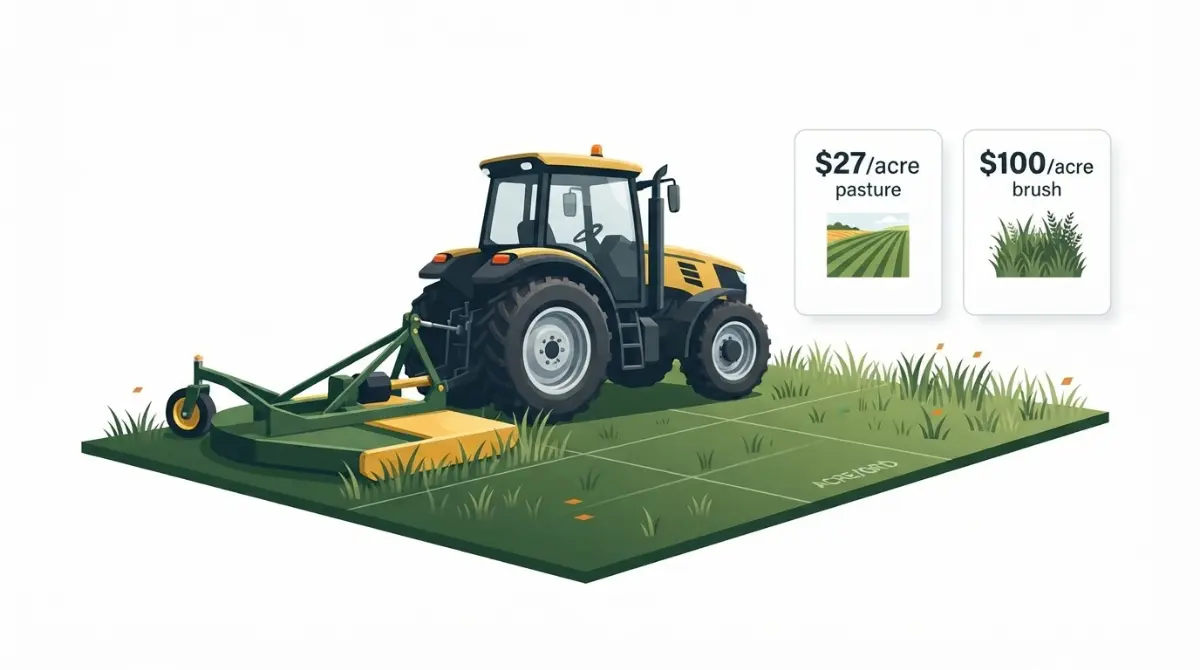
Table of Contents
What brush hogging costs right now: the short answer
This guide covers rotary cutters, the tractor-mounted “brush hogs” that come in 3-point or pull-type designs from single-spindle to batwing. The prices here come from 2025–26 US extension survey data and apply to tractors of any emissions era.
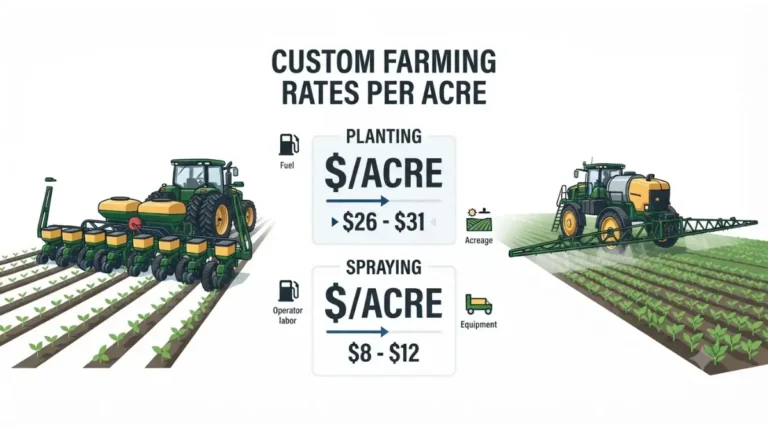
Iowa’s 2026 survey puts the median custom rate at $27 per acre for mowing pasture or CRP ground. It puts chopping brush at $100 per acre. (Bush Hog is a brand; “brush hogging” is simply what most people call the job.)
If you’re quoting a job
Start with the per-acre table below. Then build an hourly cost floor before you give anyone a number.
If you’re hiring someone
Use the table to sanity-check the quote you received. Then read why small or brushy jobs cost more. This article is part of our guide to equipment rates by machine.
ℹ️ Safety Note: Rotary cutters can throw rocks, wire, and debris with serious force, and the blades keep turning after the PTO is disengaged. Follow your cutter’s operator’s manual for guarding and bystander distance, and have an experienced operator handle steep or debris-heavy ground.
💵 About These Numbers: Rates come from the 2026 Iowa Farm Custom Rate Survey (sent February 2026), the 2026 Texas Agricultural Custom Rates survey (conducted August–October 2025), and Kansas Custom Rates 2026. Survey rates include tractor, fuel, and operator unless noted. Local rates vary with region, terrain, vegetation, and job size, so treat these as orientation, not a quote.
Brush hogging rates per acre: what the 2026 surveys show
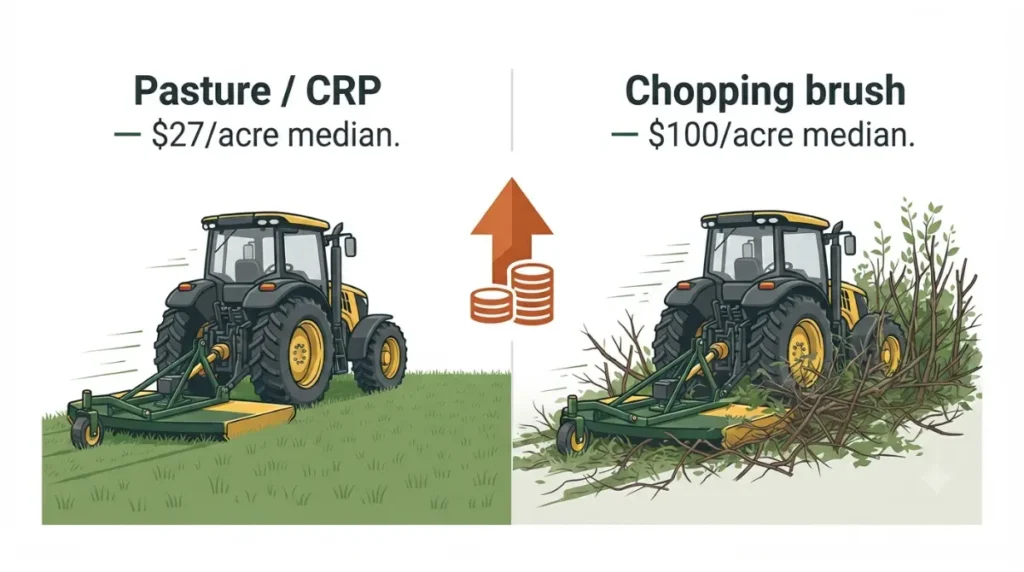
Brush hogging rates per acre depend first on what’s growing. Grass and weeds mow fast; woody brush does not.
| Job (survey label) | Rate | Statistic | What It Means |
|---|---|---|---|
| Iowa: mowing CRP or pasture | $27/acre (range $12–$50) | Median, 47 responses | Grass and weeds, open ground |
| Iowa: chopping brush | $100/acre (range $25–$200) | Median, 18 responses | Woody growth, slower passes |
| Texas: pasture shredding, statewide | $35/acre (average $46.73) | Most common, 45 responses | Full range $10–$175 |
Sources: ISU Ag Decision Maker File A3-10 (2026); Texas A&M AgriLife Extension, 2026 Texas Agricultural Custom Rates.
Grass and pasture vs. brush
The 2026 Iowa Farm Custom Rate Survey shows the brush median at nearly four times the pasture median. The Iowa ranges also leave out the single highest and lowest response, while Texas reports its full minimum and maximum. For that reason, the table labels which statistic each figure is rather than averaging across surveys.
How rates shift by region in Texas
Texas A&M AgriLife’s 2026 custom rates survey reports these regional averages for pasture shredding:
- East: $39.64 per acre
- South: $45.61 per acre
- North: $55.70 per acre
- West: $56.67 per acre, from only three responses, so treat it loosely
Brush hogging rates per hour, and how many acres you’ll cover
Many operators quote hourly rates because ground speed changes with every field.
What operators charge per hour
The Kansas Custom Rates 2026 report puts rotary mowing at an average of $134.72 per hour, up from $114.29 in 2024. In Iowa, mowing fence rows and ditches carries a $100 median, with most responses between $20 and $150.
The acres-per-hour formula
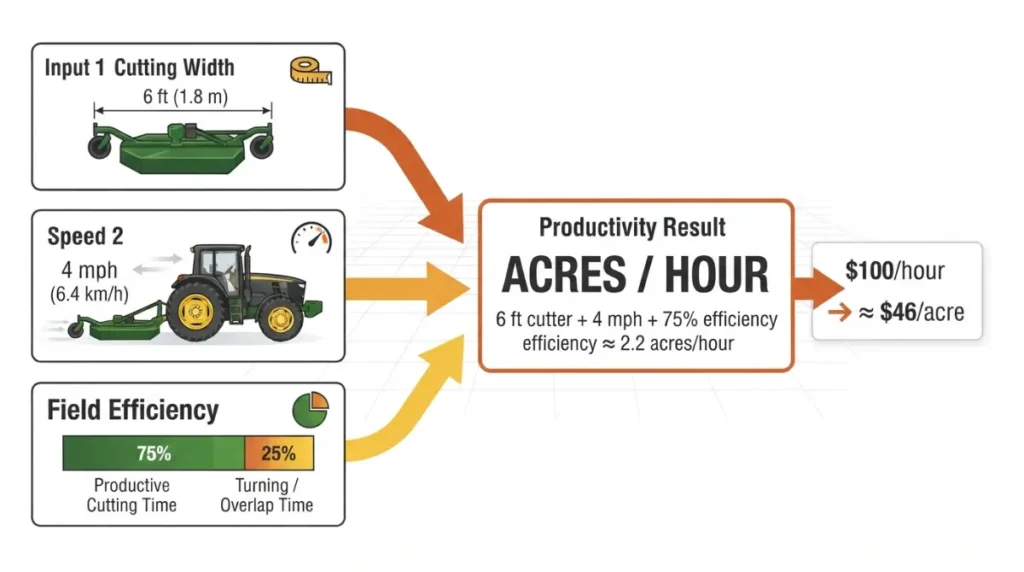
Iowa State’s field capacity guide uses this formula: acres per hour = cutting width (ft) × speed (mph) × field efficiency ÷ 8.25. Field efficiency is the share of time you’re actually cutting rather than turning or overlapping passes.
Here is an example with assumed inputs, not measured ones. A 6-foot cutter running at 4 mph and 75% efficiency covers about 2.2 acres per hour, so $100 per hour works out to roughly $46 per acre.
✅ Do This: Measure your real mowing speed rather than guessing it. Time how many seconds it takes to cover 88 feet, then divide 60 by that number to get mph. Plug the result into our acres-per-hour calculator. Your cutter’s operator’s manual governs the rated PTO speed.
Why one acre costs $27 and another costs $100+
The same field can double in price depending on what’s standing in it and what’s hidden beneath.
Vegetation, stems, and ground speed
Thick growth forces a lower gear, which lowers acres per hour and raises blade wear. Every cutter has a rated maximum stem diameter. Check the rating in your cutter’s operator’s manual for your model and serial range, rather than relying on a generic number.
Terrain, obstacles, and job size
Slopes, stumps, ditches, and odd-shaped fields add turning time and risk. Small jobs also carry the same travel and setup time as large ones. The Iowa survey itself notes that field size and shape, timeliness, and operator skill all move the rate.
Fuel and your hourly cost floor
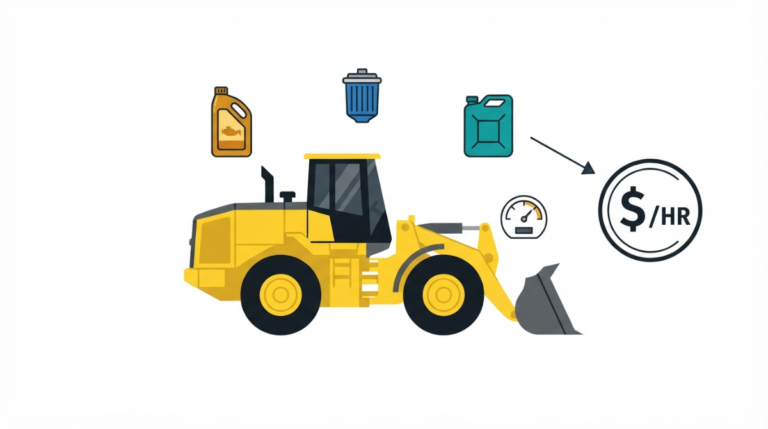
📉 Cost Reality: Iowa’s 2026 survey lists tractor-only rental at an average of $0.34 per horsepower-hour, excluding operator and fuel. It also lists operator wages for machinery work at an average of $22.95 per hour. For a 50-hp tractor, that adds up to roughly $40 per hour before fuel, cutter wear, insurance, and travel. (Source: ISU A3-10, 2026. Survey sent February 2026.)
The survey rates assumed diesel at $2.89 per gallon. If your local fuel costs more, rates built on that assumption will run low for you.
Should you quote by the acre or by the hour?
Both pricing structures work, as long as the risk sits with whoever can see the field.
Hourly with a minimum vs. per-acre after a walk-through
On ground you haven’t seen, an hourly rate with a stated minimum protects your machine and your margin. Once you’ve walked the field, a per-acre price gives the customer a firm total. Our breakdown of what to charge for tractor work applies the same cost-floor logic to other implements.
When a brush hog isn’t the right machine
If stems exceed your cutter’s rated capacity, the job belongs to a different machine. For comparison, Texas reports grubbing at an average of $167.92 per acre, and Iowa’s land-clearing median is $170 per hour. Compare forestry mulching rates before forcing a cutter through overgrown land.
Is it cheaper to buy a brush hog or hire it out?
For most small acreage, the hire cost is easy to calculate and hard to beat.
When hiring wins
Here is an example. Ten acres of pasture mowed twice a year at Iowa’s $27 median comes to about $540 a year. For a few acres a year, hiring often costs less than owning a tractor and cutter.
When owning makes sense
Owning starts to pay off when you mow often, cover a lot of ground, or already own a suitably sized tractor. Run your own numbers in our equipment cost-per-hour calculator. Match cutter width to your tractor’s PTO horsepower using the cutter manual.
Walk the field before you quote: hazards that change the job
Hazards you find before mowing change both the price and whether you take the job.
Hidden obstacles and thrown objects
Extension safety specialists warn that a rotary mower can throw debris at up to 200 mph. Their thrown-object hazard guidance calls for intact guards and eye protection.
Slopes, bystanders, and guarding
Blades can keep spinning after the PTO is disengaged. Wear the seat belt on a ROPS-equipped tractor, and keep bystanders beyond the distance your cutter manual specifies.
🔧 Stop Here: Steep slopes, heavy debris, or ground you can’t see are jobs for an experienced operator. Follow your operator’s manual.
FAQ
1. How much should I charge to brush hog an acre?
Iowa’s 2026 brush hogging survey medians are $27 per acre for pasture mowing and $100 per acre for chopping brush.
2. Is it better to charge per hour or per acre for brush hogging?
Charge by the hour on unseen ground. Quote per acre only after walking the field and checking vegetation and obstacles.
3. How many acres per hour can a brush hog cut?
Multiply cutting width in feet by speed in mph and field efficiency, then divide by 8.25, following Iowa State’s formula.
4. Why do some brush hogging quotes top $100 an acre?
Woody brush slows ground speed and wears blades. Iowa’s 2026 median for chopping brush is $100 per acre.
5. Do brush hog operators charge a minimum?
Many brush hogging operators set a stated minimum to cover travel and setup on small jobs. Get it in writing.
6. What does pasture shredding cost in Texas?
Texas A&M’s 2026 survey found $35 per acre the most common pasture shredding rate, with a $46.73 statewide average.
7. Is it cheaper to hire or buy a brush hog?
For a few acres mowed once or twice a year, hiring brush hogging often costs less than owning the equipment.
8. Does fuel price change brush hogging rates?
Yes. Iowa’s 2026 brush hogging survey rates assumed $2.89 diesel, so higher local fuel costs push real rates upward.
9. When is brush hogging the wrong tool?
When stems exceed your cutter’s rated capacity in the operator’s manual, hire forestry mulching or dozer clearing instead.
10. Why walk the field before brush hogging?
Hidden rocks, stumps, and wire in a brush hogging job can become thrown objects traveling up to 200 mph. Follow your cutter manual’s guarding and bystander guidance.
Price the field, not the acre
Grass and brush sit at very different price points, and survey medians are only a starting point. Build an hourly floor from your own costs, then convert it to a per-acre price with the formula. Walk the field before you commit to a number.