Why your excavator won’t move, and the wrong fixes to skip

An excavator that won’t move may just have its lock set: on Cat minis lever up means locked, while one 1990 machine locked with the lever down.
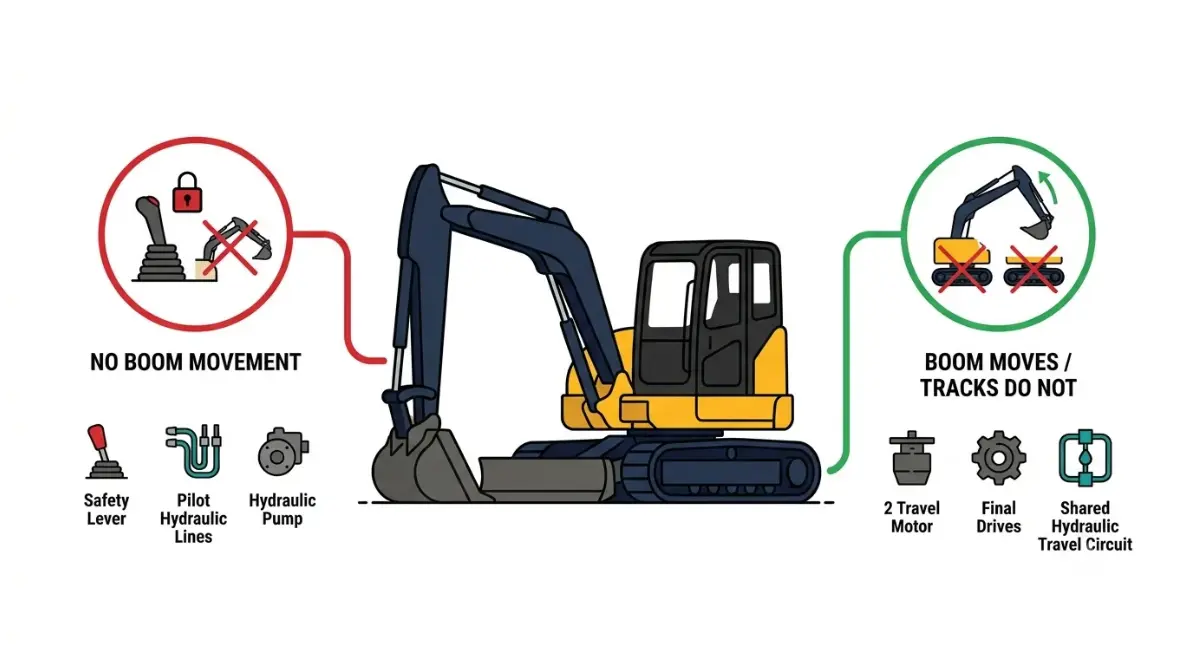
Table of Contents
Sources checked on October 29, 2026.
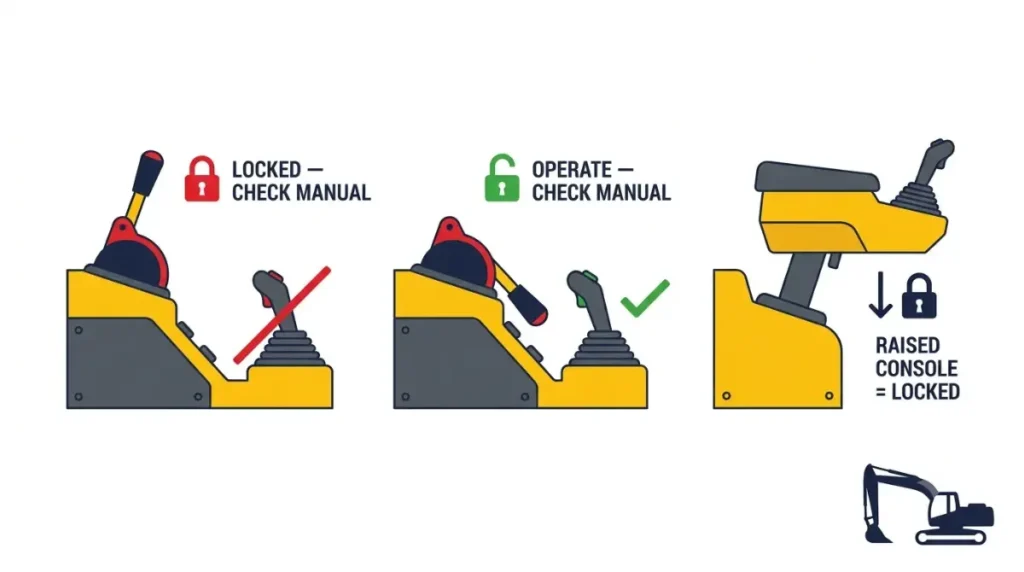
When an excavator’s engine runs but nothing moves, start with the hydraulic lock: on most pilot-control machines one lever or console cuts the joysticks and the travel circuit together. On Cat mini excavators the engine starts only with the interlock lever up, and nothing operates until the lever goes back down (Cat on its mini excavator safety interlock).
This covers crawler excavators with pilot controls, mini through full-size and any model year, where the whole machine won’t travel or nothing responds at all. One track turning while the other sits still has its own causes, worked through in what stops one excavator track while the other runs. A machine that moves but turns sluggish once the oil is hot belongs with why hydraulics slow down as an excavator warms up.
Lock lever, console and the free checks
Sit down, fasten the belt and find the lock before touching any other control. Which position counts as locked changes from maker to maker.
| Applies to | Locked position | What the lock stops | Starting rule |
|---|---|---|---|
| Cat mini excavators (Cat states all models) | Interlock lever up | Every function, until the lever is lowered | Engine starts only with the lever up |
| Bobcat 418, S/N AB4711000 and B39211000 and above | Either control console raised | Joysticks and the traction drive | Pre-start steps latch both consoles down before the key is turned |
| Kubota KX037-4, as listed by Kubota Europe | Not stated; raising the lever sets the swivel brake on the upper frame | Hydraulic lock system and travel negative brake fitted; functions not listed | Engine won’t start with the safety lever lowered |
| 1990 excavator, 12,000 lb, New York FACE case 06NY010 | Lock lever down (up was unlock) | Boom, arm, bucket and swing; travel is not listed | Not described in the report |
Sources: Cat mini excavator safety features (2023); Bobcat 418 operation and maintenance manual, 2014 edition, pp. 27 and 45; Kubota Europe KX037-4 page; New York FACE report 06NY010.
- Move the lock or console fully into the operate position your manual shows, and check the console indicator it describes. The 418’s joysticks and travel work only with both consoles latched down (p. 45), so one console left unlatched stops the machine.
- Read any code on the monitor before going further, using Cat CID and FMI fault codes decoded or Komatsu excavator error codes.
- With the engine off and the lock set, walk the undercarriage for packed mud or ice. Tracks can freeze to the ground and stop a machine from moving; parking on boards or concrete in freezing weather prevents it (manual, p. 58).
- Check the hydraulic oil level on level ground, and add only the fluid your manual lists. That check sits on Bobcat’s 10-hour list together with a function test of the console lockouts (p. 67).
The table cuts both ways on that first step. A raised lever means locked on Cat’s minis, and Kubota’s KX037-4 refuses to start with its lever lowered. On the 1990 machine, raised meant the controls were live. Your manual and serial range decide which pattern sits in your cab.
Does the boom move? What that tells a technician
One slight joystick move, with the bucket low and nobody inside the swing radius, splits the problem in two.
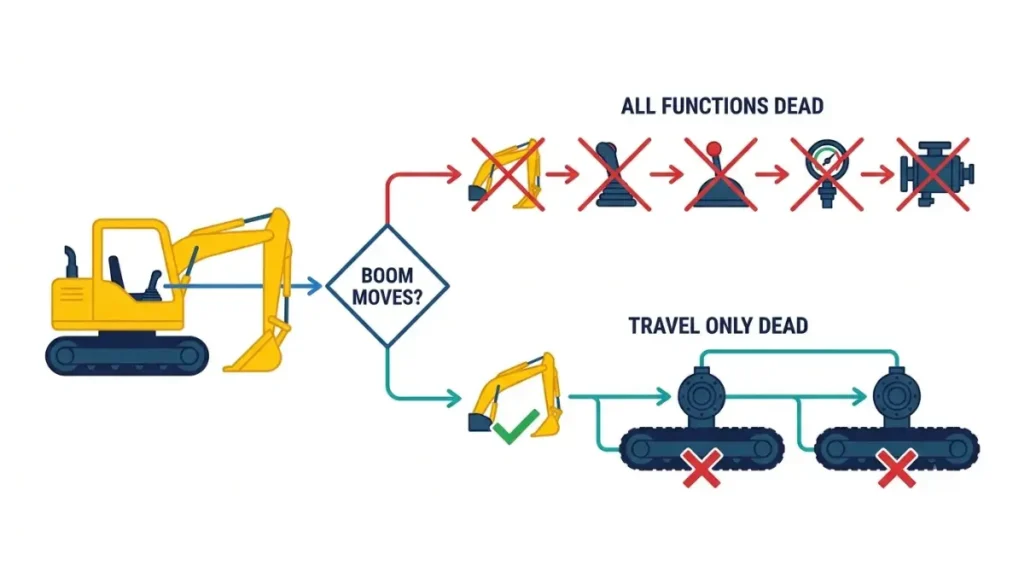
If every joystick function is as dead as the tracks, the fault sits ahead of the controls. The lock circuit, the pilot oil supply and the pump drive all live there, and testing them takes pressure gauges. That is the point to ask a dealer technician for a pilot pressure test before any part is priced.
If the boom answers and neither track turns, look at what both travel motors share. Two motors failing in the same minute is the least likely explanation.
The test reads correctly only when you know what your lock covers. The New York case report lists the boom, arm, bucket and swing as what that machine’s lock disabled, with travel absent from the list, while Cat’s minis lock every function.
Six fixes that cost more than the fault
The expensive mistakes on a stopped excavator usually come right after the free checks, when a guess turns into a purchase or a shortcut.
Parts bought on a guess
A travel motor or final drive, ordered for a machine whose tracks are both dead, is the most common one. Shared circuits come first, and replacement pricing by size class sits with final drive repair costs on a one-track failure.
A pump is next, bought before anyone has ruled out the lock circuit. When the 418’s console lockout fails its function test, servicing that system is the fix the manual prescribes (p. 69).
Turning adjustment screws on the control valve or a relief valve makes three. Owner work on that machine stops at the procedures printed in its operation manual, and everything else is reserved for qualified Bobcat service personnel (p. 65).
Which shortcuts injure people?
Jumpering the lock switch, or wiring the lockout solenoid straight to power, turns up in forum threads whenever a switch fails. The lock is what separates a bumped joystick from a swinging cab. In the 2006 New York case, an operator climbing out with the lock unset brushed the left joystick, the upper structure swung, and he was crushed against a tree (FACE report 06NY010). A failed lock goes to the dealer’s service department with one request: test the lockout switch and solenoid circuit before quoting anything else.
Cracking a fitting or swapping hoses to see whether pressure is there is the second. Trapped hydraulic fluid can exceed 2,000 psi with the engine and pump stopped (Ohio State University Extension), and Bobcat warns against using bare skin to hunt for leaks (p. 18).
Hazard: Fluid forced through the skin needs emergency care at once. Without treatment the pain turns severe within four to six hours, and the injury can end in amputation (HSENI safety alert). Go straight to an emergency department and tell staff it was a hydraulic injection.
Releasing the travel brakes to drag the machine is the third. Bobcat publishes no towing procedure for the 418. It allows the machine to be skidded a short distance with the tracks locked, onto a trailer for example, on a chain rated at 1.5 times the excavator’s weight (p. 58). Other makes print their own limits in the recovery section of the manual.
Call the dealer with what works and what doesn’t
The service desk will ask for the model and serial number first, because early and later machines sharing one model name can need different parts and procedures (operation manual, p. 8). Have the rest written down before you dial:
- serial number and hour-meter reading
- which functions respond: boom, swing, either track, or none
- the lock indicator’s state and any monitor code
- whether it quit mid-job, after sitting, or after a hard freeze
Ask for the diagnosis in writing before a part is ordered. If the wait runs to days, the daily rental ranges by size class in the excavator size guide with rent and buy costs show what a stand-in machine costs while yours is down.