Clear Custom Hay Baling Rates for Round and Square Bales

Custom hay baling rates look cheapest on small squares until you run the per-ton math: in Nebraska’s 2026 survey, they cost roughly 3x what rounds do.
Table of Contents
What custom balers charge per bale in 2026
This guide covers custom hay baling rates for dry hay: small squares, large squares, and large round bales, with and without net wrap. The numbers come from the 2026 Iowa, Kansas, and Nebraska extension custom rate surveys, and each rate includes the baler, tractor, fuel, and operator.
The quick numbers
Small squares run about $1.00–$2.56 per bale, and large rounds run about $13–$19. Large squares land around $15–$16, though few operators report them.
- Setting your own rate? Start with the round-bale table, then jump to setting your rate.
- Hiring a baler? Read what’s included and the per-ton comparison before you compare quotes.
- Thinking about buying a baler? Skip to the hire-or-buy section.
Where these rates come from
Each figure is a survey average of what operators expect to charge. Treat it as a guide, not a price list, because your county can run well above or below it.
💵 About These Numbers: Rates come from Iowa State’s 2026 survey (mailed February 2026, 205 responses), the 2026 Kansas Custom Rates report (KDA and K-State), and Nebraska’s 2026 report (108 responses, reflecting late winter 2025 into early 2026). They are self-reported averages and vary with region, fuel price, travel, field size, and local competition. Use them for orientation, not as a quote.
Round bale custom rates: net wrap vs twine
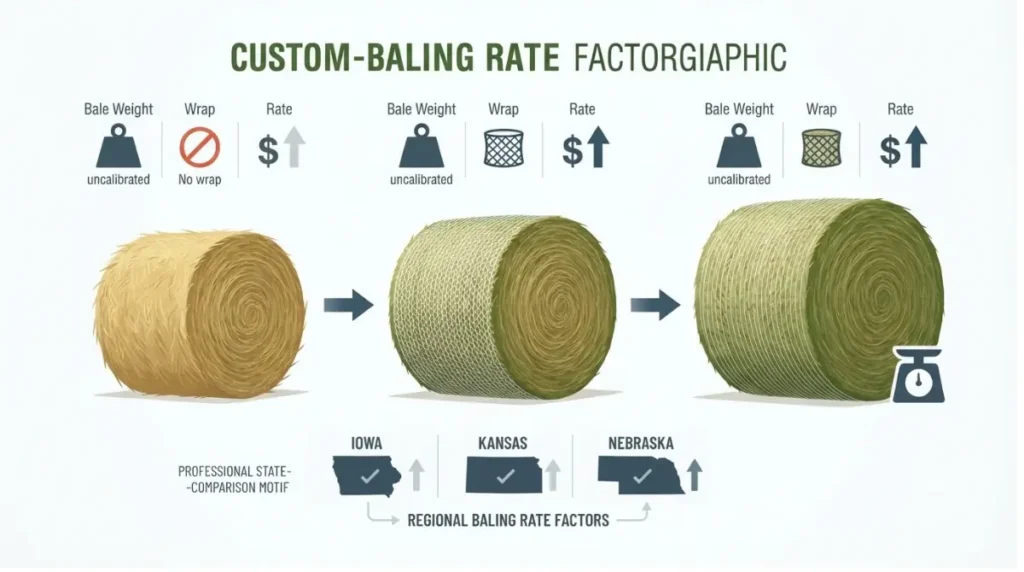
Round bales are the most-reported custom baling job. Wrap and bale weight move the price more than state lines do.
Iowa, Kansas, and Nebraska side by side
| State (2026) | Bale type | Average (range) | Responses | What It Means |
|---|---|---|---|---|
| Iowa | Large round, no wrap | $13.15 ($10–$20) | 11 | Cheapest round option surveyed |
| Iowa | Large round, wrapped | $15.75 ($12–$20) | 39 | Iowa’s best-supported round figure |
| Kansas | Under 1,500 lb, net | $16.06 ($12–$20) | 51 | Mid-weight benchmark |
| Kansas | Over 1,500 lb, net | $18.96 ($14–$25) | 54 | Heavy bales cost more |
| Nebraska | Net wrap, avg 1,559 lb | $17.88 ($12–$25) | 26 | Up 8% from 2024 |
Sources: Iowa State’s 2026 custom rate survey, the 2026 Kansas Custom Rates report, and Nebraska’s 2026 statewide summary. Iowa’s ranges exclude the single highest and lowest responses.
Why bigger bales cost more
In Kansas, net-wrapped bales over 1,500 lb average about $2.90 more than lighter ones. Kansas also shows unwrapped rounds costing more than wrapped ones, but that figure rests on only 4 reports. Don’t read anything into it.
Square bale rates: small squares and big squares
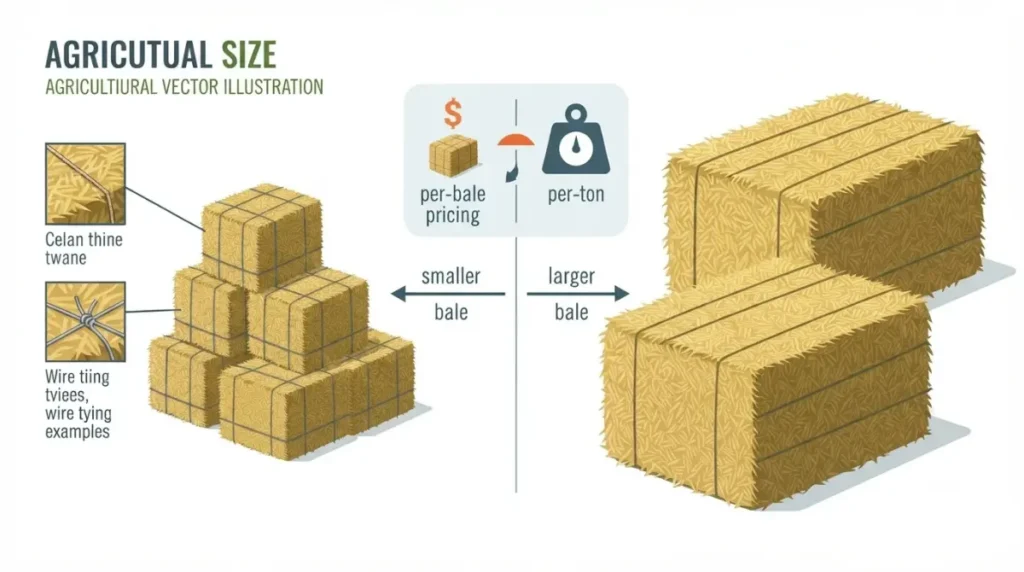
Small squares are cheap per bale but expensive per ton. Large squares have the thinnest data of any bale type.
Wire vs twine small squares
Iowa’s small square bales average $1.00 per bale across 16 responses. Kansas averages $1.85 with wire and $2.56 with twine. Nebraska averages $1.94 for 60-lb twine bales and $2.50 for 66-lb wire bales, from just 5 and 3 responses.
Kansas charges more for twine, while Nebraska charges more for wire. The samples are too small to say that tie type sets the price.
Large squares: thin data
Iowa’s large square bales average $14.90 from 7 responses. Nebraska reports $16.25 for 900-lb bales from 4 responses, and Kansas had too few reports to publish at all. The 2026 Kansas custom rates report says so directly. Ask any large-square operator what bale size and weight the quote assumes.
Round vs square: which costs more per ton of hay?
Per ton, round bales are the cheapest to custom-bale, and small squares cost roughly three times as much.
| Bale type (Nebraska 2026) | Rate | Avg weight | Cost per ton | Responses |
|---|---|---|---|---|
| Large round, net wrap | $17.88 | 1,559 lb | $22.94 | 26 |
| Large square | $16.25 | 900 lb | $36.11 | 4 |
| Small square, twine | $1.94 | 60 lb | $64.67 | 5 |
| Small square, wire | $2.50 | 66 lb | $75.76 | 3 |
Source: Nebraska’s 2026 agricultural custom rates report (EC823). Cost-per-ton figures are CabAndCargo calculations.
The per-ton math
Method: We divided each 2026 Nebraska state average rate by the average bale weight reported in that same survey, then scaled the result to a 2,000-lb ton. The formula is rate ÷ bale weight × 2,000. Use your own bale weights, and never combine one state’s rates with another state’s weights.
Why small squares cost about three times as much
🔍 Why It Happens: Every bale gets formed, tied, and ejected no matter how much hay is in it. When that per-bale work is spread over 60 lb instead of 1,500-plus, the cost per ton climbs. The square figures rest on 3–5 responses, so treat the gap as direction, not precision.
What a custom baling rate includes and what it doesn’t
Before you compare two quotes, confirm they cover the same work.
Materials, fuel, and labor
All three surveys include machine, power, fuel, and operator in the rate. Kansas and Nebraska also count baling materials such as twine, wire, and net wrap. Iowa assumed $2.89 diesel, while Nebraska operators expected $2.93 and assumed $28.79 per hour for labor.
Nebraska shows how to adjust for fuel. If diesel rises $0.90 a gallon and the machine burns 0.80 gallons per acre, add $0.72 per acre.
Mow-rake-bale packages and moving bales
Kansas prices the entire haying operation, meaning cutting, conditioning, raking, and baling, at $27.15 per large round bale and $3.81 per small bale. Moving rounds to storage costs extra: $3.25 a bale in Iowa, or $4.82 per mile in Nebraska.
✅ Do This: Put three things in writing: who supplies the wrap, whether bales get moved, and whether travel is billed.
Setting your own custom baling rate
Start with your state’s survey number, then test it against your own costs.
Anchor to your state survey
Nebraska’s report warns that average rates may not cover every operator cost. It says commercial operators should price in machinery, labor, risk, and a return to management. Some operators set per-acre minimums for thin cuttings, but no survey here quantifies them, so base yours on your own costs.
Per bale vs per hour
None of these 2026 surveys publishes an hourly baling rate. To compare baling with hourly equipment rates by machine, multiply your tracked bales per hour by your per-bale rate. Kansas does publish hourly rates for nearby jobs: $179.41 an hour for mowing or swathing hay and $110.00 for side raking.
Run your ownership and operating costs through the equipment cost-per-hour calculator. That’s the same method behind our mini excavator hourly rate breakdown and our guide on what to charge for tractor work.
Hire a custom baler or buy your own?
For most small hay operations, hiring custom is the cheaper answer.
When custom hire wins
Ownership costs, meaning depreciation, interest, insurance, and housing, add up whether the baler runs or not, according to Iowa State’s machinery cost guide. At low volume those costs spread over too few bales. A per-bale custom rate avoids them entirely.
When ownership pencils out
Divide your annual ownership and operating cost by the bales you’ll make. If the result beats your local custom rate, ownership can pay, and so can not waiting on someone else’s schedule in a wet year. Test it with the buy vs. rent calculator.
Custom hay baling rates: FAQ
1. What do custom balers charge per round bale?
In the 2026 Iowa, Kansas, and Nebraska surveys, custom hay baling rates for large rounds averaged $13.15–$18.96 per bale.
2. Does net wrap cost extra on custom round bales?
Usually it’s built into the rate. Iowa’s wrapped rounds averaged $15.75, versus $13.15 unwrapped.
3. What’s the custom rate for small square bales?
Small square custom baling averaged $1.00 in Iowa and $1.85–$2.56 in Kansas in 2026.
4. Is wire or twine cheaper for custom small squares?
It isn’t consistent. Kansas charged more for twine, Nebraska charged more for wire, and both samples were small.
5. Is round or square baling cheaper per ton?
Rounds are cheapest. In Nebraska’s 2026 data they cost about $23 a ton, versus $65–$76 for small squares.
6. Do custom baling rates include fuel and labor?
Yes. All three 2026 surveys include machine, fuel, and operator, and Kansas and Nebraska include baling materials too.
7. What does a full mow, rake, and bale job cost?
Kansas’s 2026 entire haying operation averaged $27.15 per large round bale and $3.81 per small bale.
8. How do I convert a per-bale baling rate to per hour?
Multiply your tracked bales per hour by your per-bale rate. None of the 2026 surveys covered here publishes an hourly baling rate.
9. Should I buy a baler or hire custom baling?
Divide your annual baler ownership and operating costs by bales made. If the result exceeds local custom rates, hire.
10. Why do custom baling rates vary so much?
Rates shift with region, bale weight, wrap, travel, and response count. Some 2026 rates rest on just 3–4 reports.
Round bales are the cheapest hay to custom-bale per ton, at about $23 in Nebraska’s 2026 data. Large squares run about $36, and small squares run roughly three times the round-bale figure. If you’re the operator, anchor to your state survey and then check it against your own costs. If you’re hiring, compare quotes per ton rather than per bale, and confirm in writing who supplies the wrap.