The Right Way to Use FEMA Equipment Rates for Excavators

FEMA equipment rates cover fuel, tires and overhaul but not the operator. Here’s why that makes them a benchmark, not a quote, and how to use them.
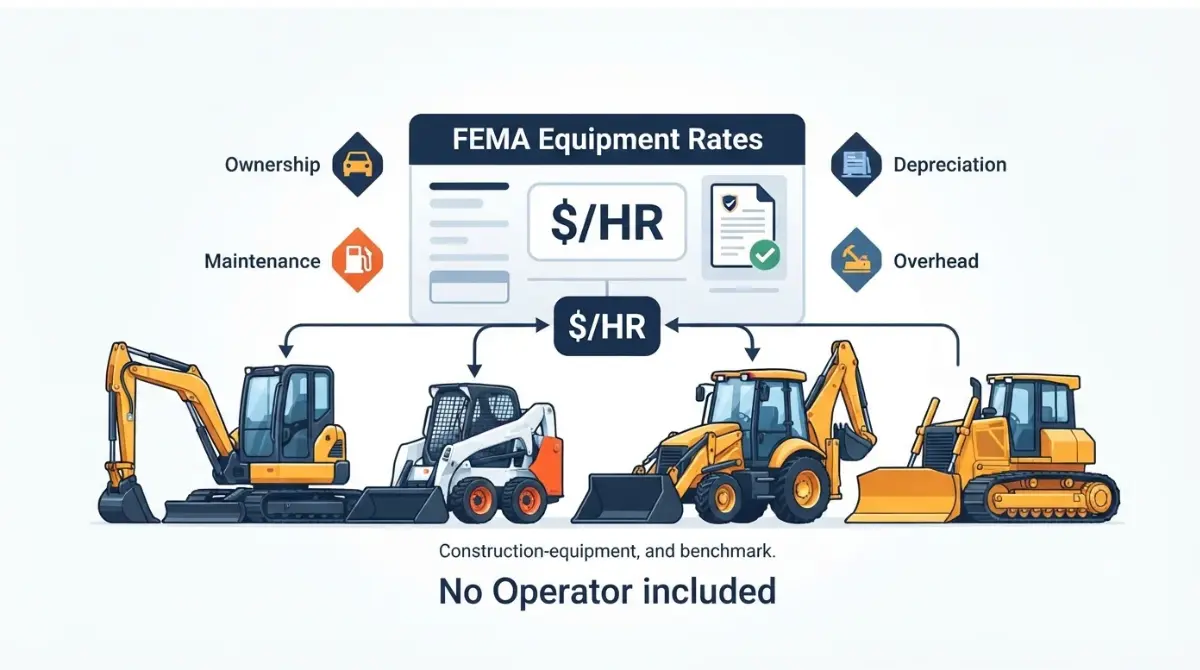
Table of Contents
What FEMA equipment rates are (and what they aren’t)
This guide covers FEMA’s 2025 Schedule of Equipment Rates, the federal hourly-rate table for applicant-owned equipment on disasters declared on or after July 1, 2025, for excavators, skid steers, backhoe loaders and dozers. Rates are class-based, not tied to an emissions tier.
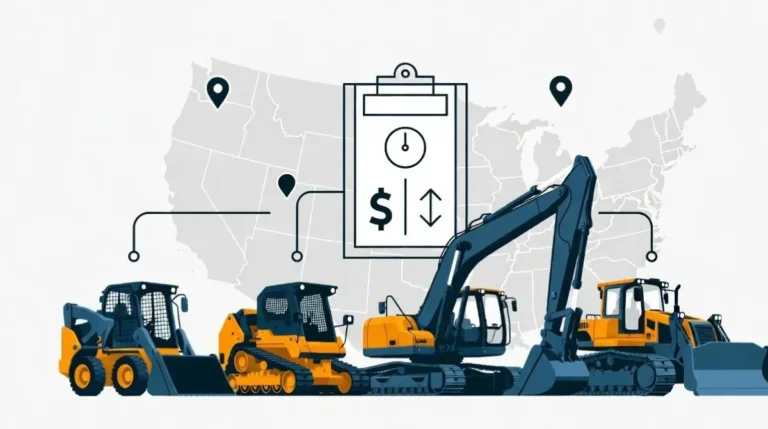
FEMA equipment rates are cost-based hourly figures covering ownership and operation, with no operator included (FEMA’s published schedule). Treat them as a benchmark, not a rental price or a quote.
- Pricing a job? Read the rate table, then why it isn’t a quote.
- Filing a disaster claim? Start at the rule order.
- Running a compact machine? Build your own hourly cost; see market-facing hourly rates by machine.
📋 Compliance Note: FEMA reimbursement rules, set in 44 CFR 206.228, vary by disaster declaration and state. This is general information, not legal advice; confirm with your state emergency management agency or FEMA Public Assistance staff.
💵 About These Numbers: Rates are from FEMA’s 2025 Schedule of Equipment Rates, checked September 30, 2026. They are FEMA reference rows, not market prices; real costs vary by region, hours, condition and configuration. Orientation, not a valuation.
What’s in a FEMA rate, and what’s left out
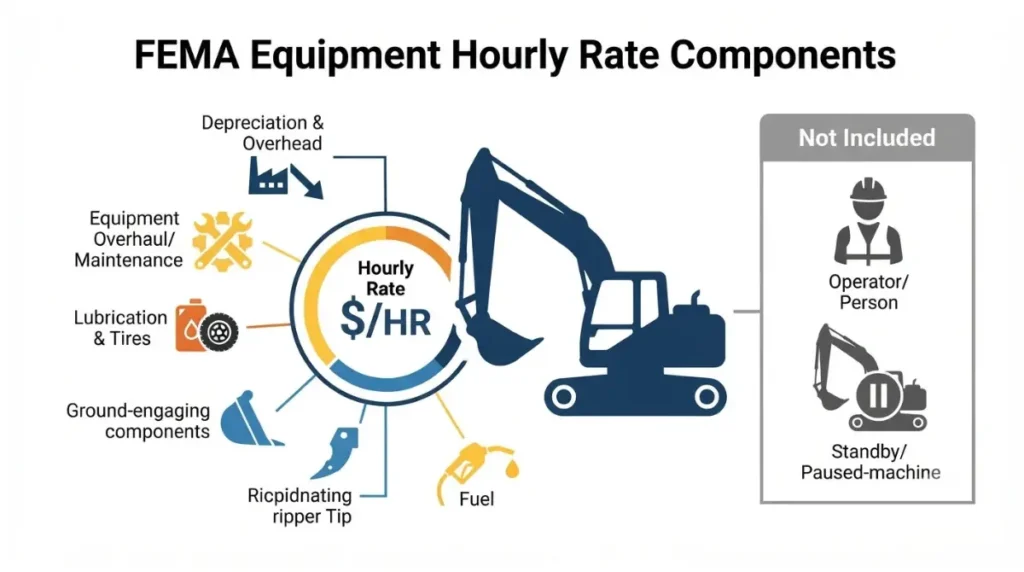
A FEMA hourly rate rolls the cost of owning and running a machine into one number.
What’s built into the hourly rate
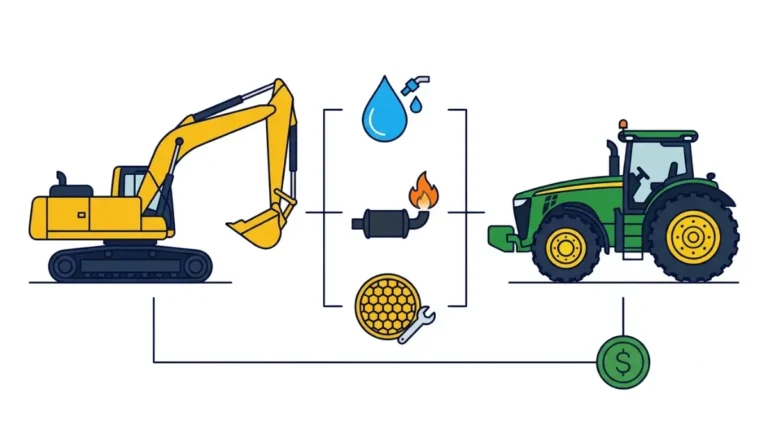
FEMA’s own breakdown of the rate components includes:
- Depreciation and overhead
- Equipment overhaul and maintenance, including labor, parts and supplies
- Lubrication and tires
- Ground-engaging components, where they apply
- Fuel
Because maintenance is in the rate, a mechanic’s labor to maintain applicant-owned equipment is ineligible.
What isn’t: operator, standby, idle time
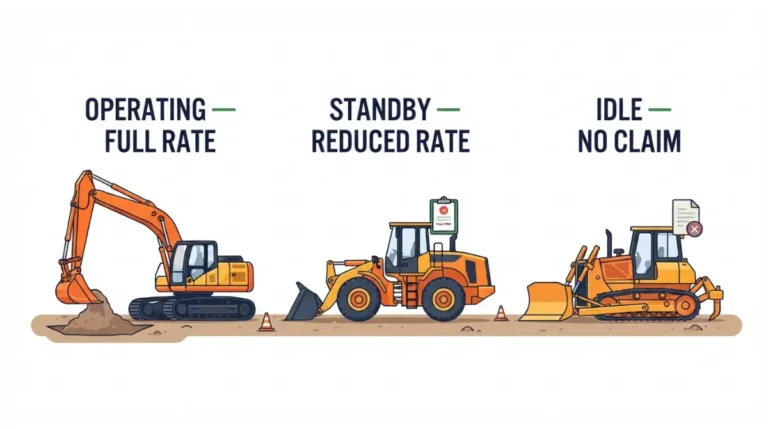
Operator labor is approved separately from equipment costs. FEMA states standby equipment costs are not eligible, and equipment must be in actual operation performing eligible work. Older summaries that call standby billable conflict with FEMA’s current wording.
Which rate wins: FEMA’s schedule or your own?
The federal regulation, 44 CFR 206.228, sets the order and covers applicant-owned equipment only.
State and local rates versus the schedule
- State rates: reasonable state-approved rates apply at $75 an hour or less; above $75, FEMA decides case by case.
- Local rates: the lower of the local rate or FEMA’s schedule applies. Claiming more takes documentation and FEMA approval of an alternate rate.
- No established rates: FEMA’s schedule is the basis.
Which schedule year applies
The 2025 schedule covers declarations on or after July 1, 2025; earlier declarations use the schedule in effect when declared. Recent schedules are dated 2019, 2021, 2023 and 2025.
✅ Do This: Ask your state emergency management agency which rate governs your claim.
FEMA hourly rates by machine: excavators, skid steers
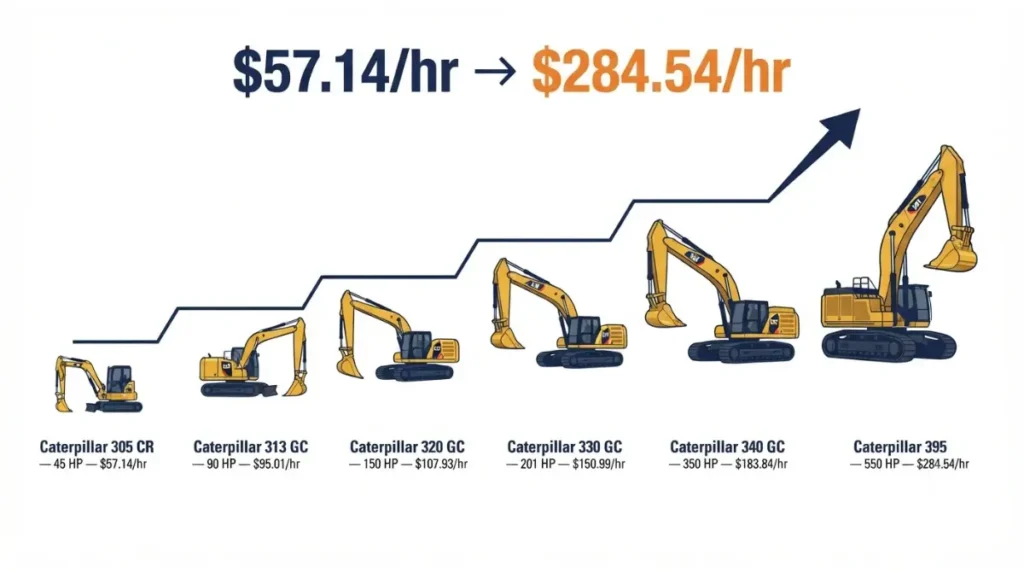
FEMA’s 2025 excavator rates run from $57.14 to $284.54 per hour, rising with horsepower tier and including the bucket.
Excavators by horsepower tier
| FEMA reference row | HP tier (“to”) | 2025 rate/hr | What It Means |
|---|---|---|---|
| Caterpillar 305 CR | 45 | $57.14 | Smallest excavator tier |
| Caterpillar 313 GC | 90 | $95.01 | +$37.87 over the row above |
| Caterpillar 320 GC | 150 | $107.93 | +$12.92 over the row above |
| Caterpillar 330 GC | 201 | $150.99 | +$43.06 over the row above |
| Caterpillar 340 GC | 350 | $183.84 | +$32.85 over the row above |
| Caterpillar 395 | 550 | $284.54 | +$100.70 over the row above |
Source: FEMA 2025 Schedule of Equipment Rates, cost codes 8280–8285. Step-ups are our arithmetic.
For what compact excavators bill in the market, see our mini excavator hourly rates.
Skid steers, a backhoe and a dozer for comparison
| FEMA reference row | HP | 2025 rate/hr | What It Means |
|---|---|---|---|
| Bobcat S70 skid steer | to 24 | $31.67 | Smallest skid steer tier |
| Bobcat S76 skid steer | to 74 | $45.23 | +$13.56 over the row above |
| Bobcat S86 skid steer | to 105 | $60.67 | +$15.44 over the row above |
| Caterpillar 420 backhoe loader | 103 | $110.03 | $49.36 above the S86 at similar horsepower |
| Caterpillar D3 dozer | to 104 | $64.18 | $45.85 below the backhoe at similar horsepower |
Source: FEMA 2025 Schedule of Equipment Rates, cost codes 8540–8542, 8572, 8251. Differences are our arithmetic.
Similar horsepower doesn’t mean similar rates: the backhoe row sits $49.36 above the skid steer row. FEMA sets tiers by horsepower, so confirm your machine’s rated engine horsepower in your operator’s manual and serial range before picking a row. If nothing fits, FEMA says it will furnish rates for unlisted equipment on request.
Why a FEMA rate isn’t a rental rate or a quote
A FEMA rate reimburses the cost of an applicant-owned machine doing eligible work; it doesn’t price a job.
Ownership-and-operating cost versus market rental
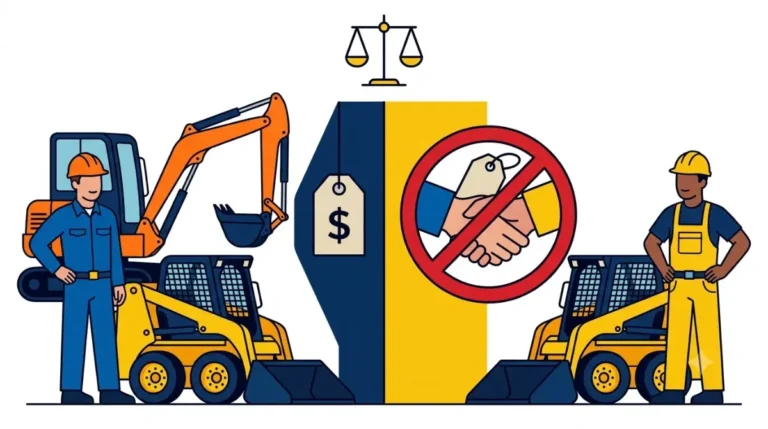
The schedule is written for applicant-owned equipment and excludes the operator, so it isn’t a rental rate. By its terms it doesn’t set what a private contractor may charge. A rental quote comes from your local market, and a job price still has to cover your operator.
Where FEMA rates work as a sanity check
Use the row for your tier as a cross-check on your own cost per hour. If your number sits far from it, find out why before you quote. To compare owning against renting, try our Buy vs. Rent Calculator.
Turn the FEMA number into your own cost per hour
Your own number has two halves: ownership cost, which runs regardless of use, and operating cost, which grows with hours.
Ownership cost versus operating cost
Iowa State’s method for farm machinery counts depreciation, interest, taxes, insurance and housing as ownership, and repairs, fuel, lubrication and operator labor as operating.
- Match your machine to the FEMA row for its horsepower tier.
- Build your hourly ownership and operating cost with our Equipment Cost-Per-Hour Calculator.
- Remove operator labor, which FEMA excludes, then compare.
Reading the gap
Few annual hours can push your figure well above the row, since ownership cost is spread over fewer hours. A figure well below it may be missing overhaul or tires, which FEMA includes. See the owning vs operating cost breakdown.
Four ways people misuse FEMA rates
Most errors trace back to scope and rules covered above.
Schedule and scope errors
- Wrong schedule year. The 2025 table covers declarations on or after July 1, 2025; check your declaration date.
- Forgetting the operator. Operator labor is approved separately, so account for it.
Billing and quoting errors
- Billing standby. FEMA states standby costs are not eligible; count only hours in actual operation.
- Quoting FEMA’s number as a market rate. It benchmarks cost for applicant-owned equipment; quote from your own cost per hour and local market.
FEMA equipment rates FAQ
1. What are FEMA equipment rates?
FEMA equipment rates are hourly figures for applicant-owned equipment, covering ownership and operating costs but not the operator.
2. Do FEMA equipment rates include operator labor?
No. FEMA equipment rates leave out operator labor, which is approved separately from equipment costs.
3. Which FEMA equipment rates schedule applies to my disaster?
The schedule in effect at declaration applies; FEMA’s 2025 equipment rates cover declarations on or after July 1, 2025.
4. What is the FEMA equipment rate for a mid-size excavator?
In FEMA’s 2025 equipment rates, the Caterpillar 320 GC row, up to 150 horsepower, is $107.93 per hour, bucket included.
5. Are FEMA equipment rates the same as rental rates?
No. FEMA equipment rates cover applicant-owned equipment without the operator, so they benchmark cost, not rental price.
6. Can standby time be billed under FEMA equipment rates?
No. Under FEMA equipment rates, standby costs are not eligible; equipment must be in actual operation on eligible work.
7. Can a local government claim more than FEMA equipment rates?
Yes, but only by documenting the basis and getting FEMA approval of an alternate rate above FEMA equipment rates.
8. Do FEMA equipment rates include fuel and maintenance?
Yes. FEMA equipment rates include fuel, lubrication, tires and maintenance, plus depreciation, overhead and equipment overhaul.
9. How do I turn FEMA equipment rates into my own cost per hour?
Build your own ownership and operating cost per hour, drop operator labor, then compare it with the FEMA equipment rates row for your tier.
10. How often does FEMA update its equipment rates?
The four most recent FEMA equipment rates schedules are dated 2019, 2021, 2023 and 2025; check FEMA’s page for the current one.
Next step: work out your own hour
Build your own cost per hour, remove the operator, and use the FEMA row for your tier as a cross-check, not a price. Before relying on any figure, confirm the current schedule on FEMA’s page and your declaration date. A gap you can’t explain means check your hours, not copy FEMA’s number.