How to Choose the Right Hourly or Per Job Excavation Price

Hourly or per job? Every per-foot price assumes a feet-per-hour pace. Check yours against Iowa’s 2026 survey rates before you quote.
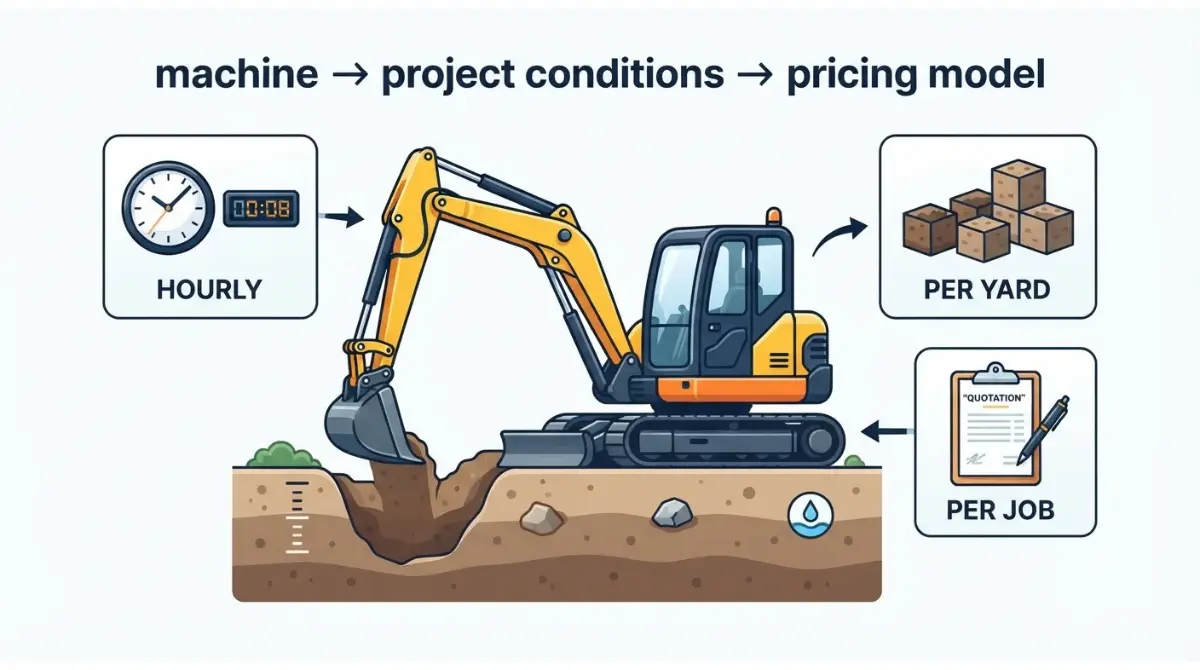
Table of Contents
Hourly or per job? The short answer for excavation work
This guide covers excavation pricing for US owner-operators and small contractors running compact to standard-size excavators and backhoe loaders. The logic is model-independent, so no emissions era applies.
Excavators are priced hourly (time and materials), by the cubic yard, or as one flat price per job. Choose hourly when quantity or ground conditions can’t be estimated, and a per-job price when both can. The federal time-and-materials test in FAR 16.601 follows the same logic.
Quoting this week? Go to the five questions. New to selling machine time? Start with what a rate must cover. Need rates by machine? See equipment rates per hour by machine.
ℹ️ Safety Note: Pricing guidance only. Trench and excavation work follows OSHA’s excavation standard, your operator’s manual, and a designated competent person.
📋 Compliance Note: OSHA 29 CFR 1926 Subpart P governs US construction excavations; state requirements vary, so verify with your state agency.
💵 About These Numbers: Rates and minimums come from consumer cost guides retrieved October 1, 2026; the ownership example is University of Illinois farmdoc (August 2025). Orientation, not a quote; values vary by region and hours.
What your excavation hourly rate has to cover
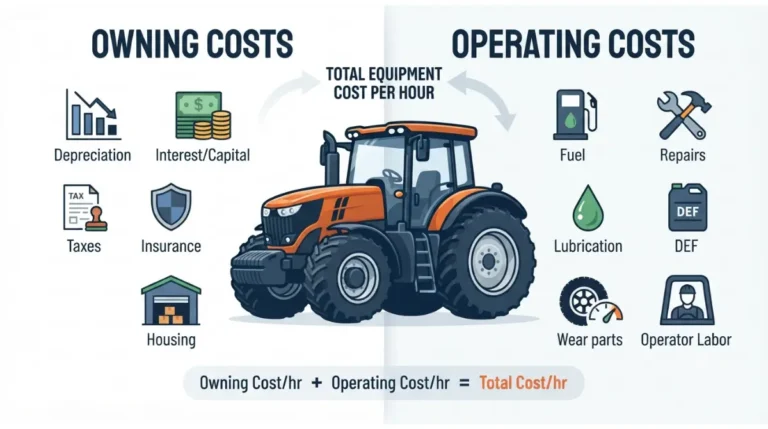
A machine-only figure isn’t a billable rate. Cover all six:
- Depreciation and interest on the machine
- Insurance and housing
- Repairs and maintenance
- Fuel and lubricants
- Operator labor
- Overhead and profit
The Army Corps’ 2021 equipment schedule (EP 1110-1-8) excludes operator labor, mobilization, overhead, contingency, and profit, so treat published machine rates as a floor.
🔍 Why It Happens: Ownership costs are fixed per year, so fewer hours raise the hourly cost. University of Illinois farmdoc puts depreciation plus interest at $174.12 an hour at 150 annual hours and $58.04 at 450 (175-hp tractor, August 2025). The method transfers; the dollars don’t.
Too few hours? Price higher, or rent instead. The ownership and operating cost per hour method shows where you stand.
Hourly vs per-job vs per-yard: where each one wins
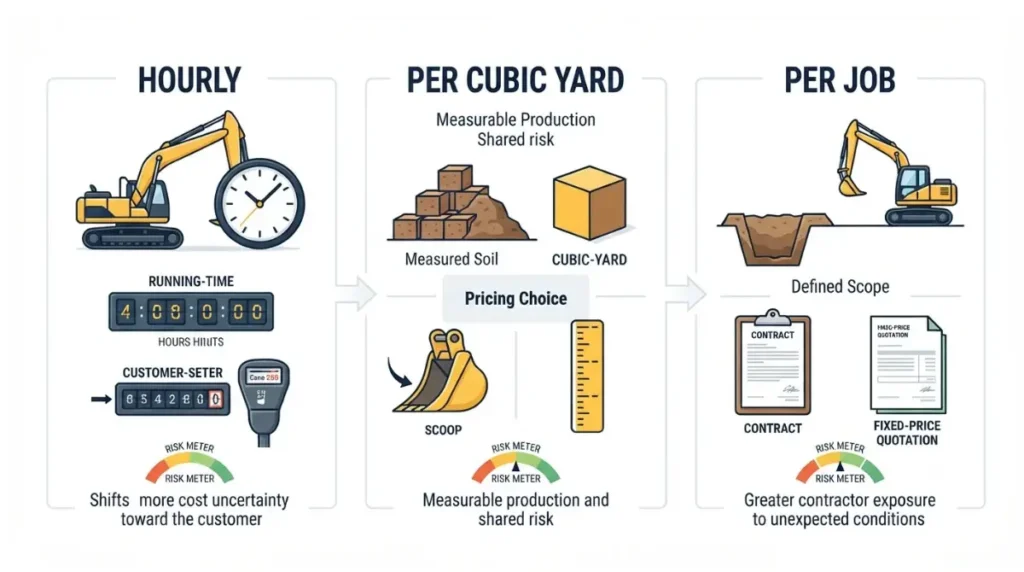
Each model decides who pays when a job runs long.
| Model | Who Carries the Risk | Best For |
|---|---|---|
| Hourly (time and materials) | Customer | Scope or ground you can’t estimate |
| Per cubic yard (unit price) | Shared | Large, measurable volumes |
| Per job (lump sum) | You | Defined scope, known ground |
Sources: FAR 16.601; published cost guides, retrieved October 1, 2026.
Hourly (time and materials)
Hourly rates carry wages, overhead, and profit (FAR 16.601, federal work). HomeGuide lists $100–$300 an hour with operator; USA Construction Rentals lists $70–$300+. Compact machines: mini excavator hourly rate.
Unit price per cubic yard
Build unit prices from your own production data; published per-yard ranges (HomeGuide, A-1 Grading) differ more than tenfold.
Lump sum per job
You carry every surprise on a lump sum, so price only what you can see.
Why the cheapest hourly rate can cost more per job
Illustration: $150 an hour for six hours costs $900; $120 an hour for eight costs $960.
Five questions to ask before you quote
Run these in order; the first “no” in questions 1 or 2 decides the model.
1. Can you put quantity and finish grade on paper?
No: quote hourly. Yes: continue.
2. Do you know the soil, water, rock, and utilities?
No: quote hourly. Yes: continue.
3. Does the customer need a firm number?
Yes: quote unit price or lump sum, with written exclusions. No: either model works.
4. Can you fix your minimum and mobilization?
Price both as separate lines under any model.
5. Will the machine stay busy?
Few annual hours raise your hourly cost; price from your own hours, not the local rate.
✅ Do This: If question 1 or 2 is “no,” quote hourly with a minimum charge and a stated range, never a lump sum.
Method: an editorial framework, ordered by how early each question eliminates a pricing model and anchored to FAR 16.601(c). Not survey data or an industry standard.
Costs a flat price can’t absorb: ground, depth, utilities
A lump sum fails on what you can’t see.
Unknown ground: rock, water, bad soil
Rock, water, and unsuitable soil change production and cost. Price them as unit-price adders or hourly extras.
Trench depth and protective systems as a line item
OSHA’s protective-system rule requires protection unless the excavation is entirely in stable rock, or under 5 feet and a competent person finds no sign of cave-in. Price protection as its own line.
🔧 Stop Here: Protective-system choice and entry decisions belong to your designated competent person and, for some designs, a registered professional engineer. Ask what your depth and soil require before you price.
Utility locates and what a lump sum leaves out
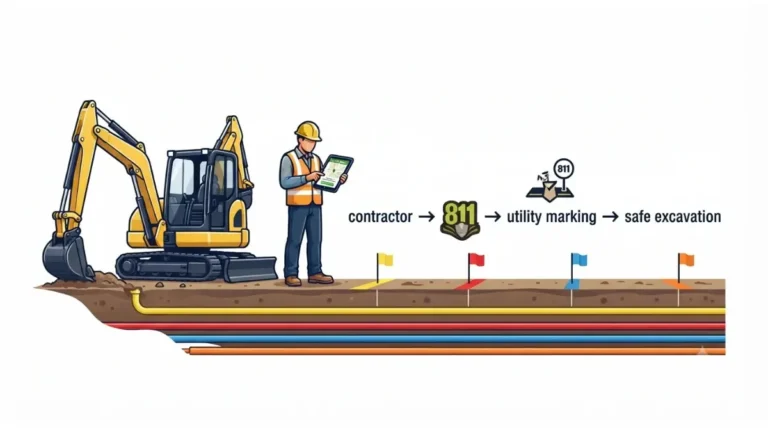
OSHA requires contacting utility owners to locate underground installations before digging. Say in your quote who orders locates and how late marks change the price.
Minimums, mobilization, change orders: protect either model
Terms in the quote protect you more than the rate does.
Minimum charge
Set one before you leave the yard. See excavator mobilization fees and minimum charges.
📉 Cost Reality: HomeGuide lists $500–$800 project minimums, AHM’s mini-excavator guide says 2–4 hour minimums are common, and an Oregon contractor guide cites $500–$1,500+ callouts. Consumer guides, retrieved October 1, 2026; regional.
Mobilization as its own line
List mobilization and demobilization separately; the Army Corps schedule excludes both from machine rates.
Written exclusions and change orders
Write down what the price excludes, such as rock, water, haul-off, and protection, and agree changes in writing before work continues.
Estimate vs bid
Treat a bid as a price you may be held to, and label estimates as estimates. Have an attorney review your contract wording.
When a fixed-price job hits rock or water
Hitting rock or water mid-job is a pricing event, not just a delay.
Stop and document the condition
Pause the affected work, photograph it from a safe position, note its depth and extent, and tell the customer the same day. Where trench stability is in question, your competent person’s call comes first.
Reprice before you continue
Agree the change in writing, using the unit-price adder or hourly rate you quoted for exactly this.
✅ Do This: Name rock, water, and unsuitable soil as priced adders in the original quote, so the change order is a lookup, not an argument.
Hourly vs per job pricing FAQ
1. Do excavators charge by the hour or by the job?
Both. Hourly vs per job pricing turns on one test: hourly when quantity or ground can’t be estimated.
2. Is hourly or flat rate better for the contractor?
Flat suits known quantity and ground; hourly with a minimum suits unknowns. A flat price puts every surprise on you.
3. How do you price an excavation job?
Run the five questions, build your hourly cost, then add minimum, mobilization, and written exclusions.
4. What does an excavator hourly rate include?
Depreciation, interest, insurance, housing, repairs, fuel, operator labor, overhead, and profit; the Army Corps schedule omits labor, overhead, and profit.
5. What is a typical minimum charge for excavation work?
Published guides cite $500–$800 project minimums or 2–4 hour minimums; one Oregon guide cites $500–$1,500+. Check your region.
6. How much per hour for a mini excavator with operator?
Published guides list $70–$300+ an hour by machine size; see our mini excavator hourly rate guide.
7. What is lump sum vs time and materials?
Lump sum is one fixed price, so you carry the risk; time and materials shifts cost risk to the customer.
8. What’s the difference between an estimate and a bid?
Treat a bid as a price you may be held to; label estimates as estimates and have an attorney review wording.
9. At what depth does OSHA require trench protection?
At 5 feet or deeper, unless it’s entirely in stable rock; shallower trenches need none only if a competent person finds no cave-in sign. Have your competent person decide what applies.
10. When should I use hourly pricing for excavation?
When quantity or ground can’t be estimated; add a minimum charge and a stated range to keep hourly pricing predictable.
Pick the model, then write the exclusions
Quote hourly when you can’t see the quantity or the ground; quote per job when you can see both. Whichever you choose, price protection, minimums, and mobilization as their own lines, and write down what the price excludes. Check your true hourly cost, then run your next quote through the five questions above.