Straight Talk on Equipment Standby Rate and Idle Days

FHWA’s equipment standby rate is half the ownership rate, not half the hourly rate; Montana and WSDOT pay nothing for breakdown days.
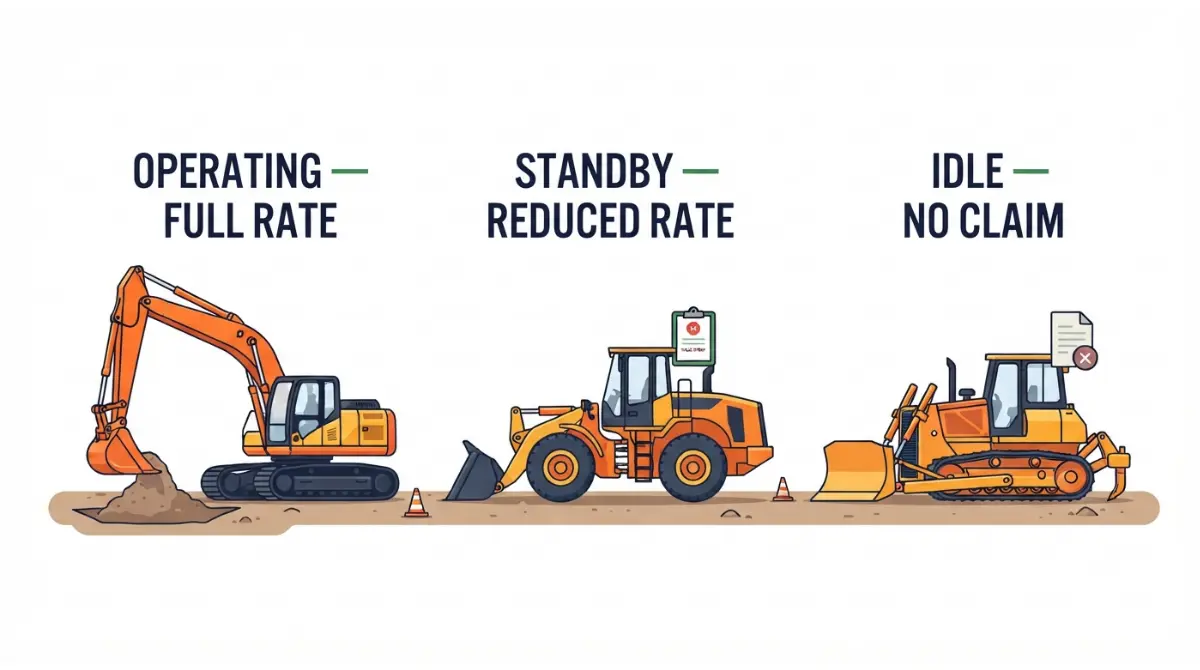
Table of Contents
What you can bill when the machine isn’t working
This guide covers construction equipment — excavators, loaders, dozers, backhoes — owned or rented and billed by the hour in the US. Model year changes a rate guide’s number, not the standby logic; emissions tier doesn’t apply. Trucking detention and layover pay are out of scope.
A machine is in one of three billing states: operating, on standby, or idle with no claim. Operating earns the full rate, standby a reduced one, and idle time earns nothing unless someone ordered the hold.
Billing a general contractor or public owner? Read Sections 2–4. Renting? Jump to Section 5. Building your own rates? Start with our guide to what to charge per hour by machine.
📋 Compliance Note: FHWA guidance covers federal-aid highway contracts only. State agencies and private contracts differ, and your contract controls. This isn’t legal advice.
💵 About These Numbers: No market prices appear here. Formulas and policies come from the named sources, retrieved October 2, 2026; any dollar example is hypothetical.
How the equipment standby rate is calculated
An equipment standby rate is what you may bill while a machine is held on the job but not working. FHWA’s equipment rental rate guidance accepts 50% of an approved guide’s ownership rate, with no operating costs, capped at 8 hours a day and 40 a week.
The 50% convention
The half applies to the ownership rate, not the full hourly rate. With no industry standard, courts have normally halved ownership rates. A hypothetical $40 an hour of ownership cost gives a $20 standby rate.
What the rate leaves out
Operating costs such as fuel are excluded. EquipmentWatch’s own method counts depreciation, facilities capital and indirect costs, and skips overhaul. Your contract’s named guide decides the formula.
For the split between the two, see our guide to owning versus operating cost.
Where the published standby methods disagree
Each source calls it “standby” but counts different costs.
Five methods, one question
| Source | Standby counts | Cap | What It Means |
|---|---|---|---|
| FHWA | 50% of ownership rate | 8/day, 40/week | Federal-aid baseline |
| Army Corps EP 1110-1-8 | Half depreciation plus facilities capital | 40 hours | Corps contracts |
| EquipmentWatch | Depreciation, facilities capital, indirect | 8 per 24 hours | Guide default |
| Montana DOT | EquipmentWatch standby rate | 8/day, 40/week | Breakdown unpaid |
| Indiana DOT | Ownership cost halved (“idle rate”) | Not stated | Guide’s standby figure rejected |
Source: Army Corps EP 1110-1-8 (2021), Montana DOT procedures (2025), FHWA, EquipmentWatch, Indiana memo 18-06; retrieved October 2, 2026. Confirm Indiana’s is current.
Ordered standby is the trigger
Ordered standby is the common thread: WSDOT’s rental agreement pays it only when the Engineer orders it, and Montana requires approval. FEMA’s current schedule reimburses no standby; see our FEMA equipment rates benchmark.
Breakdown, rain days and owner holds: who pays
Check four things in order: whether the machine worked, who ordered or caused the idle, whether weather was the cause, and what your contract says.
Breakdown days
A breakdown earns nothing under Montana’s procedures. WSDOT also withholds standby from other equipment the breakdown idles.
Owner-ordered holds
An owner-ordered hold can earn standby. Montana pays nothing when the contractor suspends work for its own reasons.
Rain days
Routine rain doesn’t qualify for relief. Per delay-claims consultancy Long International, unusually severe weather typically earns time, not money, unless the owner caused the delay.
Last, read your contract; its clause overrides every guide above.
🔧 Stop Here: If a claim runs to thousands of dollars, have a construction attorney or contract administrator read the clause before you invoice.
Renting a machine: rain days and breakdown credits
Rental companies write their own rules, and the two examples below split on breakdowns.
Rain days on a rental
Cat dealer Butler Machinery’s rental terms make no weather allowance and give no rent reduction unless agreed in writing. Professional Pavement Products’ rental form likewise gives no credit for inclement weather. If you rent, plan on paying for rain days.
Breakdown credits
A downtime credit is rent knocked off when a machine can’t run through no fault of yours. Butler credits the rent, swaps the machine or ends the rental when repairs you didn’t cause keep it down past 48 weekday hours; Professional Pavement Products disclaims breakdown downtime expense.
Two examples aren’t a rule, so read your own agreement; it controls.
Log it daily so a standby claim holds up
A standby claim is only as good as its paper trail.
What goes in the daily log
Record hours operated, hours on standby, hours down, weather and who ordered the hold. Montana records hours to the nearest half hour and requires each machine’s serial number and model year.
What agencies ask for
WSDOT ties standby to an Engineer’s order, so get any hold order in writing.
✅ Do This: Keep one log line per machine per day and attach the written hold order to each standby day.
For a full hourly rate on one machine class, see our mini excavator hourly rate guide; to compare pricing models, see hourly versus per-job pricing.
Four billing mistakes that sink a standby claim
Four errors undercut a standby claim, each tied to a rule above.
Billing half the full rate
FHWA’s half applies to the ownership rate; half of the full hourly rate overstates it.
Billing breakdown days
Montana and WSDOT pay nothing for a machine that is broken down.
Billing around the clock
EquipmentWatch normally limits standby to eight hours per 24; FHWA, Montana and WSDOT cap it at 8 hours a day and 40 a week.
Billing without an order
The public documents checked tie standby to an order or approval, so undocumented holds are hard to defend.
Equipment standby rate FAQ
1. What is an equipment standby rate?
An equipment standby rate is the reduced hourly amount billed while a machine is held on the job but not working.
2. Is the equipment standby rate 50% of the full hourly rate?
No. FHWA’s equipment standby rate is 50% of the guide’s ownership rate only, with operating costs excluded.
3. What does a standby rate leave out?
An equipment standby rate excludes operating costs such as fuel; EquipmentWatch’s method also skips overhaul.
4. How many standby hours can be billed?
FHWA and Montana cap standby at 8 hours a day and 40 a week; the Army Corps uses a 40-hour maximum.
5. Is a standby rate the same as an idle rate?
Not always. Indiana DOT halves ownership cost as an idle rate and doesn’t recognize EquipmentWatch’s standby figure.
6. Can you bill standby when a machine breaks down?
Not under Montana’s or WSDOT’s procedures, which pay nothing for a broken-down machine; check your own contract.
7. Can you bill standby on rain days?
Usually not: unusually severe weather typically earns time, not money, unless the owner caused the delay or your contract says otherwise.
8. Do rental companies credit rain days?
Not in the two examples checked: Butler Machinery and Professional Pavement Products both make no weather allowance on rental rates.
9. Is there a breakdown credit on rentals?
It varies: Butler credits downtime past 48 weekday hours for repairs you didn’t cause; Professional Pavement Products disclaims breakdown downtime expense.
10. Do I need written approval before billing standby?
In the public documents checked, standby follows an order or approval, so get the hold in writing before billing standby.
Bill standby only when it’s earned
An equipment standby rate is usually a half-rate on the ownership portion, payable only when a working machine is held at someone else’s order. Breakdown days and most rain days don’t qualify, and your contract beats any rate guide. Work out your ownership cost first, log every day in writing, and read the clause before you invoice.