Estimate the Right Hours to Dig a Foundation With an Excavator

Foundation dig time with an excavator hinges on yards moved, reach, and OSHA’s 5-foot rule. See where three Cat sizes fit.
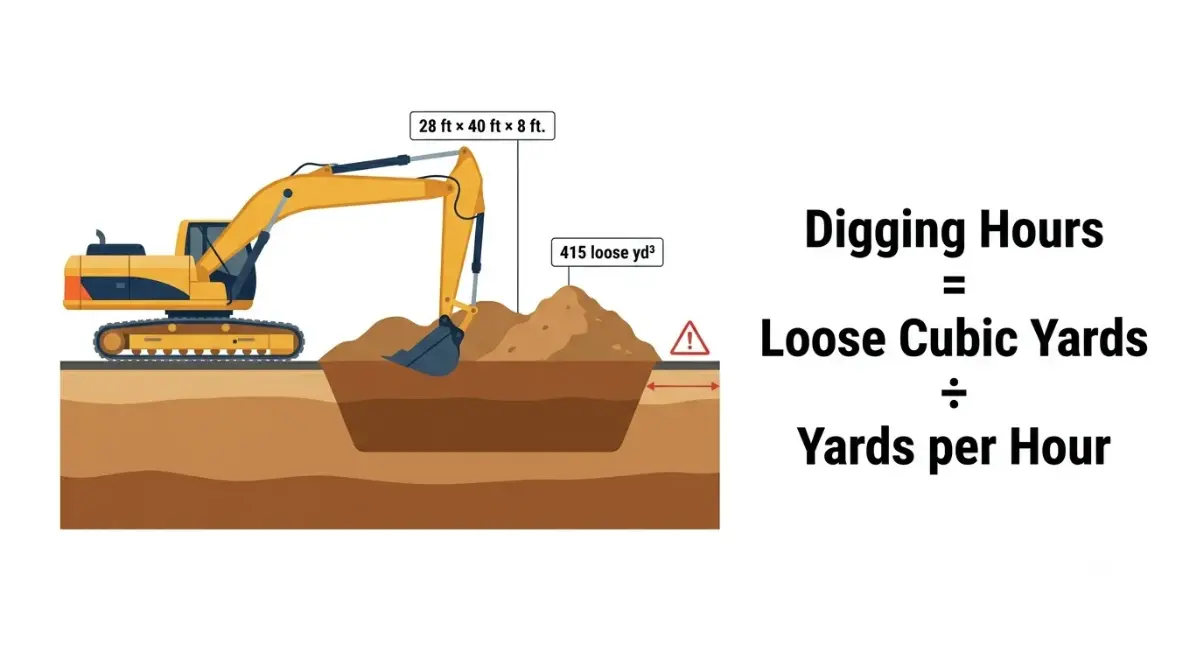
Table of Contents
Short answer: it’s yards in the hole ÷ yards per hour
The one-line formula
Digging a foundation takes the loose cubic yards you must move divided by your excavator’s realistic yards per hour. This guide compares three Cat crawler excavators, about 4 to 25 tons, in common soil; hours are calculated, not measured.
Where to start
First dig? Start with bank versus loose yards. Checking a quote? Jump to the hours table. Going 5 feet or deeper? Read the OSHA section first.
ℹ️ Safety Note: Open excavations can collapse, and buried utilities may sit where you plan to dig. Follow OSHA’s excavation rules, your operator’s manual, and a competent person’s direction.
📋 Compliance Note: OSHA’s excavation standard, 29 CFR 1926 Subpart P, protects employees in excavations; state rules can differ. Confirm with OSHA or your state agency.
Can your excavator even reach the bottom of the footing?
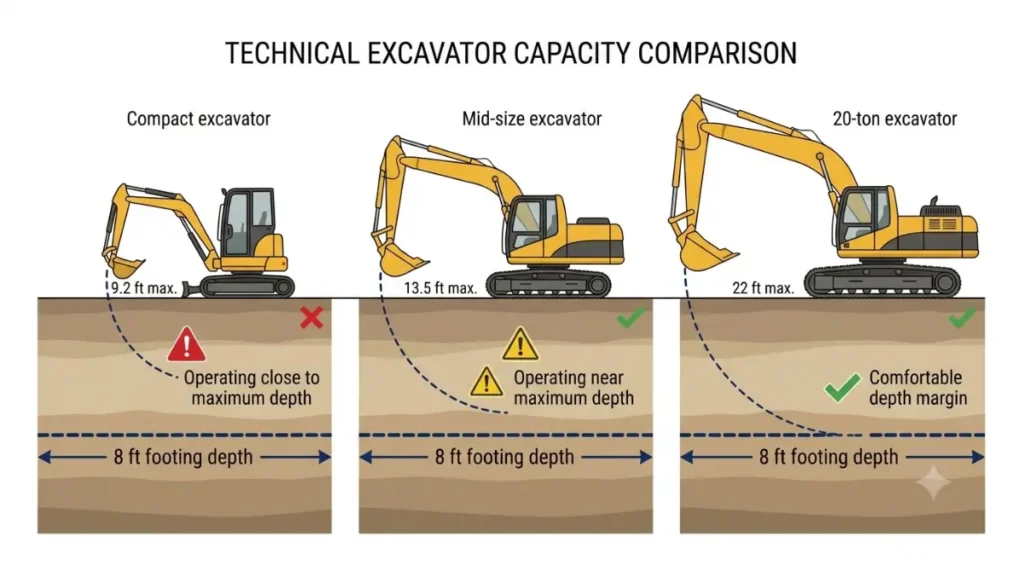
Max dig depth vs. comfortable depth
Maximum dig depth is full-extension reach below grade; estimating references put the efficient zone near 30–60% of it. An 8-foot basement uses about 87% of the 303.5 CR’s reach, 59% of the 308 CR’s, and 36% of the 320’s.
| Class | Cat model | Operating weight | Max dig depth | For an 8-ft dig |
|---|---|---|---|---|
| A | 303.5 CR | 7,673–9,239 lb | 9.2 ft | Near max; size up |
| B | 308 CR | 18,754–20,771 lb | 13.5 ft | Inside the band |
| C | 320 | 49,800 lb | 22 ft | Comfortable margin |
Source: Caterpillar US pages, read October 9, 2026, for the 303.5 CR, 308 CR, and 320.
Check your machine
Confirm depth and bucket size in your operator’s manual. Class A pricing is in our mini excavator hourly rate guide.
Convert the hole to the yards you actually move
Bank yards from the hole’s dimensions
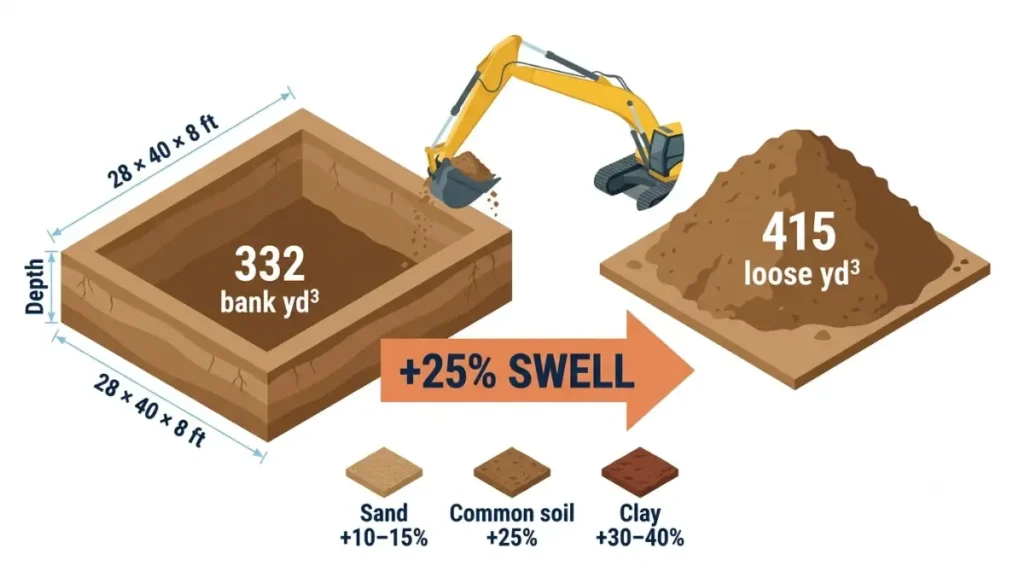
Bank cubic yards measure soil in the ground: length × width × depth in feet, divided by 27. A hypothetical 28 × 40 ft basement dug 8 ft deep is 8,960 cubic feet, or about 332 bank yards.
Swell: why the pile is bigger
Digging loosens soil, and swell runs near 25% for common soil: 332 bank yards becomes about 415 loose. References put sand near 10–15% and clay at 30–40%.
Dig rates by machine size: the job-hours sequence
The five steps in order
Production depends on bucket volume, fill, efficiency, and cycle time:
- Bank yards from the hole’s dimensions.
- Multiply by swell for loose yards.
- Yards per hour = bucket × fill × efficiency × 3,600 ÷ cycle seconds.
- Loose yards ÷ yards per hour, plus non-digging time.
Hours for the example dig
| Class | Illustrative bucket | Loose yd³/hr | Digging hours | What it means |
|---|---|---|---|---|
| A (303.5 CR) | 76 L (0.10 yd³) | 9–19 | 22–46 | Depth too close to max |
| B (308 CR) | 229 L (0.30 yd³) | 28–57 | 7–15 | Workable at this depth |
| C (320) | 1.56 yd³ | 143–296 | 1.4–2.9 | Fastest; heaviest machine |
Calculated, not measured: 415 loose yards; 85–95% fill; 45–50 working minutes per hour; 15–25 second cycles. Bucket volumes are illustrative, from Cat and Cat-dealer listings. Treat these hours as a floor.
What eats hours that bucket math doesn’t count
Utility locates and weather
OSHA requires utility locations determined before you dig, and state wait times can exceed its 24-hour window; see our 811 locate rules for contractors. A competent person must also re-inspect after every rainstorm.
Spoil, trucks, and trimming
Spoil and equipment must stay at least 2 feet from the edge unless retaining devices hold them back. Waiting on trucks, trimming to grade, and a first-time operator all add hours the formula never counts.
✅ Do This: Request utility locates before booking the machine. Read OSHA’s specific excavation requirements.
Turn hours into a job cost, then decide rent vs. hire
Hours × rate
Multiply hours by the hourly rate for your class from our equipment hourly rates by machine guide or the cost-per-hour calculator. Delivery and minimum rental periods sit outside the hourly rate.
Rent or hire?
Hire the dig if depth nears the machine’s maximum, a protective system is required, or no one has run an excavator. Pricing jobs for others? See hourly vs. per-job excavation pricing.
Before you dig: the OSHA rules that change your plan
Depth thresholds
OSHA requires a protective system at 5 feet deep or more unless the excavation is in stable rock; shallower digs need a competent person’s exam showing no sign of cave-in, per OSHA’s protective-system rules.
Why sloping enlarges the hole
At OSHA’s default 1½:1 slope, an 8-foot dig widens 12 feet per side. Keeping the 28 × 40 ft bottom, our example grows from about 332 to 630 bank yards, so sloping roughly doubles the work.
🔧 Stop Here: If anyone will enter a 5-foot hole, bring in a competent person to classify soil and choose sloping, shoring, or shielding.
Frequently asked questions
1. How long to dig a foundation with an excavator?
Loose yards ÷ yards per hour, plus non-dig time; our example runs 1.4–46 digging hours by size.
2. How many cubic yards is a basement dig?
Length × width × depth in feet ÷ 27; 28 × 40 × 8 ft is about 332 bank yards.
3. What is swell factor in excavation?
Volume growth when soil is dug; common soil swells about 25%, so 332 bank yards becomes roughly 415.
4. How deep can a mini excavator dig?
Cat’s 303.5 CR reaches 9.2 feet; confirm yours in your manual and serial range.
5. What size excavator suits a basement?
The smallest keeping depth within 30–60% of maximum; near the limit, size up or hire.
6. How many yards per hour does an excavator move?
About 9–19 loose yards (303.5 CR), 28–57 (308 CR), and 143–296 (320), under our assumptions.
7. Does digging deeper slow an excavator?
Yes; efficiency falls outside roughly 30–60% of maximum depth, so work slows near the limit.
8. When does OSHA require shoring or sloping?
At 5 feet or deeper unless in stable rock; shallower digs need a competent person’s exam. Ask a competent person.
9. Must utilities be located before digging?
Yes; OSHA requires locations determined first, and state waits can run longer. Contact the utility owners.
10. Rent an excavator or hire an operator?
Hire if depth nears maximum, protection is required, or no one has run an excavator.
Plan the dig, then re-forecast after day one
Hours equal loose yards divided by yards per hour, plus time the bucket isn’t digging. Run it for your hole and machine, then replace the assumptions with real yards moved after day one.