Excavator cold start in winter, from plug-in to first bucket

Cold excavator starts in winter: DEF freezes at 12°F yet won’t stop the engine starting, and No. 2 diesel clouds near 14°F, so blend fuel early.
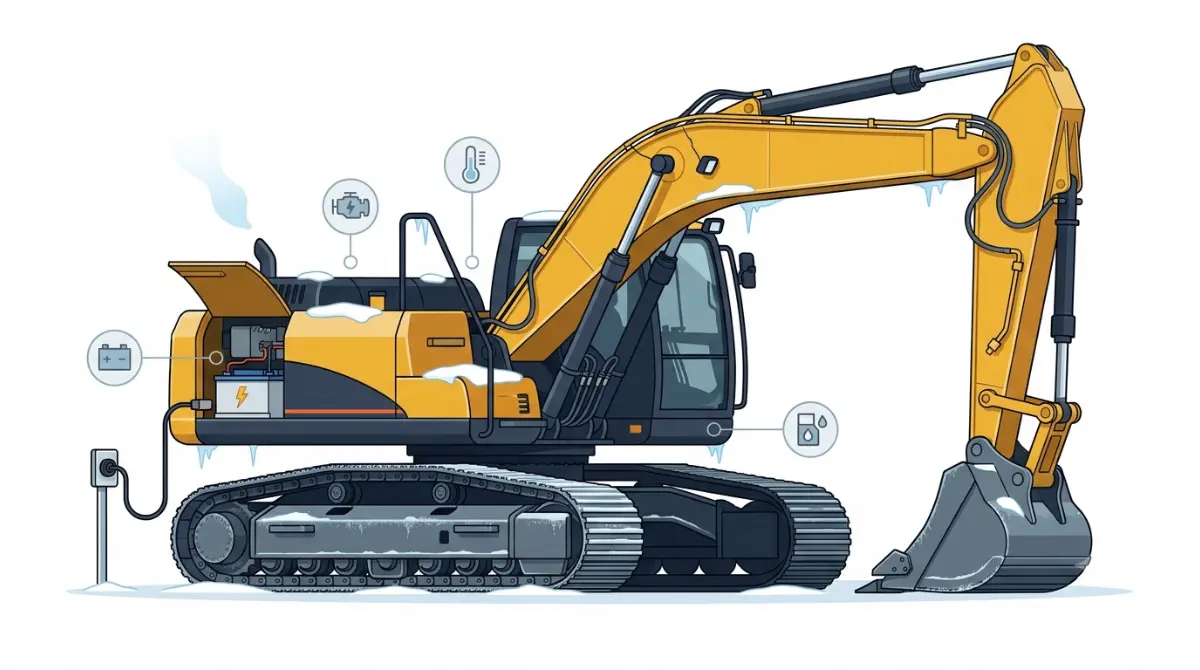
Table of Contents
Rates and sources checked on October 27, 2026.
Plug in the block heater on a timer, let the preheat lamp go out before you crank, then idle about five minutes and work every hydraulic function slowly until the cab gauges read normal. Fuel, DEF and batteries get their attention the week before a cold snap, because none of them can be fixed fast on a frozen morning.
This covers diesel crawler and wheeled excavators of any size; the DEF points apply only to Tier 4 Final machines with SCR. The operation and maintenance manual for your serial range sets your warm-up time, cranking limit and oil grades, and it governs.
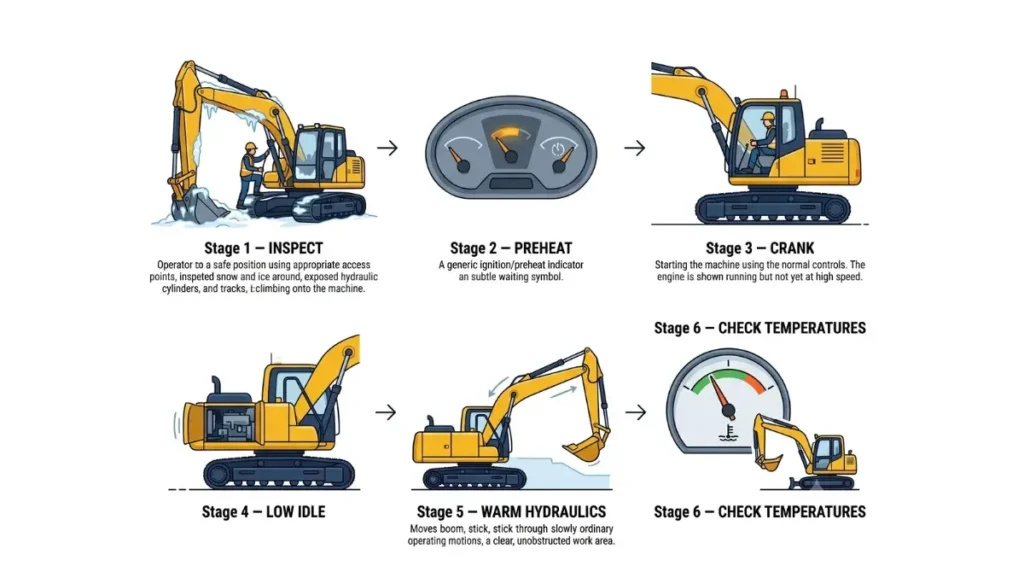
Start-up on a cold morning, step by step
- Knock packed snow and ice off the boom and cylinders before you climb in. Volvo CE warns that snow compacted around a hydraulic cylinder can break it.
- Turn the key to on and wait for the glow plug or intake heater lamp to go out.
- Crank within the time limit your manual gives, then let the engine settle at low idle.
- Idle for about five minutes, the figure in both Volvo CE’s and SANY America’s winter guidance, and longer in extreme cold.
- Move off slowly and cycle the boom, stick, bucket and swing so warm oil reaches the cylinders and lines.
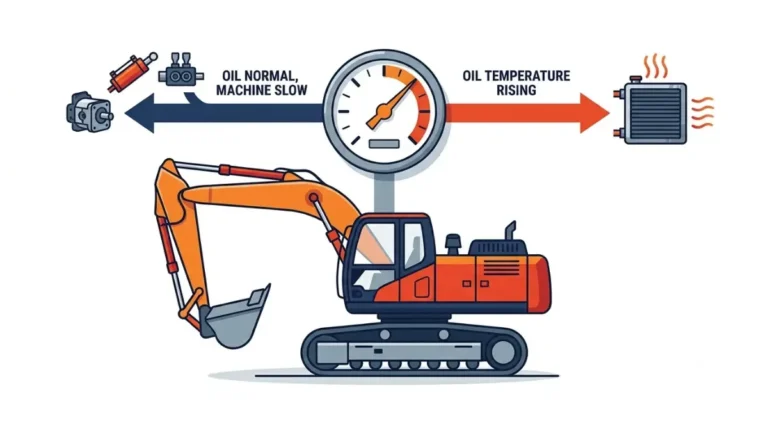
- Go to full power once the temperature indicators in the cab sit in their normal range.
Some manuals add a hydraulic warm-up step, such as holding a function over relief in short bursts. Do it only if your manual describes it, for the time it states.
Blocking off part of the radiator also speeds warm-up, according to Caterpillar’s cold-weather fleet tips.
Where each system gives out in the cold
Two of the lines below sit only about two degrees apart, and they belong to DEF and No. 2 diesel.
| System | Published line, °F (sources checked Oct. 2026) | What it means at start-up | Source |
|---|---|---|---|
| Batteries | No single line | Cranking takes nearly twice the amps in cold weather | Caterpillar |
| No. 2 diesel | About 14 | Wax crystals form and can plug the fuel filter | Cenex |
| No. 1 diesel | About −35 | Blending it in lowers a tank’s cloud point | NDSU Extension |
| DEF (Tier 4 Final, SCR) | 12 | The engine still starts with frozen DEF | Cummins |
| Engine and hydraulic oil | Set by your manual’s viscosity chart | The grade has to suit your coldest mornings | Your operation and maintenance manual |
Frozen DEF looks worse than it is. Once the engine runs, the SCR system heats the tank and lines and the fluid thaws with nothing for you to do.
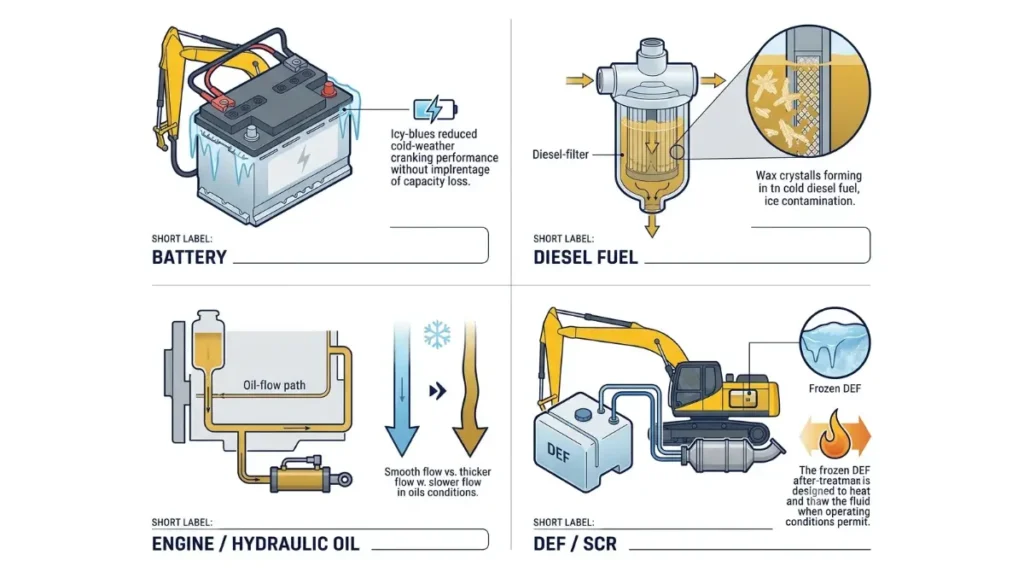
Oil is the one row without a number, because the grade follows your machine’s chart. If a change comes due this winter anyway, the guide to hydraulic oil change intervals by brand covers the timing.
Block heater vs idling, priced by the hour
One hour of idling costs as much as about 34 hours on a 600-watt block heater.
The inputs:
- Heater draw: Caterpillar’s 594-6293 block heater kit uses a 120-volt, 600-watt jacket water heater.
- Electricity: 13.54 cents per kilowatt-hour, the US commercial average for May 2026.
- Fuel burn: 0.44 gallon per hour, Argonne National Laboratory’s no-load idle figure for a diesel medium-heavy truck with a 6- to 10-liter engine. Argonne did not measure excavators, so use your telematics idle burn if your machine reports one.
- Diesel price: $6.276 a gallon, the EIA US on-highway average for the week of October 19, 2026.
The working: 0.6 kW × 1 hour × $0.1354 = $0.08 for the heater, and 0.44 gal × $6.276 = $2.76 for the idle.
Four hours on the timer before a start comes to about 32 cents. An extra 20 minutes of idle each morning instead costs about 92 cents. It also puts a third of an hour on the meter for no work, which over 20 working days is 6.7 hours counted toward the next service. Those idle hours also feed into Tier 4 operating costs per hour and the owning costs by excavator size.
Note: EIA’s figure is the pump price for on-highway diesel with taxes included. Price the idle with what your off-road fuel costs delivered.
Starting fluid and long idles
Caterpillar’s cold-weather guidance keeps starting fluid on a short leash: store it at room temperature and inject it only while the engine is cranking. Engines with glow plugs or an intake air heater are a separate case. The starting-aid section of your manual decides whether starting fluid is allowed on them at all. If it says no, the answer is no.
Hazard: Starting fluid is highly volatile and flammable. Keep it and any open flame away from a cold engine bay, and use it only by the method your manual gives.
Long warm-up idles cost more than they save. Draft model guidance from the Ozone Transport Commission for nonroad diesel equipment puts the warm-up most modern machines need at 3 to 5 minutes unless the manufacturer specifies longer. It also treats working the machine as the faster way to warm it. If a Tier 4 machine has started regenerating more often, DPF regen problems on excavators covers the light-load side of it.
Winter fuel goes in before the cloud point
Once overnight lows head toward 30°F, blend stored No. 2 diesel with No. 1 and additives while the fuel is still about 15°F above its cloud point. Each 10% of No. 1 lowers cloud point by about 3°F, and crystals that form before you blend stay in the fuel.
Cold flow improvers keep wax crystals from clumping but do not lower cloud point, and they will not blend into fuel already at or below it.
Store bulk DEF below 86°F and above its freezing line, and put batteries into winter fully charged. These checks belong in the fall service on your mini excavator maintenance schedule.
Cranks but won’t fire? What the dealer tests
A cold no-start shows up in one of three ways:
- Slow or clicking crank: battery charge and cable connections come first, given the cranking load in the table above.
- Normal crank with no fire: let the whole preheat cycle finish before cranking again. A lamp that never lights or never goes out points to the preheat circuit.
- Fires, then dies or loses power: suspect clouded fuel, since wax at the filter starves the engine.
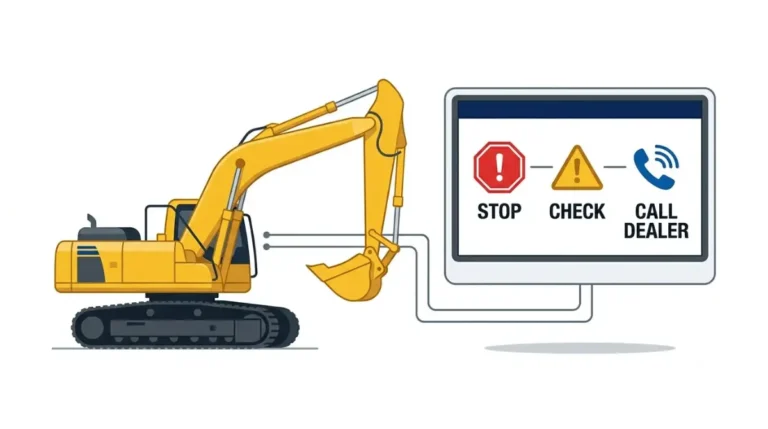
Past those checks, call the dealer service department and ask them to test the preheat circuit and read any stored codes. Jump-starting follows the procedure in your manual for your machine’s electrical system. If nobody on the crew knows it, have a qualified equipment technician walk through it before the first hard freeze.
Warm the machine outdoors or in a ventilated bay. Carbon monoxide risk rises in winter inside buildings sealed against cold and wind.