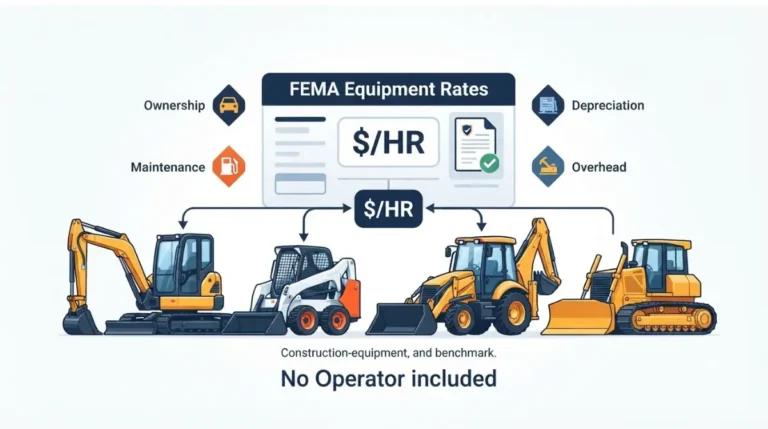
Backhoe hourly rate for Case 580 and Deere 310 work

Backhoe rates with operator ran $75–$150 an hour in Maryland and Delaware’s 2025 survey, and the $125 median is under the floor for FEMA’s older Case row.
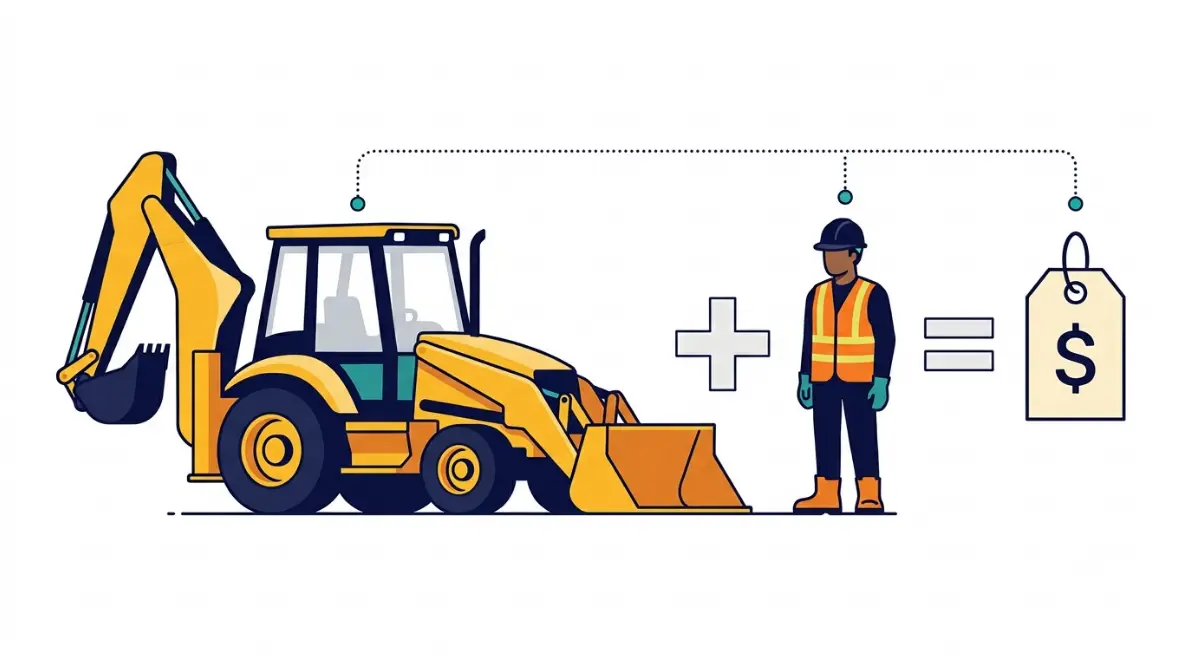
Table of Contents
Rates and sources checked on November 4, 2026.
Two contractors bid $170 and $210 an hour for a loader/backhoe with operator on the Town of Greenwich, Connecticut equipment rental bid tabulation dated March 25, 2026, and the town’s terms put insurance, fuel and transport to and from the job inside those rates. Maryland and Delaware operators reported $75 to $150 per hour of backhoe work, with a $125 median, in the 2025 Custom Work Charges survey from the University of Maryland and University of Delaware.
The Greenwich tab asked bidders to specify size and make but doesn’t show what each one named. The survey files the row as “Backhoe Rental (Rate/Hour)” and says its reported rates include the machine, fuel, lube and the operator’s labor. Public schedules price something narrower, and the gap between the two is the person in the seat.
Where a 580 Super N or 310 P-Tier sits on public schedules
Neither machine appears by name on FEMA’s 2025 schedule or on Iowa DOT’s FY 2027 list. FEMA prices the class through a CAT 420 row and an older Case row, and Iowa splits loader-backhoes at 90 hp.
| Schedule row | Applies to | Region and window | Machine rate, USD per hour, operator not included |
|---|---|---|---|
| FEMA code 8572 | CAT 420 center-pivot backhoe loader, 92/103 hp net, 14 ft dig, 24,251 lb | National, disasters declared on or after July 1, 2025 | $110.03 |
| FEMA code 8401 | Case 580 Super L, 80 hp, 0.87 cu yd, listed as discontinued 2000 | National, same window | $92.56 |
| Iowa DOT, loader-backhoe, wheel | More than 90 hp | Iowa cities and counties, FY 2027 | $72.55 |
| Iowa DOT, loader-backhoe, wheel | 90 hp or less | Iowa cities and counties, FY 2027 | $54.68 |
Sources: FEMA 2025 Schedule of Equipment Rates; Iowa DOT Schedule of Equipment Rates, FY 2027.
FEMA’s rates cover depreciation, overhead, maintenance, field repairs, fuel, lubricants and tires, and its schedule page states that “Labor costs of the operator are not included in the rates.” Iowa builds its rows from the Rental Rate Blue Book, and the state rule counts operator wages as a separate labor cost (Iowa Administrative Code 761, chapter 178).
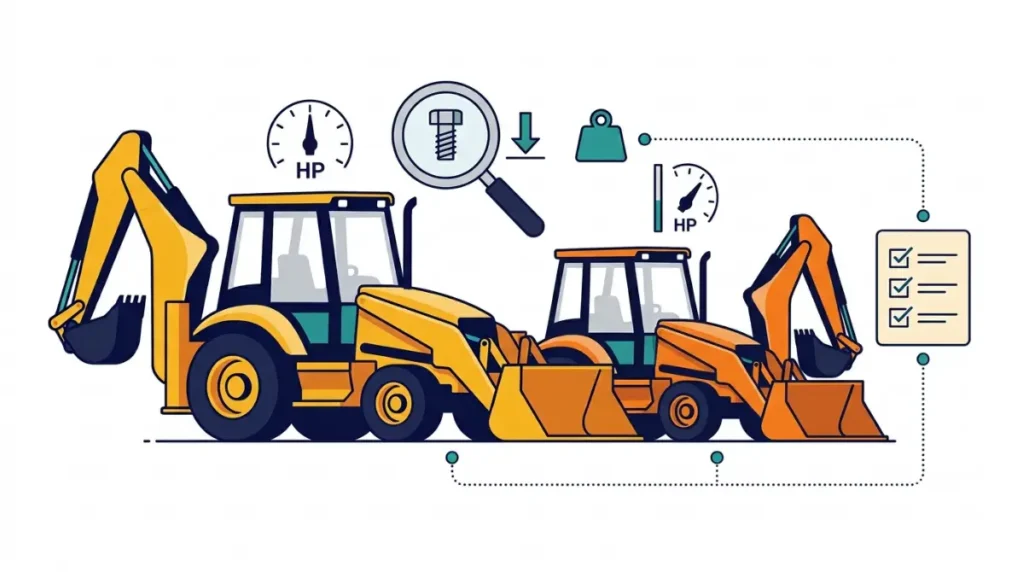
The Tier 4 Final Case 580SN is rated 95 net hp, with 14 ft 6 in of maximum dig depth on the standard dipper and 17 ft 11 in with the Extendahoe out (Case spec sheet for the 580SN, 2018 edition). The Final Tier 4 310 P-Tier carries 100 hp net peak at 1,600 rpm, weighs 16,217 lb and digs 13 ft 8 in on the standard dipperstick (Papé Machinery’s 310 P-Tier spec page). On power, both sit nearer FEMA’s 420 row and inside Iowa’s upper band. Your serial-number spec sheet and operator’s manual settle the match.
For how FEMA’s numbers work as a reference, see using FEMA equipment rates as a benchmark. Iowa’s rows also move between schedules: its upper-band rate was $96.96 in FY 2025 and $70.38 in FY 2026, so the FY 2027 figure is 25.2% below its level two schedules back.
What does the operator add to each hour?
Operating engineers and other construction equipment operators earned a median $59,850 a year in May 2025 (BLS Occupational Outlook Handbook). Over a 2,080-hour year that is $28.77 an hour.
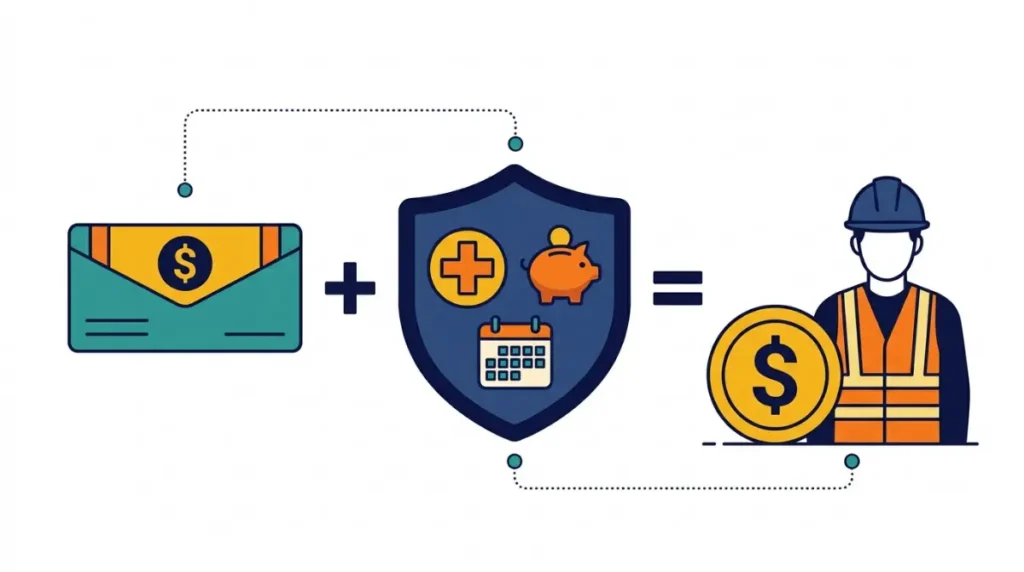
Pay is only part of the cost. For construction employers, benefits ran $15.84 an hour against $36.13 in wages in June 2026, a load of 43.84% on top of pay (BLS employer costs for employee compensation by industry). That benefit figure counts paid leave, insurance and retirement as well as legally required payroll costs.
$28.77 × 1.4384 = $41.38 per operator hour, loaded.
If your operator draws no paid leave or retirement, the 10% surcharge used in the skid steer, excavator and dozer rate breakdown fits better. On the same wage it gives $31.65.
$151 an hour: the floor under a 420-class backhoe
A floor is the schedule’s machine rate plus the loaded operator, before overhead, travel, insurance or profit. Bill below it and the hour doesn’t cover the machine and the person running it.
| Schedule row | Applies to | Floor, USD per hour (schedule machine rate + loaded operator cost) |
|---|---|---|
| FEMA code 8572 | CAT 420, 92/103 hp net | $151.41 |
| FEMA code 8401 | Case Super L, 80 hp | $133.94 |
| Iowa DOT, FY 2027 | Loader-backhoe over 90 hp | $113.93 |
| Iowa DOT, FY 2027 | Loader-backhoe 90 hp or less | $96.06 |
Worked out from the FEMA, Iowa DOT and BLS figures above.
FEMA’s 420 floor and Iowa’s upper-band floor sit $37.48 apart for machines of similar power. Neither agency publishes the cost build behind its row, so your own ownership cost decides where inside that spread you belong.
Connecticut bids and Maryland survey rates against that floor
Greenwich’s two bids land $18.59 and $58.59 above the 420-row floor. Under the town’s terms, that margin carries insurance, transport, overhead and profit. The town pays a minimum of four hours, at straight time only.
The survey reads differently. Its $125 median falls $26.41 short of the 420-row floor and $8.94 short of the Super L floor, and the $118.75 average is $15.19 under that Super L line. Only Iowa’s upper-band floor sits beneath the median, by $11.07. The $75 low reaches none of the four.
At least half the operators in the Maryland and Delaware survey reported a rate below the floor for a machine FEMA lists as discontinued. At these inputs, a rate that low leaves either the machine’s depreciation or part of the operator’s loaded cost unpaid.
Before you quote: start from the floor for the row that matches your machine, then add overhead and travel before any profit. Matching a neighbor’s lower rate means absorbing the difference yourself.
A year of diesel added $3 to $4.50 an hour
Caterpillar’s fuel tables, built from telematics data, give the 420 a burn rate at three load levels. U.S. on-highway diesel averaged $6.292 a gallon for the week of November 2, 2026, $2.539 above a year earlier (EIA Gasoline and Diesel Fuel Update).
| Load level | Applies to (Cat 420 series, share of idle time) | Fuel burn, gal per hour | Added cost in dollars an hour, from the U.S. diesel rise, Nov 2025 to Nov 2026 |
|---|---|---|---|
| Low | 420-07, 50% idle | 1.16 | $2.95 |
| Medium | 420-07, 30% idle | 1.46 | $3.71 |
| High | 420-07, 10% idle | 1.77 | $4.49 |
Source: Cat Performance Handbook fuel consumption tables, North America, December 2022; added cost is burn × $2.539.
Regional rises shift the medium-load figure to $3.84 in the Midwest (up $2.629 a gallon) and $4.59 in California (up $3.143). Even at high load, the year’s fuel increase comes to about 11% of the operator’s loaded cost. EIA’s prices include highway taxes that dyed off-road diesel doesn’t carry, so price your own burn at the figure on your fuel invoice.
Case’s Super N also draws diesel exhaust fluid from a 3.6-gallon tank, and Cat’s backhoe tables give no DEF rate, so DEF stays outside these numbers. When diesel moves mid-contract, a fuel surcharge clause for equipment work handles it without reopening your quote.
Lines that belong outside the hourly rate
A minimum charge, like the one Greenwich pays, sits beside the rate. Attachments are another: on the same tab, the hammer lines came in at $250 and $340 an hour, which puts the hammer premium at $40 for one bidder and $170 for the other.
Standby is a third. FEMA won’t pay for an idle machine (“Standby equipment costs are not eligible”), so a contract written on its terms leaves waiting time with you. On private work, put the waiting rate in writing first; billing standby time on equipment jobs covers how.
If the haul isn’t in the rate, the trip goes on its own line, and mobilization fees and minimum charges covers how to set both.
Hazard: Trench walls can collapse without warning, burying and crushing a worker. OSHA requires a protective system in trenches 5 feet deep or more unless the excavation is entirely in stable rock, and at 20 feet or more the system must be designed by a registered professional engineer (OSHA trenching and excavation fact sheet). Ask the site’s competent person which protective system the trench needs before you price it, and bill the trench box or shoring separately. Call 811 before the bucket goes in.
Pull last year’s billed hours before the next quote
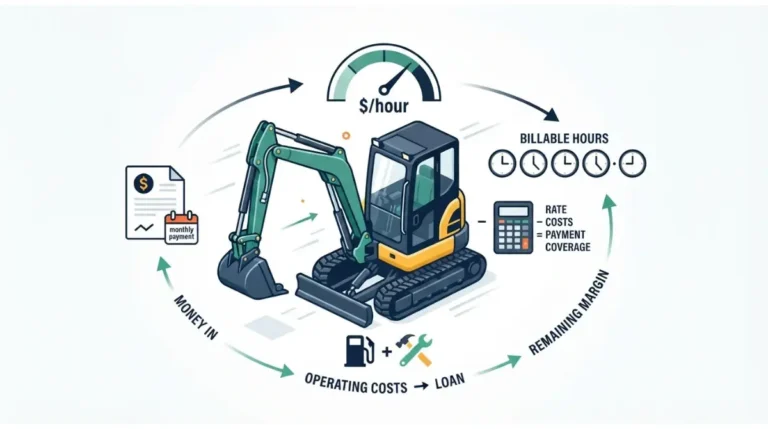
Your own floor depends on billable hours, because the machine’s ownership cost spreads across every hour you invoice. Total the hours you invoiced on the backhoe last year and divide your annual ownership and insurance cost by that number. Add the gallons per hour your fuel receipts show, at your own price, and swap the loaded operator figure above for the one your payroll shows. If the result runs above the FEMA 420 row, quote from yours, and check your hours against billable hours a year for owned equipment.