Equipment hourly rates by state from extension surveys

Equipment hourly rates by state vary less than jobs do: Texas dozer responses over 160 hp spanned $230, wider than any gap between state averages.
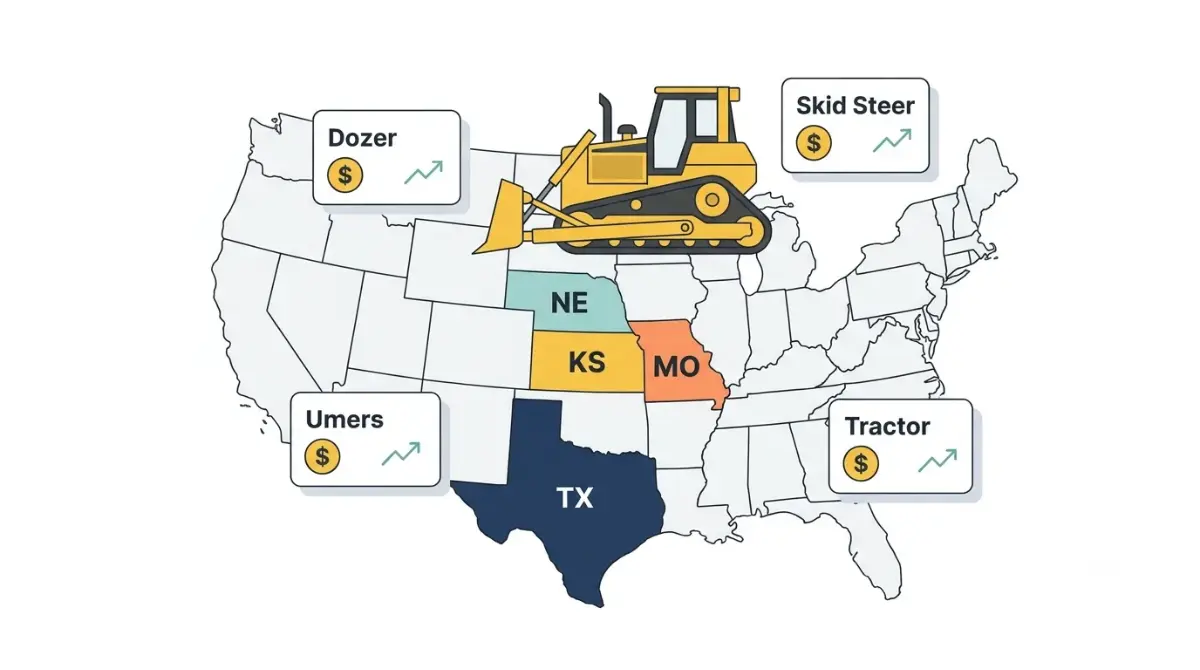
Table of Contents
Rates and sources checked on October 23, 2026.
Operated dozer work averaged $144 to $240 an hour across the 2026 custom rate surveys from Kansas, Missouri, Nebraska and Texas, with the operator and fuel included in the price. Bare skid steer and tractor rent, with no fuel or operator, comes in a separate table further down, because a rent figure and an operated figure measure different things.
Kansas, Missouri, Nebraska and Texas rates with an operator
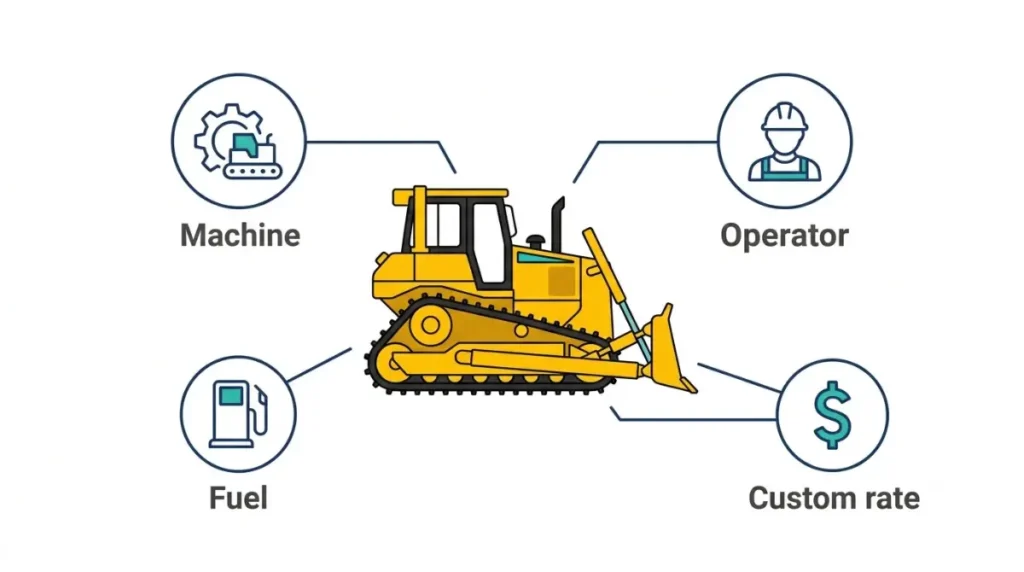
A Kansas custom rate pays for the machinery, the power unit, the fuel and the operator, and leaves out materials such as seed and chemicals. Each row below is one survey line, kept as its state reported it, with nothing blended across state lines.
| Machine and job | State | Average, USD per hour with operator and fuel | Range | Responses |
|---|---|---|---|---|
| Dozer, land clearing, under 160 hp | Texas | $144.23 | $50–$250 | 26 |
| Dozer, land clearing, over 160 hp | Texas | $176.46 | $70–$300 | 24 |
| Bulldozer, over 150 hp | Missouri | $198.89 | $165–$235 | 9 |
| General dozer work | Kansas | $202.86 | $150–$275 | 21 |
| Bulldozing and clearing land | Nebraska | $240 | $210–$275 | 4 |
| Mini excavator, 2–6 ton band | Missouri | $110.00 | $100–$135 | 5 |
| Excavator, medium and large | Missouri | $198.33 | $140–$250 | 6 |
| Excavating and hauling | Nebraska | $200 | $175–$250 | 4 |
| Skid loader | Missouri | $120.50 | $100–$150 | 10 |
| Skid loader tree shearing | Kansas | $138.08 | $60–$220 | 26 |
Sources: Kansas Custom Rates 2026 (K-State and the Kansas Department of Agriculture, rates for 2025–2026); Custom Rates for Farm Services in Missouri (University of Missouri Extension, revised March 2026, surveyed fall 2025 through winter 2026 on rates charged or paid in 2025; its heavy-equipment table includes operator labor); 2026 Nebraska Agricultural Custom Rates (University of Nebraska–Lincoln, April 2026, rates for late winter 2025 and early 2026); 2026 Texas Agricultural Custom Rates (Texas A&M AgriLife Extension, published February 2026, surveyed August through October 2025). Missouri labels its mini excavator band “2–6 tons” without saying whether it means US short tons or metric tonnes.
For dozer size classes and what a bare dozer rents for by the day, the D3 to D6-class dozer hourly rates go machine by machine. Texas prices excavator work per acre rather than per hour, so it has no excavator row in this table.
Bare machine rent before fuel and labor
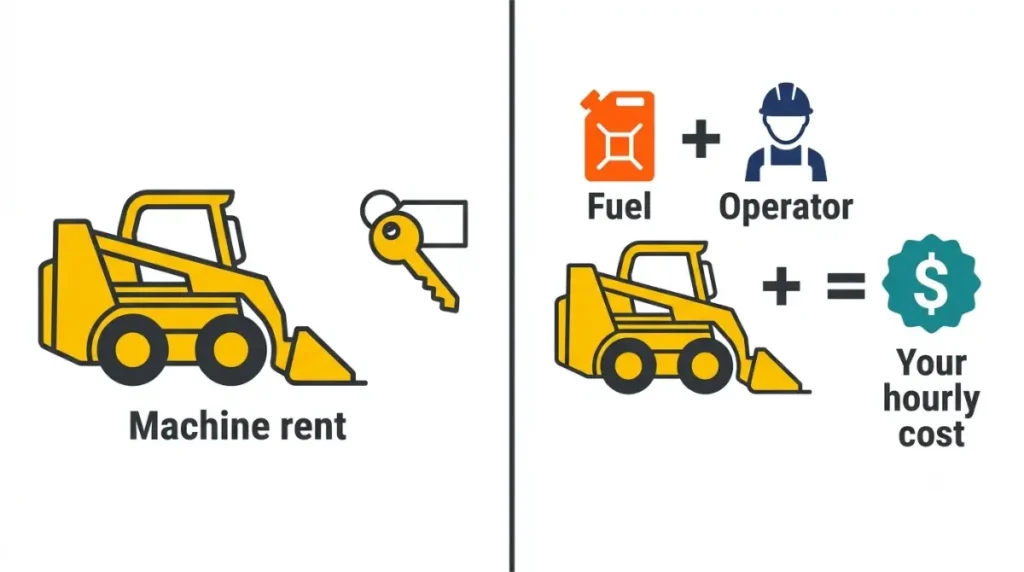
Without an operator or fuel, a skid steer rents for less than either operated skid loader rate above.
| Machine | State | Average, USD per hour, machine only | Range | Responses |
|---|---|---|---|---|
| Skid loader | Kansas | $95.56 | $80–$120 | 9 |
| Skid steer | Nebraska | $105 | $60–$150 | 4 |
| Tractor, 250+ hp | Kansas | $203.43 | $80–$260 | 7 |
| Tractor, over 250 PTO hp | Nebraska | $158.57 | $85–$400 | 7 |
| Tractor, over 250 hp | Texas | $128.15 | $36.40–$250 | 23 |
Sources: the machinery rental table in the Kansas report (page 34); the skid steer and tractor rental lines in the Nebraska report (pages 23–24), priced per metered hour, meaning time on the hour meter; the tractor rental table in the Texas report (page 4). All five rows exclude fuel and operator.
Rent is the figure to hold up against a rental yard’s counter rate. It tells you nothing about what to charge once you are the one in the seat, which is where building a skid steer or CTL rate from your own costs comes in.
Missouri’s guide gives a rough tractor rule in place of a rental table: $0.72 per engine horsepower per hour, a median it asks readers to treat with caution because few people answered. On a 250 hp tractor, that rule works out to $180 an hour.
Does the state matter more than the job?
A $40.31 gap on dozer work shows up inside Kansas alone, with the eastern region averaging $218.64 an hour and central Kansas $178.33.
Across the four states, the highest and lowest dozer averages in the first table sit $95.77 apart. Compare only the rows for dozers over 150 to 160 hp and the gap narrows to $63.54. The Texas responses for dozers over 160 hp, on their own, ran across $230 from bottom to top.
Skid steer rent follows the same pattern. Nebraska’s average sits $9.44 above Kansas’s, while Nebraska’s own four responses span $90.
So a contractor in central Kansas and one in eastern Kansas can be further apart than two state averages several hundred miles from each other. Missouri’s guide puts the width of its ranges down to the type and size of equipment, the mix of labor and equipment, and the different aims of full-time custom operators and farmers doing custom work on the side.
Find your state’s latest survey and its date
Kansas and Nebraska survey every other year, as does Ohio, and Missouri goes every three years, so editions across state lines rarely line up.
| State | Latest edition | Publisher | Report |
|---|---|---|---|
| Iowa | 2026, revised March 2026 | Iowa State University Extension | Iowa Farm Custom Rate Survey (A3-10) |
| Kansas | 2026 | K-State and Kansas Department of Agriculture | Kansas custom rates survey page |
| Nebraska | 2026 (EC823) | University of Nebraska–Lincoln Extension | Nebraska custom rates |
| Missouri | 2026 (G302) | University of Missouri Extension | Missouri custom rates guide |
| Texas | 2026 | Texas A&M AgriLife Extension | Texas A&M custom rates survey page |
| Ohio | 2026 | Ohio State University Extension | Ohio custom rates and machinery costs |
| Michigan | 2026, released December 2025 | Michigan State University Extension | MSU custom work rates report |
| Maryland and Delaware | 2025 | University of Maryland Extension | Maryland custom work charges |
| Arkansas | 2025 | University of Arkansas Cooperative Extension | Arkansas custom rates (FSA-21) |
| Georgia | 2024 | University of Georgia | 2024 Georgia Custom Rate Survey Summary |
| Kentucky | 2024 | University of Kentucky | Custom machinery rates for Kentucky |
| Mississippi | 2024 | Mississippi State University Extension | Custom Rates for Mississippi (P4048) |
| Tennessee | 2023 | University of Tennessee Extension | Tennessee custom rates (D239) |
| Pennsylvania | 2022 | USDA NASS | Pennsylvania Machinery Custom Rates |
| Oklahoma | 2021–2022 | Oklahoma State University Extension | Farm and Ranch Custom Rates (CR-205) |
Michigan’s report is built from machinery cost estimates for Michigan conditions, so read its figures as the cost of doing the work. South Dakota State University Extension reopened its custom farming rates survey in May 2026, the first in several years.
Public work: DOT schedules adjust rates by state
Caltrans sets its own numbers. The current Labor Surcharge and Equipment Rental Rate Book runs from September 1, 2026 through March 31, 2027 and prices the cost of equipment ownership on Caltrans contracts.
Many other DOTs work from the EquipmentWatch Rental Rate Blue Book under the FHWA method. Iowa DOT’s Blue Book specification takes the monthly ownership rate, multiplies it by Iowa’s regional adjustment and a model-year adjustment, divides by 176 hours, then adds the hourly operating cost. Oregon’s specification sets the regional adjustment at 1.00, which leaves the ownership rate unchanged.
The contracting agency’s specifications decide which schedule, edition and adjustments apply to your job. Before you price extra work on a public contract, ask the agency’s construction office which rate book edition your contract uses and whether regional and model-year adjustments apply. Disaster work runs on a single federal schedule, and how FEMA equipment rates work as a benchmark covers that one.
Price above rent plus labor before you quote
Start from what the machine costs you to put on a job. Rent at Nebraska’s average skid steer rate from the rent table, pay yourself the $28.79 an hour Nebraska custom operators reported as their average labor rate, and you are at $133.79 an hour before fuel.
Add your own gallons per hour times the diesel price; Nebraska respondents expected to pay $2.93 a gallon in 2026. Then add margin.
Kansas gives a cross-check. Its tree-shearing rate in the operated table sits $42.52 above the state’s bare skid loader rent, and that $42.52 has to pay the operator, the fuel, the shear and the profit.
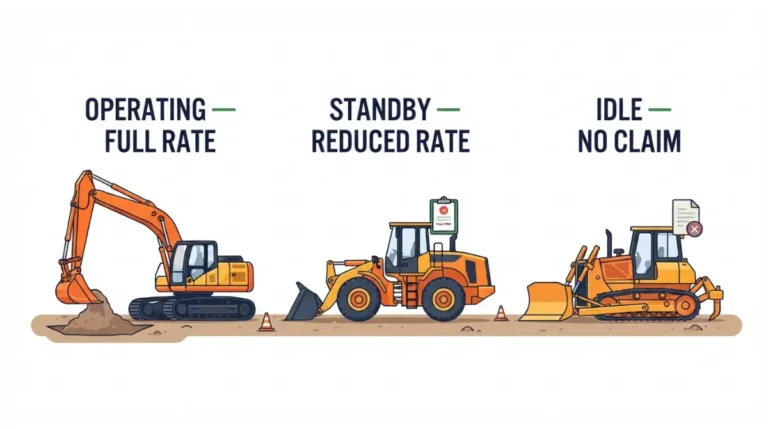
Mobilization, minimum charges and standby time sit outside every hourly figure on this page; how mobilization fees and minimum charges are set covers the first two. To build the figure from your own costs, start with how owning and operating costs split per hour, then set it beside the hourly rates for each machine class.