Straight Answer on a Contractor License for Excavation Work

A contractor license for excavation can hinge on a dollar line, a type of work or a city rule. Here is the order to check them in before you quote.
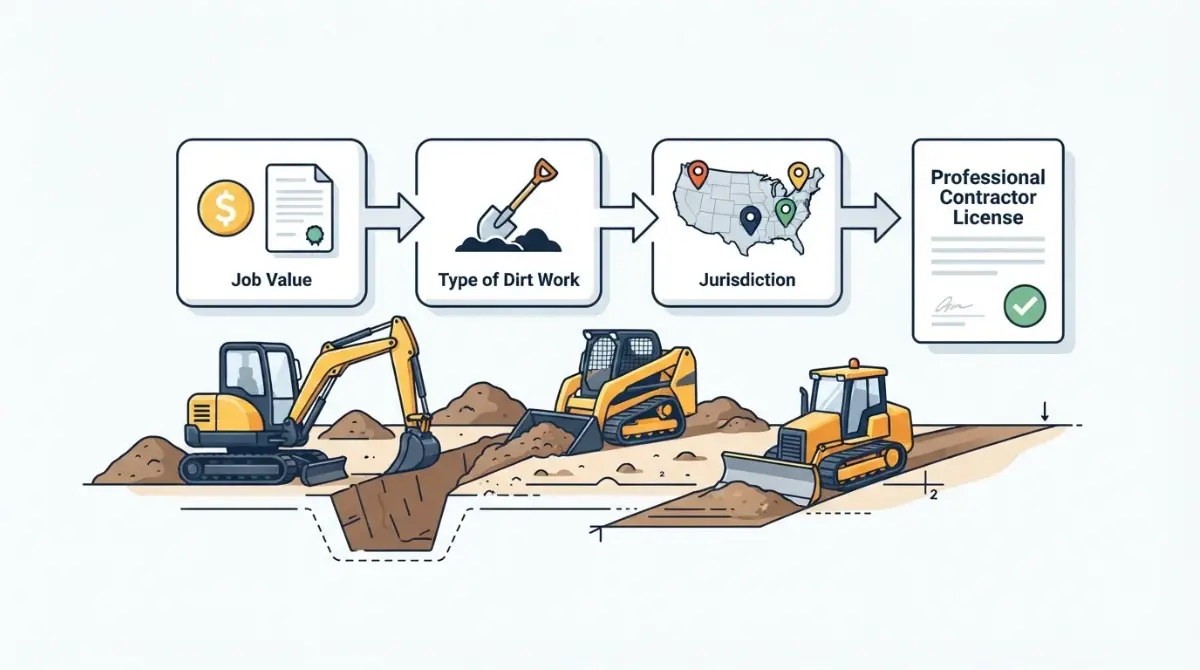
Table of Contents
Short answer: it depends on the job size and where you dig
U.S. rules only, reviewed October 2026: this covers the contractor license for excavation (state and city level) for paid work with excavators, backhoes, dozers and skid steers. Operator tickets, CDL transport and emissions eras are out of scope.
We found no federal contractor license program, so states and cities decide. California’s small-job exemption ends at $1,000, or sooner if you hire workers or need a building permit; Tennessee’s line is $25,000 and up. A contractor license is a credential to take paid work, not a permit for one dig.
If a neighbor just asked you to dig for pay, start at Check 1 in Section 3. If you are pricing a first job, read contractor rate vs. homeowner rate once the checks are done. If you cross a state line, go to Section 4.
Who this is for
Landowners with a compact machine, first-time sellers of machine time, and small owner-operators.
What this article does not cover
Operator tickets, CDL transport, emissions rules, and any state beyond three examples.
ℹ️ Safety Note: Digging is hazardous, and this article covers licensing, not safe trenching. Follow OSHA excavation rules, put a trained competent person on any dig people enter, and contact 811 before digging.
📋 Compliance Note: Thresholds are set by states and cities and change; California’s moved on January 1, 2025. This is general information, not legal advice, so confirm with your state licensing board and city. Last reviewed October 7, 2026.
No federal license: your state and city make the call
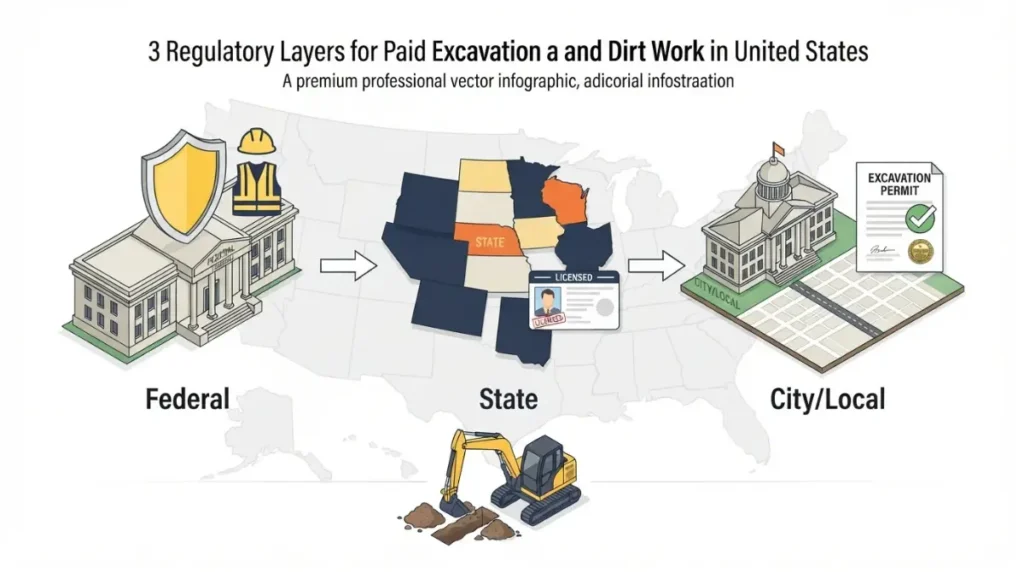
Three layers set the rules for paid dirt work, and only two of them issue licenses. A license lets you take paid work, a permit approves one job, and insurance pays for damage; none of the three replaces the others.
Is there a federal contractor license?
We found no federal contractor license program for excavation work. States license contractors, and OSHA sets safety duties.
Does the operator need a license?
Under OSHA’s general construction safety rule, an employer may let only workers qualified by training or experience run equipment. That is a duty on the employer, not a license. Whether your state adds an operator rule is a question for your state board.
What cities add on top
Cities can add their own license or permit, as Philadelphia does in Section 4. Your own state board and city office have the final word, so call your building department before you quote.
Five checks, in order, before you take the job
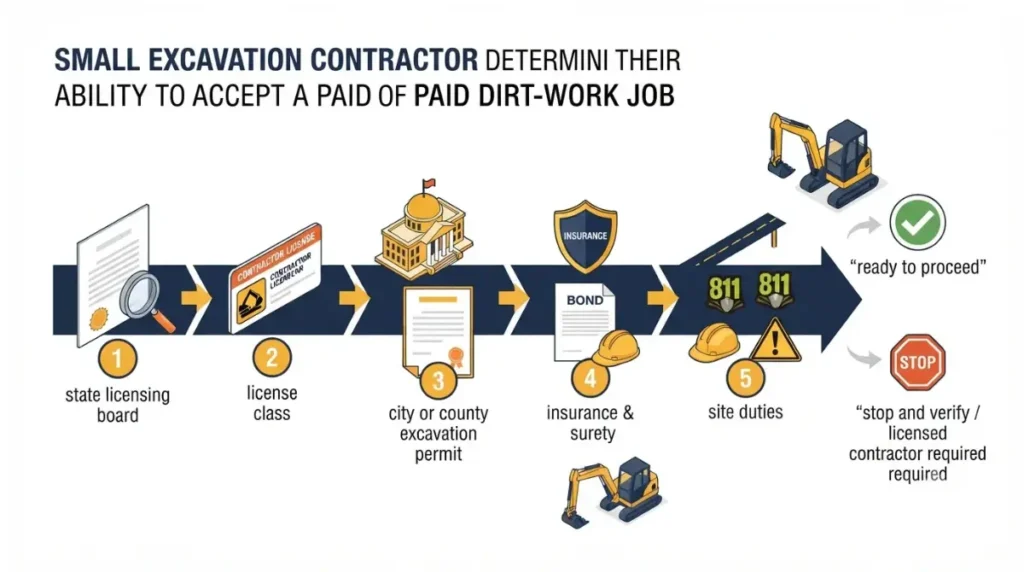
Run these five checks in order and stop at the first one that says a licensed contractor is required.
Checks 1 to 3: the license questions
- State licensing board. Compare the job’s total price (labor, materials and every other item) to your state’s dollar or work-type trigger. A “no license needed” here is not the end.
- License class. Find the class that covers earthwork and trenching. A “no” looks like your work counting as part of another trade.
- City or county. Ask the building department about an excavation license, excavation permit or right-of-way permit. Cities can add rules where the state adds none.
Checks 4 and 5: insurance and site duties
- Your insurer, and surety if a bond is required. Ask in writing whether your policy covers this work as you will do it.
- Site duties. Locate utilities before digging, and know the OSHA competent-person duties if anyone will enter a trench (Section 7).
Stop the moment any check says a licensed contractor is required: then get licensed, hire a licensed contractor, or decline the job. If checks 1 to 3 all say no license is needed, finish checks 4 and 5 before you start.
We ordered these by who can say no first and what is cheapest to check, based on the state, city and OSHA sources cited here. It is our method, not a legal requirement. Your state board and city have the final word.
🔧 Stop Here: If the class or the “incidental work” question is unclear after checks 1 and 2, ask your state board in writing or a contractor-licensing attorney: “Does my specific work fall under classification X, and is the total price over the threshold?” Print the five-check worksheet (PDF) to record each answer.
California, Tennessee and Philadelphia: three different triggers
The trigger can be a dollar line, a type of work, or a city rule, so you must check your own.
| Where (as of October 2026) | What triggers it | License or class | What else it asks |
|---|---|---|---|
| California (CSLB’s notice on the $1,000 rule) | A total price past the $1,000 exemption (labor, materials, all items), or any job with workers or a building permit. Effective January 1, 2025 | C-12 Earthwork and Paving | Confirm the exact wording of the line with CSLB |
| Tennessee (Tennessee’s licensing board) | Projects of $25,000 and up, licensed before bidding or offering a price | State contractor license; confirm the excavation class with the Board | Not covered here |
| Philadelphia (Philadelphia’s excavation license page) | Performing excavation services in the city. Utility trenches, geotechnical exploration and demolition without added excavation are excepted | Excavation Contractor License, renewed annually | A site safety manager with OSHA 30 and OSHA 3015 training |
Source: the three pages linked above, checked October 7, 2026. This is a snapshot of three examples, not a 50-state list, and your own board decides.
Dollar triggers: California and Tennessee
In California, excavation falls under C-12 Earthwork and Paving, which CSLB defines as digging, moving and placing earth so a cut, fill, grade, trench or backfill can be done. Tennessee’s line is the dollar figure, not the class.
A city license for the work itself: Philadelphia
On the page we read, Philadelphia’s trigger is the work, not a dollar line. A state license does not tell you whether a city wants its own.
What it costs to get licensed
You may not need a license, a bond or an insurance quote at all: a job under your state’s line may need none of them. If a check says you do, Philadelphia’s excavation license shows what the pieces look like:
- License fee: $103, plus a $20 non-refundable application fee, renewed annually.
- Surety bond: $100,000 face amount.
- Insurance minimums: $2,000,000 general liability per occurrence, $300,000 automobile liability, and workers’ compensation of $100,000 per accident and per employee with a $500,000 policy limit.
- Training: OSHA 30 and OSHA 3015 for the site safety manager.
A bond’s face amount is not what you pay. You pay a premium, a percentage of the face amount that varies by state, license class, credit and entity type.
💵 About These Numbers: Source: Philadelphia L&I’s license page, checked October 7, 2026. Costs vary by state, class, credit and entity type, so this is orientation, not a quote.
Once you have your own figures, fold them into your hourly equipment rates by machine before you quote. The cost-per-hour calculator adds license, bond premium and insurance to hourly overhead.
Penalties for working without a license: a California example
CSLB lists these penalties for unlicensed contracting. They are California only, and other states differ.
- Administrative fines up to $15,000.
- Jail up to 6 months and criminal fines up to $5,000.
- Repeat offenders: mandatory 90 days in jail, plus $5,000 or 20% of the contract price, whichever is greater.
Can I hire a helper and still skip the license?
In California, no. The small-job exemption applies only if you hire no workers and need no building permit.
If a check says you cannot legally take the job, decline it or hire a licensed contractor. If you decide to get licensed, see what equipment insurance costs before you quote.
A license is not trench safety
A license says you may take the job; it does not make the trench safe. OSHA’s excavation rule sets duties that apply to licensed and unlicensed workers alike:
- Underground utilities must be located before the excavation is opened.
- A competent person must inspect the excavation daily.
- Trenches 4 feet or deeper need a safe way out within 25 feet of lateral travel for employees.
Do I need to call 811 for a small dig?
Yes. Contact 811 before any dig, whatever its depth, so utilities are located first.
Does a license cover trench safety?
No. Protection depends on soil and depth, which this article cannot judge.
🔧 Stop Here: If anyone will enter a trench, stop and bring in a qualified competent person before the first cut. Ask them which protection your soil and depth require.
FAQ
1. Do I need a contractor license for excavation?
It depends where you dig: California’s small-job exemption ends at $1,000, Tennessee requires a contractor license at $25,000 and up, and cities can add rules.
2. Do you need a license to operate an excavator?
OSHA lets employers use only workers qualified by training or experience to operate equipment. That is the employer’s duty, not a license.
3. Is there a federal contractor license?
We found no federal contractor license program for excavation work. States and cities issue the licenses, so check your own state board.
4. What is a C-12 license?
A C-12 license is California’s Earthwork and Paving class, covering digging, moving and placing earth for cuts, fills, grades, trenches and backfill.
5. How much does an excavation contractor license cost?
An excavation contractor license cost varies by state: Philadelphia’s fee is $103, plus a $100,000 surety bond; you pay a premium, not the full amount.
6. Do cities require a separate excavation license?
Some do. Philadelphia requires its own Excavation Contractor License, renewed annually, for excavation services in the city, so call your building department before you quote.
7. Can I hire a helper and still skip the license?
In California, no. The small-job exemption applies only if you hire no workers and need no building permit; check your own state’s rule.
8. What is the penalty for unlicensed excavation work?
In California, CSLB lists administrative fines up to $15,000, jail up to six months and criminal fines up to $5,000; repeat offenders face mandatory jail.
9. Do I need to call 811 for a small dig?
Yes. Contact 811 before any dig, whatever its depth, so utilities are located first, then follow OSHA’s excavation rule if anyone will enter a trench.
10. Does a license cover trench safety?
No. A license does not make a trench safe; OSHA’s excavation rule applies either way, so bring in a qualified competent person before anyone enters.
Your next step
Find your state or city in the table above, or look up your own board, then run the five checks and write each answer on the worksheet. Price the job only after no check says a licensed contractor is required. When you do, work from what to charge per hour so license, bond and insurance costs sit inside your rate.