Straight Answers on 811 Before Digging for Contractors

811 before digging contractor: Tennessee says a homeowner’s ticket won’t cover your dig. Here’s
whose name goes on the ticket where you work.
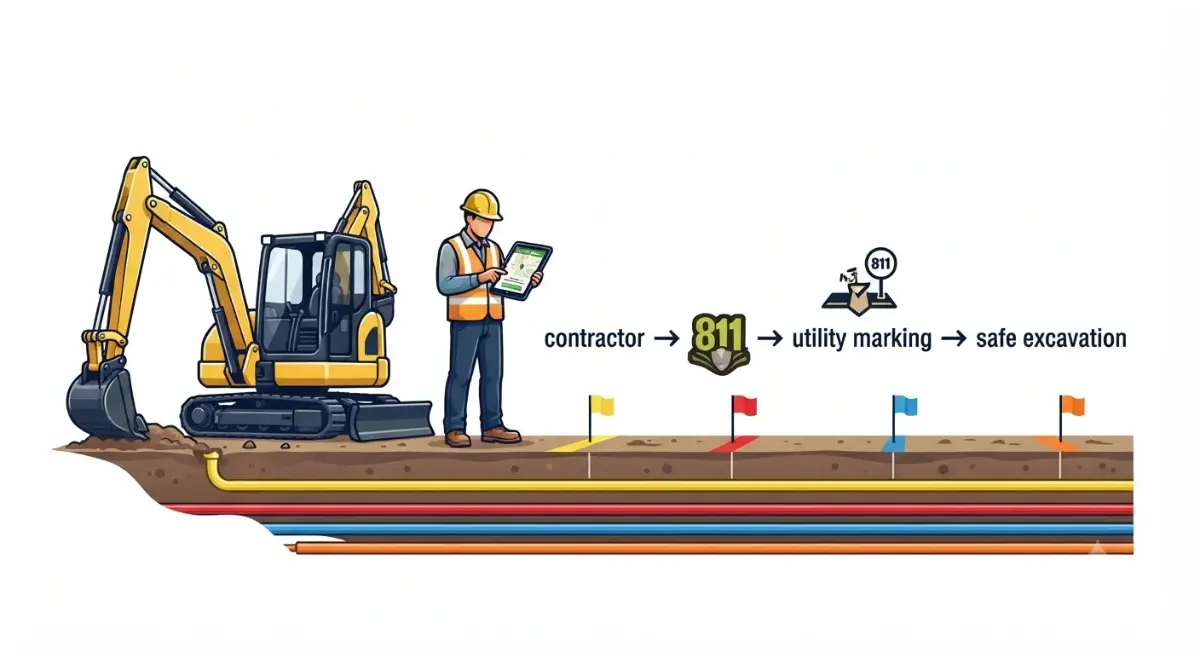
Table of Contents
If you’re hired to dig, the call is yours
This guide covers US owner-operators digging for hire with compact excavators, backhoe-loaders, and trenchers under federal OSHA Subpart P and state 811 one-call laws, reviewed October 2026. No model-year or emissions-era split applies; wait times, tolerance zones, and ticket life vary by state.
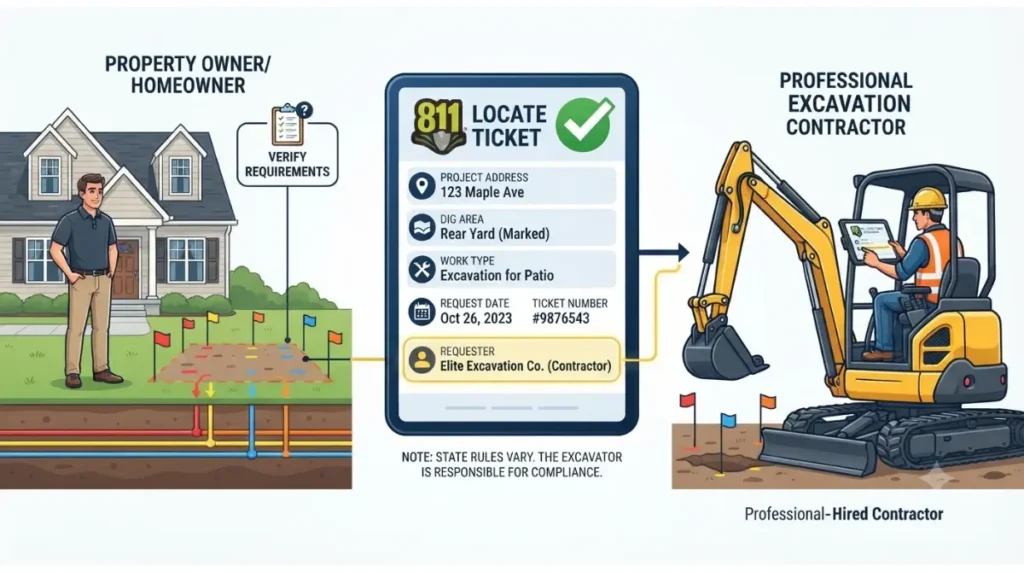
The short answer: the excavator doing the work calls 811, not the owner who hired them. Florida’s Sunshine 811 and New York 811 both say so, and Texas811 tells owners to ask the contractor for the ticket number.
Digging for hire? Read every section. Hiring someone to dig? Sections 1 and 2 are yours.
ℹ️ Safety Note: Striking a buried gas or electric line, or working in a trench, can kill. This article is general guidance: follow your state’s law and OSHA’s standard, and have a competent person on site.
📋 Compliance Note: This article covers OSHA 29 CFR 1926 Subpart P (the excavation standard dates to 1989, last amended 1994) and state one-call laws. State requirements and OSHA state plans vary and laws change, so verify with your state 811 center before relying on it. Facts checked October 7, 2026.
Whose name goes on the ticket
A ticket is your state 811 center’s record of your locate request, and in several states it belongs to the company doing the digging.
Homeowner tickets and subcontractors
Tennessee says a homeowner’s ticket does not cover the hired excavator, which needs its own. Virginia requires each company to file its own notice and bars subcontractors from working under another company’s ticket. These are state examples, not a national rule.
What 811 asks you for
811 is free. Have the address, county, nearest cross street, project type, and exact dig area ready. Tennessee treats a ticket over 15 calendar days old as expired; Virginia requires an update past 15 days or when marks become illegible.
How long to wait, state by state
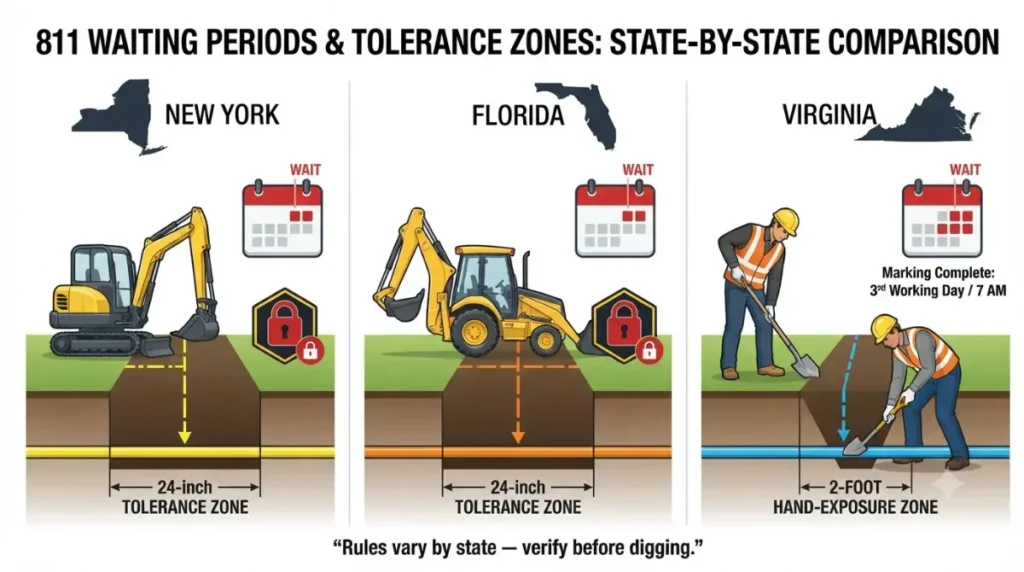
State law sets the wait, and three states show the range.
| State | Wait before digging | Tolerance zone |
|---|---|---|
| New York | 2 full business days (max 10 working days ahead) | 24 in |
| Florida | 2 full business days | 24 in |
| Virginia | Ends after 7 AM, third working day | Hand-expose within 2 ft |
Sources: New York 811, Sunshine 811, Virginia811, Duke Energy. Weekends and legal holidays excluded. Checked October 7, 2026.
The Common Ground Alliance advises filing a few business days ahead; confirm your state’s period with its 811 center.
Price the wait into your rate
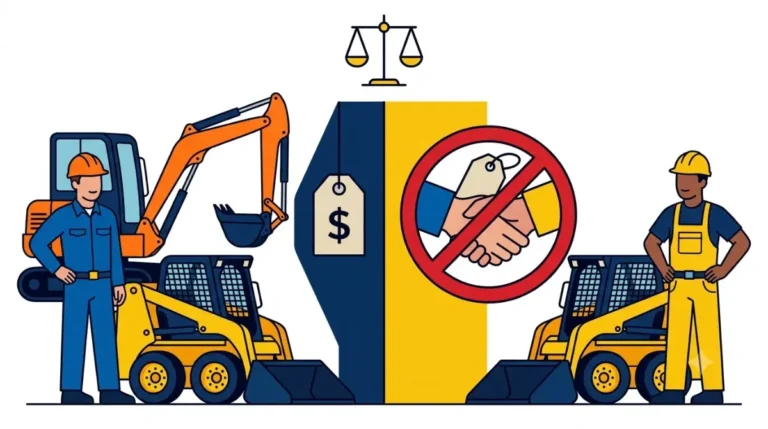
Whether a locate delay costs you or the customer is a billing decision; settle it before the job with our equipment standby rate billing guide.
What OSHA adds, and what 811 won’t mark
OSHA adds a locate duty for employers before any excavation opens.
OSHA’s 24-hour clause vs. state law
Under 29 CFR 1926.651(b), employers must locate utilities before opening an excavation and confirm exact locations safely nearby. If owners can’t respond within 24 hours, the employer may proceed with caution and detection equipment, unless state or local law requires longer. New York and Florida require two business days, so state law governs.
Private lines 811 won’t mark
Florida, Tennessee, and Virginia put marking private lines on the owner, so ask in writing what’s buried there; Tennessee says to hire a private locator.
🔍 Why It Happens: 811 relays requests to utilities that own lines; a line the owner installed has no utility behind it, so no one marks it.
Where utility strikes actually come from
CGA’s damage data shows a few repeat causes, each tied to a step you control.
Root cause to step
| Step | Root cause targeted (CGA 2024) |
|---|---|
| 1. File in your own name | Failure to notify 811 (24.54%) |
| 2. Wait fully; confirm all responses | Not marked, locator error (11.94%) |
| 3. Check marks; hand-expose first | Marked inaccurately (8.58%); dug before verifying marks by potholing (4.94%) |
| 4. Keep zone clearance | Clearance not maintained (16.07%) |
| 5. Update when marks fade | Marks faded or lost (2.17%) |
Percentages: CGA 2024 DIRT report; step mapping is CabAndCargo analysis. CGA’s 2025 data still ranks failure to notify first.
The tolerance zone
The tolerance zone is a marked line’s width plus a state-set distance each side, 24 inches in New York and Florida.
🔧 Stop Here: If marks are missing or illegible, don’t start; call 811 again. A competent person and state law set how close machines may work.
Trench rules that trigger at 4 and 5 feet
OSHA’s trench rules turn on two depths.
5 feet: protective systems
- Five feet or deeper: sloping, shoring, or shielding, unless cut entirely in stable rock, per OSHA’s protective systems standard. Shallower trenches need a competent person’s no-cave-in exam.
4 feet: a way out
- Four feet or more: a ladder, ramp, or other safe exit within 25 feet of lateral travel.
Who decides on site
A competent person inspects before work, during the shift, and after rain. OSHA binds employers; if you work alone, ask OSHA how it applies to you. Pricing a trench job? See our mini excavator hourly rate guide.
🔧 Stop Here: Soil classification and protective-system choice belong to your competent person; designs outside OSHA’s standard options need a registered professional engineer.
Who pays if you hit a line
Liability turns on state law and whether your ticket was current.
Who pays
Tennessee says an expired ticket can leave you paying for repairs. West Virginia’s regulator chairman wrote that utilities can hold you responsible, with penalties up to $5,000. Insurance doesn’t replace a ticket; ask your insurer in writing how it treats underground damage without one (see our equipment operator insurance cost guide).
What to keep
Keep the ticket number, dates, utility responses, mark photos, and the owner’s written private-line note.
If you hit a line
Stop digging and call the utility owner; Tennessee also requires notifying 811. With gas or electric involved, call emergency services first.
Questions about 811 for contractors
1. Do homeowners or contractors call 811 for hired digging?
The contractor doing the work calls 811, per Sunshine 811 and New York 811; owners should ask for the ticket number.
2. Does a subcontractor need its own 811 ticket?
In Virginia, yes; subcontractors can’t work under another company’s ticket. Tennessee also requires the hired excavator’s own ticket.
3. How long do I wait after calling 811 before digging?
New York and Florida require two full business days; Virginia’s marking period ends after 7:00 AM on the third working day.
4. How long does an 811 ticket last?
Tennessee treats a ticket over 15 calendar days old as expired; Virginia requires an update past 15 days or when marks become illegible.
5. What is the 811 tolerance zone?
It’s a marked line’s width plus a state-set distance each side: 24 inches in New York and Florida; Virginia requires hand-exposing within 2 feet.
6. Does 811 mark private utility lines?
No. Private lines are the owner’s responsibility, and Tennessee says to hire a private locating service for them.
7. Can I dig if utilities don’t respond within 24 hours?
Only with caution and detection equipment, and not where state or local law requires longer, as New York and Florida do.
8. How deep can a trench be before OSHA requires protection?
Five feet or deeper needs a protective system unless cut in stable rock; shallower trenches need a competent person’s no-cave-in exam. Have your competent person decide on site.
9. Who pays if I hit a line?
It depends on state law and whether your ticket was current; in Tennessee, an expired ticket can leave you paying for repairs.
10. What do I do if I hit a line?
Stop digging, call the utility owner, and notify 811 where state law requires it. With gas or electric involved, call emergency services first.
Before you break ground
Call 811 in your company’s name, wait out your state’s full period, verify the marks, hand-expose near them, and keep records. Then check trench depth against OSHA’s 4-foot and 5-foot triggers, and read OSHA’s trenching and excavation page for the full picture. Pricing the job? Start with equipment hourly rates by machine.