Clear Numbers on Equipment Billable Hours Per Year for Excavators

Billable hours per year: one published 60% utilization rule rests on 22 days a month, not meter hours. See what that does to your rent-or-buy call.
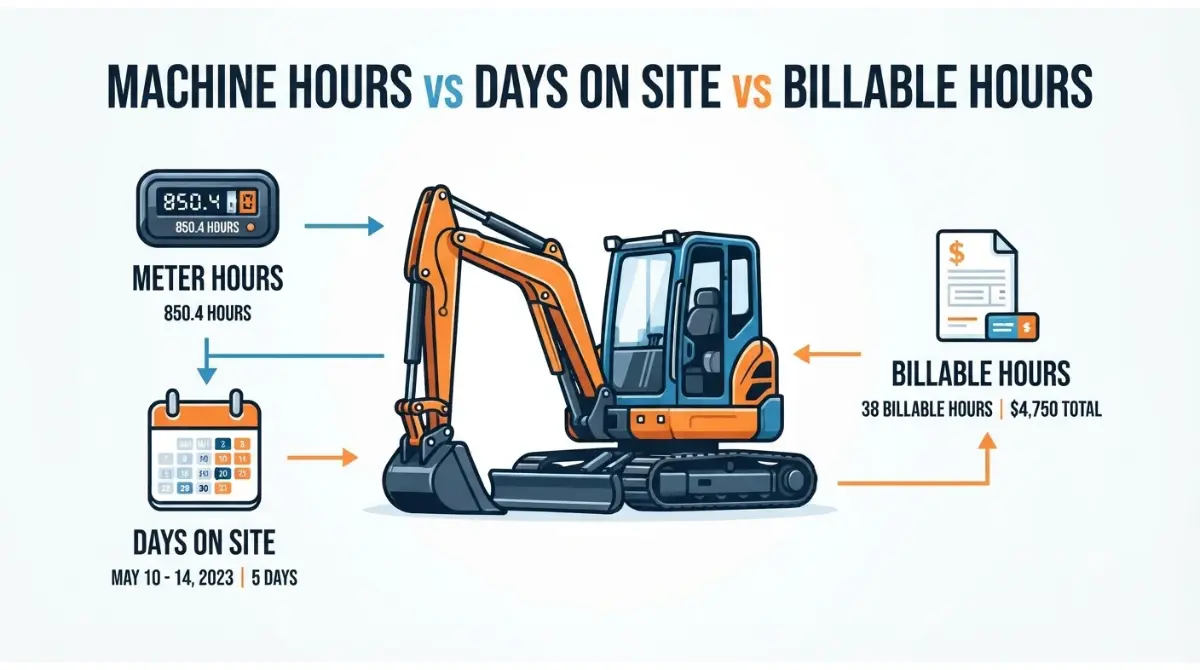
Table of Contents
How many billable hours can one machine really earn?
This guide covers owner-operated construction and farm machinery in the US: compact excavators and skid steers (about 1–9 t), small excavators to about 21 t, and farm tractors, in every emissions era. Hours benchmarks don’t change by Tier; each figure carries its source and date.
Who this is for
Billing a compact excavator by the hour? Read Sections 3–5. Own a tractor for your own acreage? Read Sections 5 and 6. Want your own number? Jump to Section 7.
What the three kinds of numbers are
Published hours figures come in three kinds: typical use, break-even lines, and rules of thumb. Rates sit in our equipment rates by machine guide.
💵 About These Numbers: Hours figures come from Iowa State (March 2026), Illinois farmdoc (August 2025), Equipment World (July 2009), United Equipment (August 2026), and undated EquipmentWatch and ForConstructionPros pages. Section 4’s dollar inputs are illustrative; hours and costs vary by region, machine age, and work type.
Meter hours, days on site, billable hours: three numbers
Billable hours are the hours a customer pays for; engine hours are what your hour meter logs, and the two rarely match.
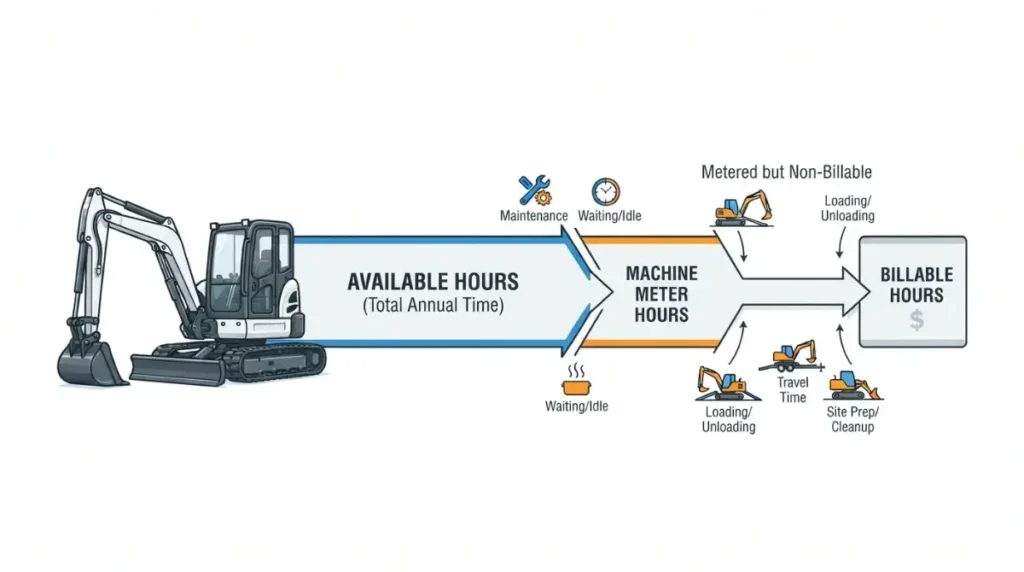
Available hours: the 2,000-hour year
ForConstructionPros columns by consultant Garry Bartecki use a 2,000-hour year; EquipmentWatch assumes 176 hours a month, or 2,112 a year (our arithmetic).
Why a utilization percent counts days
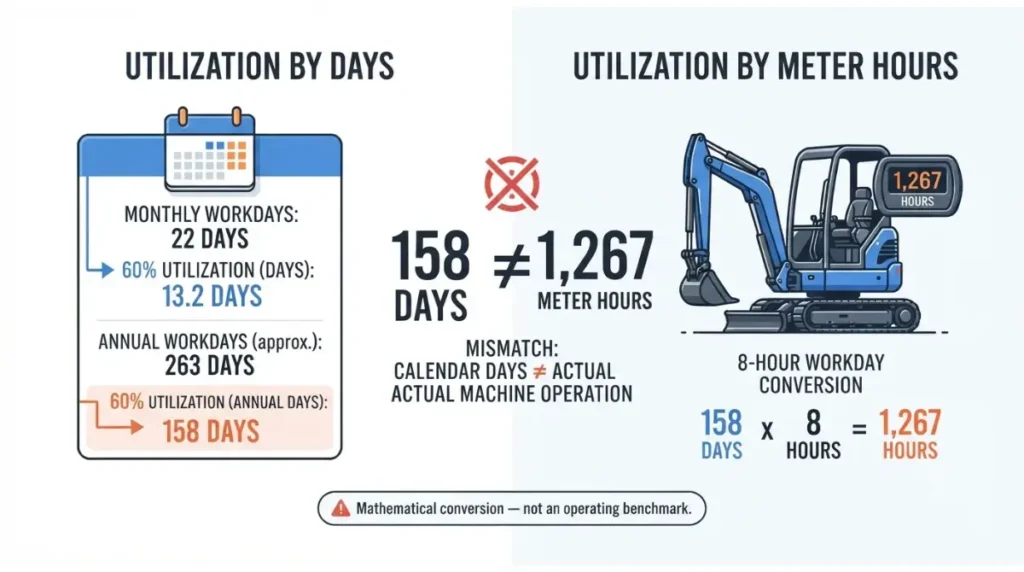
Utilization divides hours used by hours available, but Bartecki’s 60% buy rule rests on 22 days of use per month, a day count.
What your hour meter counts
Your operator’s manual says what your meter counts; confirm it before comparing to invoices. Iowa State puts labor hours 10–20% above field machine time.
How many hours a year does a machine actually run?
A 3–4 t compact excavator typically logs 350–400 hours a year as a primary machine and 100–200 as a backup, per a 2009 Equipment World feature quoting Bobcat staff.
The ladder: typical use, break-even line, rule of thumb
| Figure and class | Kind of number | Source and date | What It Means |
|---|---|---|---|
| 350–400 h/yr primary, 100–200 backup (3–4 t) | Typical use | Equipment World, Jul 2009 | 17 years old |
| Rent below 465 h/yr (6.1–21.0 t) | Break-even line | EquipmentWatch, undated | Cat 312D basis |
| Rent below 400–500 h/yr (3–6 t) | Company guidance | United Equipment, Aug 2026 | No sources cited |
| Buy at 60%+ utilization; rent below 40% | Rule of thumb | Garry Bartecki, ForConstructionPros, undated | Counts days |
Method: four named sources compared and labeled by kind; no owner survey or machine measurements.
Why 60% of days isn’t 60% of meter hours
At 22 days a month, 60% is about 158 days a year, or roughly 1,267 hours at 8 hours a day (our arithmetic). A primary compact excavator logged 350–400, so the percentage counts days, not meter hours. Rates for the class sit in our mini excavator hourly rate guide.
Break-even hours: what one machine earns at 600, 1,000, 1,400
Break-even hours equal annual fixed cost divided by your hourly rate minus variable cost per hour. Iowa State’s machinery cost method splits costs the same way.
The formula, run once
Take the 20-ton excavator from our rates guide: $65,000 a year fixed, $75 an hour variable, billed at $150. It breaks even near 867 hours.
🔍 Why It Happens: Fixed costs are owed whether the machine runs or not, so each billable hour only has to cover the $75 variable cost; the rest chips away at the $65,000.
The same machine at three hour levels
| Billable hours | Revenue at $150 | Cost | Margin |
|---|---|---|---|
| 600 | $90,000 | $110,000 | −$20,000 |
| 1,000 | $150,000 | $140,000 | +$10,000 |
| 1,400 | $210,000 | $170,000 | +$40,000 |
Illustrative inputs; arithmetic ours; not market data.
Iowa State warns that tax depreciation shouldn’t set your rate. The cost split is in how hours move each half of the cost.
Rent or own: who says what, and what they sell
Three sources give a rent-below line; none measured your year.
Three lines, three interests
- United Equipment’s August 2026 guide: rent below about 400–500 hours a year; no sources cited.
- EquipmentWatch: rent below 465 hours for 6.1–21.0 t excavators; it sells the analytics behind the number.
- Garry Bartecki, a consultant to the Independent Equipment Dealers Association: rent below 40% utilization.
What to do under the line
If your realistic hours sit under these lines, rent for the jobs you land or sub the work out. The lines rest on different bases (hours, weeks, days), so get a current rental quote and lender terms before you buy.
Farm tractors: hours are modeled, not measured
Extension cost tables assume annual hours; they don’t report measured averages.
What extension models assume
Iowa State’s worked example runs a 300-PTO-hp tractor 400 hours a year. Illinois farmdoc’s 2025 tractor cost table assumes 300 and shows $26,118 a year of depreciation and interest on a 175-hp tractor: $174.12 an hour at 150 hours, $87.06 at 300 (our arithmetic).
What more hours do to resale value
Iowa State’s table gives a five-year-old 30–79 hp tractor 48% of list price at 200 hours a year and 40% at 600. For 80–149 hp tractors it barely moves.
Find your own number from last year’s invoices
Five checks, cheapest first, show whether your year matches the benchmarks.
Check order, cheapest first
- Add up the hours on your last 12 months of invoices.
- Subtract the meter reading from a year ago from today’s.
- Count the days the machine worked on site.
- Divide billed hours by meter hours.
- Compare with Sections 3 and 4; under the Section 5 lines, run rent-versus-own first.
✅ Do This: Check your operator’s manual for where the meter sits and what it counts, then log it the same way every time.
Where short jobs eat billed hours
Travel and loading hours go unbilled. Price mobilization and minimums as separate lines so a two-hour job still pays.
Equipment billable hours per year: quick answers
1. What are equipment billable hours per year?
Equipment billable hours per year are the hours a customer is invoiced for the machine, usually fewer than its meter hours.
2. How many hours is a full work year for equipment?
Published guides use about 2,000 available hours for a working year; EquipmentWatch assumes 176 a month, about 2,112.
3. How many hours a year does a compact excavator run?
A 2009 Equipment World feature put a 3–4 t compact excavator at 350–400 hours a year as a primary machine, 100–200 as a backup.
4. At what hours should I rent instead of buying an excavator?
United Equipment says below roughly 400–500 hours for 3–6 t machines; EquipmentWatch says below 465 for 6.1–21.0 t. Neither measures your year.
5. Is the 60% utilization rule realistic for one machine?
That rule counts days on site, not meter hours; 60% of 22-day months is about 158 days, which doesn’t convert to hours.
6. How do you calculate break-even billable hours?
Divide annual fixed cost by your hourly rate minus variable cost per hour; our illustrative 20-ton example breaks even near 867 hours.
7. How much can one machine earn in a year?
In our illustrative 20-ton example at $150 an hour, margin runs from −$20,000 at 600 billable hours to +$40,000 at 1,400.
8. How many hours a year does a farm tractor run?
Extension tables assume 300 to 400 hours a year; those are modeling assumptions, not measured averages.
9. Do more hours lower a tractor’s resale value?
Iowa State lists 48% of list price at 200 hours versus 40% at 600 for a five-year-old 30–79 hp tractor; 80–149 hp barely changes.
10. How do I find my own billable hours?
Total your last 12 months of invoiced hours, then compare them with your meter reading and days on site.
Run the one number that matters
A rule of thumb counts days; your decision runs on your own billed hours and your break-even. This week, pull last year’s invoices and meter reading, rerun Section 4 with your costs, then compare the result with Section 3 before you rent, buy, or quote.