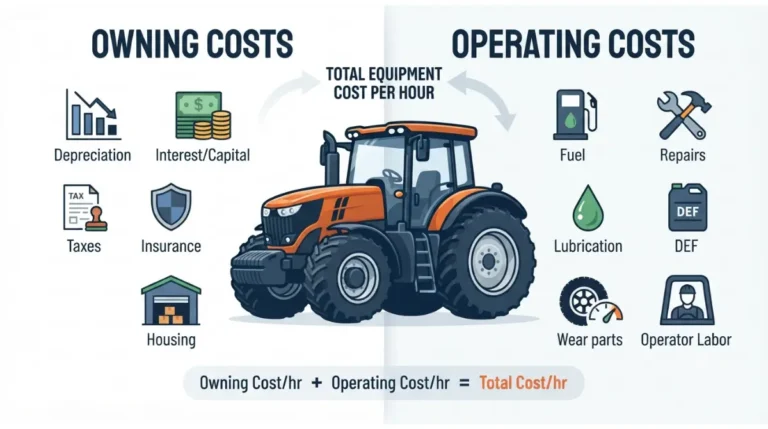
Equipment Maintenance Cost per Hour for 544K Filters and Fluids

Equipment maintenance cost per hour: Deere lists Plus-50 II oil at 500 hours and Torq-Gard II at 250. The cheaper pail can cost more per hour.
Table of Contents
Filter and fluid cost per hour: what this covers
This article covers scheduled filter and fluid costs per operating hour for one 4WD wheel loader, the John Deere 544K (PINs covered by Deere’s May 2022 parts guide; EPA Final Tier 4), and shows how to adapt the method to other machines.
Who this is for
If you’re setting an hourly rate, this is the maintenance line behind it. If you’re checking a service invoice, these figures show what each interval costs. On a smaller machine, the method carries over; the intervals don’t.
What’s in the numbers (and what isn’t)
These figures cover scheduled filters and fluids only; repairs, tires, fuel and ownership sit in your equipment rates per hour by machine. Your operator’s manual and serial range govern every interval here.
ℹ️ Safety Note: Hydraulic systems stay pressurized after shutdown, and escaping fluid can penetrate skin and cause a serious injury. This article covers costs, not procedures; follow your operator’s manual and have a qualified technician service pressurized systems.
📋 Compliance Note: Used-oil and DEF rules reflect EPA pages checked October 2026. Requirements vary by state; verify with your state environmental agency.
💵 About These Numbers: Intervals and capacities come from Deere’s May 2022 parts guide. Prices vary by region, supplier and brand, so this article gives per-hour quantities and leaves price to your current quote.
How to turn a service interval into cost per hour
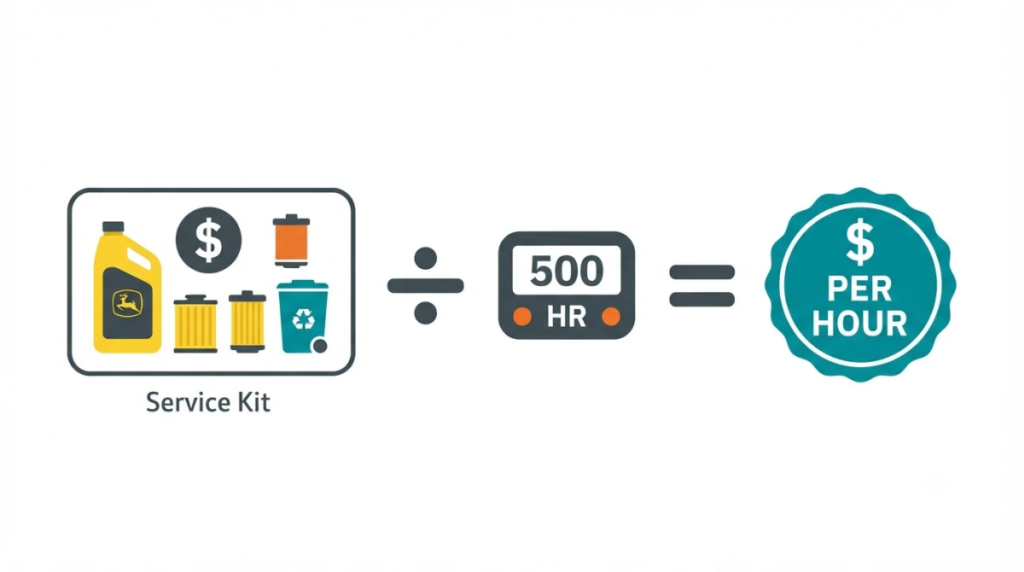
Maintenance cost per hour is the cost of one scheduled service’s parts, fluid, labor and disposal, divided by the operating hours between services, then added up across every item on the schedule. The hour meter turns that schedule into dollars per operating hour.
The formula, one line item at a time
For each item: (parts and fluid + labor + disposal) ÷ interval hours = cost per hour. Iowa State’s Estimating Farm Machinery Costs separates operating costs from ownership costs.
Why repair costs belong in a separate bucket
Scheduled service runs on a clock; repairs don’t. Keep repair costs in their own bucket, built from your own invoices, and see owning versus operating cost for how the buckets combine.
Which service intervals set your cost per hour
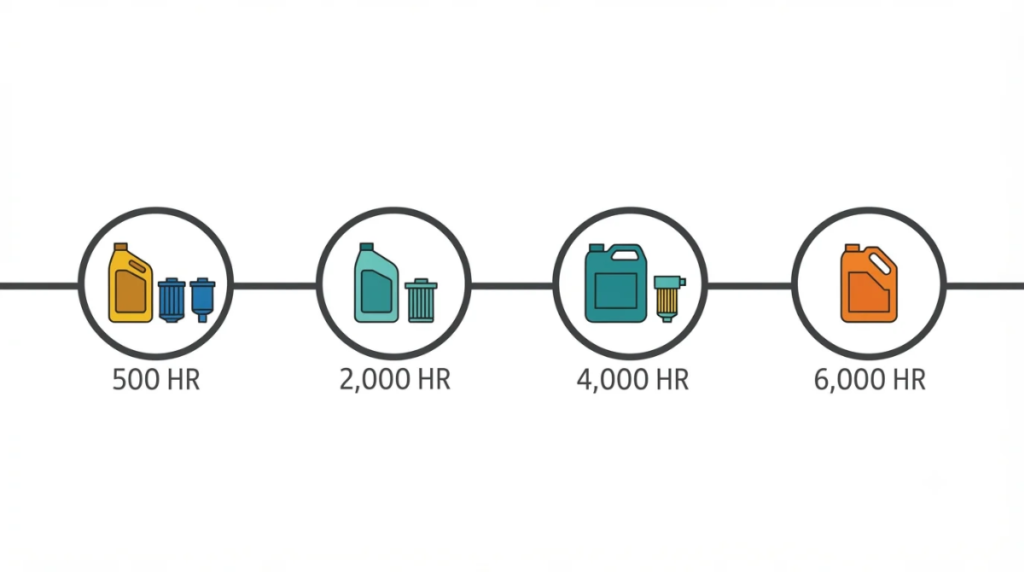
On the 544K, a short-interval group and a long-interval group set the schedule.
- 500 hours: engine oil and filter; primary and final fuel filters
- 2,000 hours: transmission oil and filter
- 4,000 hours: hydraulic oil and return filter
- 6,000 hours: coolant
Short-interval items (engine oil, fuel filters)
Per Deere’s 544K parts guide, engine oil takes about five gallons per fill, and these items recur most often.
Long-interval, high-volume items (hydraulic, drivetrain)
Hydraulic oil is the largest fill by volume, about 24 gallons. Your billable hours per year decides how often each interval lands.
📊 Verified Spec: Deere 544K parts guide, May 2022 release. Axle oil and air filters are omitted here; confirm all intervals, your PIN range, and whether yours is a 544K or 544K-II in your operator’s manual.
Filter and fluid cost per hour, line by line
Multiply each per-100-hour quantity by your price, then divide by 100.
| Item | Per service | Interval (hours) | Per 100 operating hours | What it means |
|---|---|---|---|---|
| Engine oil | 5.0 gal | 500 | 1.0 gal | Most frequent oil change |
| Transmission oil | 5.6 gal | 2,000 | 0.28 gal | Changes with its filter |
| Hydraulic oil | 24.3 gal | 4,000 | 0.61 gal | Biggest fill, longest gap |
| Coolant | 5.9 gal | 6,000 | 0.098 gal | Rare, but budget for it |
| Engine oil filter | 1 | 500 | 0.2 | Changes with engine oil |
| Fuel filters (primary + final) | 2 | 500 | 0.4 | Price both per service |
| Transmission oil filter | 1 | 2,000 | 0.05 | Changes with transmission oil |
| Hydraulic return filter | 1 | 4,000 | 0.025 | Changes with hydraulic oil |
Source: Deere 544K parts guide, May 2022 release. Per-100-hour figures are our arithmetic (capacity ÷ interval × 100); prices and labor are your inputs.
Per-service cost to cost per hour
Add labor and disposal per service, divide by the interval. Oil choice moves the interval: Deere’s store listing credits Torq-Gard II with 250 hours and Plus-50 II with 500, so a cheaper pail can cost more per hour.
✅ Do This: Get a dated, itemized quote for each line from your dealer’s parts desk and enter it in the table.
What changes if you pay a dealer
Dealer service swaps your labor for the shop’s rate and may add a travel charge; take it if an itemized quote beats your parts-plus-time figure. Tracked machines also carry a separate undercarriage cost per hour.
Can oil analysis safely stretch your intervals?
Fluid analysis can justify a longer interval, but only in steps and only with samples.
How to extend in steps, not leaps
Caterpillar’s guidance, written for its own program, aims for 1.5 to 2 times the current interval, sampling at each step and every 100 hours at the target. Deere’s 544K guide says analysis results may change your intervals; consult a dealer.
When extending doesn’t pay
Sampling costs money, and a machine running few hours a year saves little by stretching. Stay on the manual’s interval if you won’t sample.
✅ Do This: Ask your Deere dealer which analysis program they support and how it affects warranty before changing any interval.
The costs most hourly rates leave out
Two recurring costs can go missing: disposal and DEF.
Used oil and filter disposal
EPA’s used-oil guidance for businesses covers businesses that generate used oil from equipment maintenance; farms generating 25 gallons a month or less are exempt from the generator standards. Properly hot-drained filters are excluded from federal hazardous-waste rules, and your state may be stricter.
DEF and aftertreatment on Tier 4 Final machines
If your Tier 4 Final machine is SCR-equipped, DEF is a usage-based cost; treat it as its own line, since consumption varies. EPA’s DEF page tracks the 2025–26 guidance on derates.
Aftertreatment defeat exists, is prohibited, and costs owners in resale, warranty and liability. See Tier 4 operating costs per hour.
Service jobs worth paying a technician to do
Hydraulic and hot-fluid service carries injury risks that a labor line doesn’t price.
Pressurized hydraulics and hot fluids
Hydraulic lines can hold pressure after shutdown, and a pinhole leak can inject fluid through skin. Fluids at operating temperature can burn.
🔧 Stop Here: If a line, fitting or filter housing is leaking, or you are unsure the system is depressurized, stop and call your dealer’s service department. Ask them to relieve pressure and inspect the system. If fluid may have entered skin, get emergency medical care at once.
What your manual says is operator-level
Your operator’s manual lists which tasks are operator-level and which are not. Follow it, and if a job isn’t listed, treat it as a technician’s.
Frequently asked questions
1. How is equipment maintenance cost per hour calculated?
Divide each service’s parts, fluid, labor and disposal cost by the operating hours between services, then add the lines together.
2. What is a typical filter and fluid cost per hour for a wheel loader?
No single figure; it depends on intervals, fill volumes and current prices, so multiply the table’s per-100-hour quantities by your quotes.
3. Which filters are due at 500 hours on the 544K?
Per Deere’s parts guide, the engine oil filter and the primary and final fuel filters are listed at 500 hours; confirm in your manual.
4. Which fluid change costs the most in a service?
By volume, hydraulic oil, since the 544K’s hydraulic system holds about 24 gallons; price per gallon and labor then set the dollars.
5. Can oil analysis extend my oil change interval?
Sometimes, in steps with sampling at each one, but ask your dealer first because Deere says analysis results may change your intervals.
6. Does a longer interval always lower maintenance cost per hour?
No; sampling costs money and low annual hours limit the savings, so stay on the manual’s interval if you won’t sample.
7. Do I have to recycle used oil and filters from equipment maintenance?
Businesses generating used oil fall under EPA’s standards; farms at 25 gallons a month or less are exempt, and states can be stricter.
8. Does DEF count in equipment maintenance cost per hour?
Treat it as a separate usage-based line on SCR-equipped machines, because consumption varies from machine to machine.
9. Is dealer service cheaper than doing it myself?
Compare an itemized dealer quote with your parts-plus-time cost; unless your manual lists it as operator-level, leave pressurized hydraulic work to a qualified technician.
10. Where do I find my machine’s service intervals?
In your operator’s manual for your serial range, or Deere’s parts guide for your PIN; the manual governs.
Put the numbers to work
Cost per hour comes from four inputs: how often each item comes due, how much it holds, what you pay, and whose labor does it. Use the table with your own dated quotes, keep repairs in their own bucket, and let your operator’s manual set the interval. Then enter the result in your hourly rate.