Skid steer hourly rate and the extra a CTL should bill

Skid steer hourly rate for wheeled vs tracked: at a Utah Cat rental store, CTLs rent $9.88–$16 an hour more than the same-engine skid steer.
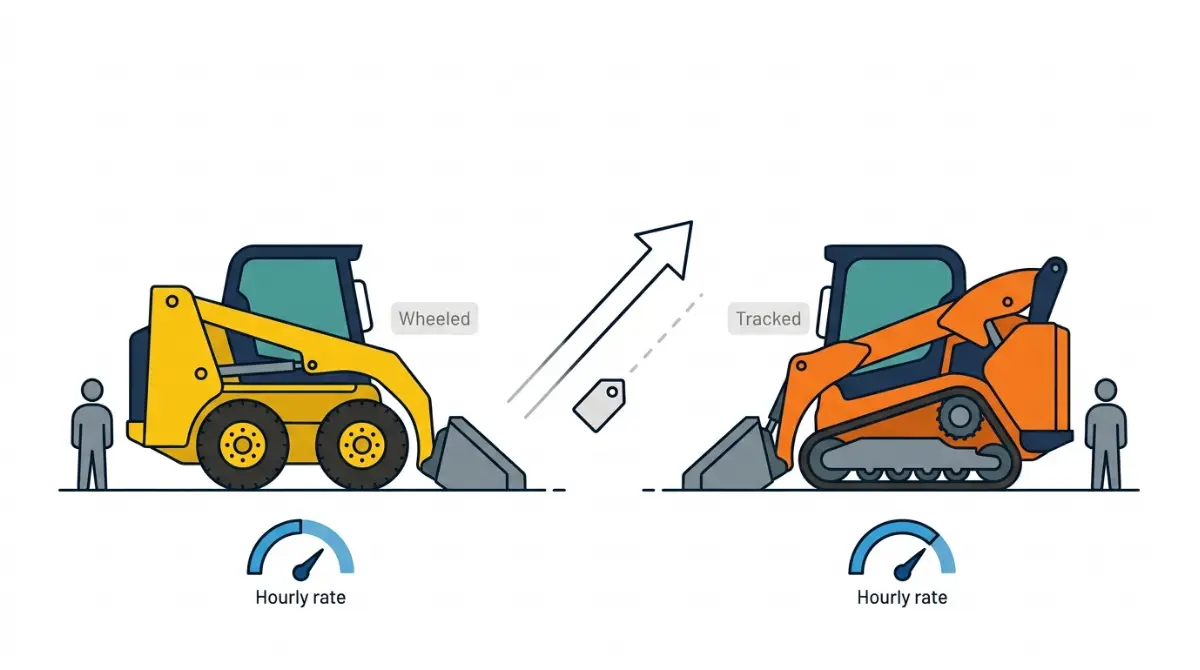
Table of Contents
Rates and sources checked on November 3, 2026.
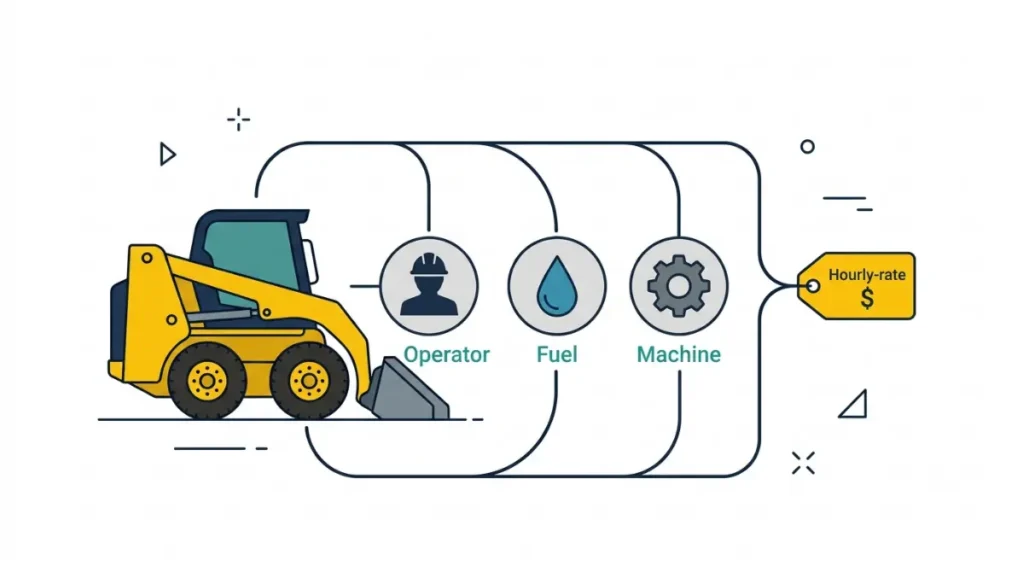
With an operator, skid loader work billed a median of $122.50 an hour in Missouri’s survey of rates charged in 2025, with the operator and fuel in the price and responses running from $100 to $150. At Wheeler Machinery’s Cat Rental Store in Utah, a tracked loader rents for $9.88 to $16 an hour more than the wheeled machine with the same engine, and the renter still pays for track wear on top.
What skid steer work bills with an operator
Ten people answered the skid loader line in Custom Rates for Farm Services in Missouri, and their rates averaged $120.50 an hour. The University of Missouri Extension guide, revised in March 2026, asked farmers, agribusinesses and land improvement contractors what they charged or paid in 2025. Its heavy-equipment table includes operator labor in every row.
Ten answers make a small sample, and the guide itself warns that its averages carry no assurance of covering your costs. The skid loader row also doesn’t separate wheeled from tracked machines, or one frame size from another.
Rent-only figures, with no operator or fuel, come from separate surveys; skid loader rent and operated rates by state sets the Kansas and Nebraska numbers beside Missouri’s.
Same-engine Cat loaders rent $9.88 to $16 an hour apart
Put a Cat 226D skid steer beside a Cat 239 compact track loader on the same rate sheet and the tracks cost $128 more a day.
| Applies to (Wheeler listing: hp, rated capacity) | Day rate, USD, Wheeler Utah and Nevada stores, 2025 guide, machine only, renter supplies fuel | Per hour, USD (day ÷ 8) | Cat medium-load fuel burn, US gal/hr | Tracked over wheeled, USD per hour |
|---|---|---|---|---|
| Cat 226D skid steer, 67 hp, 1,500 lb | $412 | $51.50 | 2.46 | Wheeled baseline |
| Cat 239 CTL, 67 hp, 2,050 lb | $540 | $67.50 | 2.46 | +$16.00 (31.1%) |
| Cat 262D/260 skid steer, 74 hp, 2,700 lb | $540 | $67.50 | 2.62 | Wheeled baseline |
| Cat 259 CTL, 74 hp, 2,900 lb | $619 | $77.38 | 2.62 | +$9.88 (14.6%) |
Sources:
- Day rates: Wheeler Machinery 2025 rental rate guide, compact track loader and skid steer pages, where a day is 8 hours.
- Fuel burn: Caterpillar Performance Handbook fuel consumption tables, America North, December 2022, for the D3-series model of each frame.
- Per-hour and gap figures are worked out from the day rates.
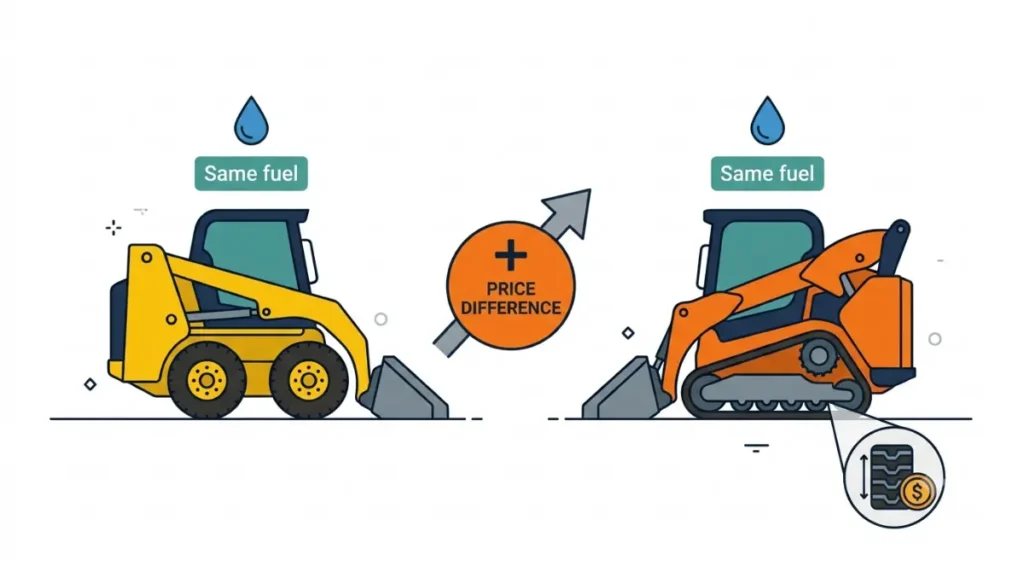
Fuel does not account for the difference. Each tracked machine in the table burns the same medium-load fuel in Cat’s handbook as the wheeled loader built around its engine, so the extra rent pays for a costlier machine.
Two terms on the Wheeler sheet matter to an owner pricing against it. The renter pays all wear and damage to rubber tires or tracks, so the counter premium comes before any track wear. The capacity column also misleads. Cat’s 299D3 page lists that loader’s rated capacity at 35% of its tipping load, so pair a wheeled and a tracked machine by engine and leave the capacity figures aside.
Public cost schedules barely separate the two. The FEMA 2025 Schedule of Equipment Rates is built to cover owning and operating costs except operator labor. Its Bobcat T86 track loader row sits $1.71 an hour above its Bobcat S86 skid steer row, both in the band up to 105 hp. How FEMA’s equipment rates work as a benchmark goes through what those rates include.
How low can a skid steer or CTL rate go?
Start from the FEMA row that matches your loader’s horsepower, then add a paid operator and the diesel price rise of the past year.
The operator line is $41.38 an hour. That starts from the median wage for operating engineers and other construction equipment operators, $59,850 a year in May 2025. Spread over 2,080 paid hours, that comes to $28.77. It is then multiplied by 1.438, the ratio of total compensation to wages for construction employers in BLS’s June 2026 employer cost release, which puts compensation at $51.96 against $36.13 in wages. Nebraska custom operators put their own labor at an average of $28.79 an hour, two cents from that wage.
Fuel is the second adjustment. Take Cat’s medium-load burn from the table above and multiply it by the $2.634 a gallon that U.S. on-highway diesel rose in the year to the week of October 26, 2026. That gives what this fall’s diesel adds to a FEMA rate. The step assumes the 2025 schedule carries fuel at roughly last year’s price; the schedule doesn’t print its diesel basis, so put your own fuel invoices in its place.
| Applies to (FEMA 2025 row; Cat fuel class) | Machine, USD/hr, national, no operator | Fuel added since a year ago, USD/hr | Floor with operator, USD/hr | Left under Missouri’s median, USD/hr |
|---|---|---|---|---|
| Skid steer up to 74 hp (Bobcat S76 row; 2.62 gal/hr class) | $45.23 | $6.90 | $93.51 | $28.99 |
| Skid steer 75 to 105 hp (Bobcat S86 row; 3.3 gal/hr class) | $60.67 | $8.69 | $110.74 | $11.76 |
| CTL up to 55 hp (Bobcat T450 row; 2.46 gal/hr class) | $41.49 | $6.48 | $89.35 | $33.15 |
| CTL 56 to 105 hp (Bobcat T86 row; 2.62 gal/hr class) | $62.38 | $6.90 | $110.66 | $11.84 |
Sources:
- Machine rates: FEMA 2025 Schedule of Equipment Rates, codes 8541, 8542, 8381 and 8382, for disasters declared on or after July 1, 2025.
- The floor adds the operator line above to the first two columns.
- The last column subtracts each floor from the Missouri median.
Bill a mid-size CTL at the Missouri median and it keeps less than half the margin of a wheeled loader up to 74 hp, before a dollar of track wear. Missouri’s row mixes both kinds of loader, so read that last column as the direction your quote has to move.
If you run the business alone with no benefit plan, your employer costs fall to the legally required ones, $4.42 an hour in the same BLS construction row. That takes $9.09 off every floor in the table.
Before you quote: These floors carry no truck, trailer, liability insurance, travel or profit, and the CTL rows carry no track wear.
Haul, attachment and standby charges outside the rate
$224 hauls a skid steer or CTL under 25 miles on the same Wheeler sheet, with $364 covering 25 to 60 miles and $8 a mile beyond. Bury a single haul of that size in a 3-hour job and it adds $74.67 to each billed hour; pricing mobilization and a minimum charge shows how to put the move on its own line.
Standby on that sheet runs $200 an hour once the truck has waited more than half an hour at the jobsite.
A high-flow brush mulcher head rents there for $589 a day, or $73.63 an hour across an 8-hour day, nearly as much as the 259 loader it would hang on. Pricing skid steer and excavator attachments works through turning that rent into an hourly adder.
Renting a loader to do a customer’s job leaves little room. Start with a 262D/260 at the hourly rate in the first table. Add Wheeler’s damage-protection charge ($10.80) for a renter with no proof of insurance. Add its fuel burn from the first table at the Rocky Mountain diesel average of $6.521, which is $17.09, and the operator line above. That comes to $136.77 an hour before the haul, which sits $14.27 above the Missouri median, though the two figures come from different states.
Before you sign: Wheeler’s rental terms make the renter responsible for tire and track wear and expect the machine back with a full tank. They also add a charge of 16% of rental unless proof of insurance reaches the store before the machine leaves the yard. Ask your insurance agent whether your policy covers rented equipment, by name or on a blanket certificate, since that answer decides whether the charge applies.
Price your track wear before the next CTL quote
Pull the invoice for the last set of rubber tracks you fitted, along with the hour-meter readings from the day they went on and the day they came off.
- Divide the installed price by the hours that set ran; undercarriage cost per hour uses the same division for steel-track machines.
- Add the result to the CTL row in the floor table above.
- Add your truck, insurance, overhead and profit, then hold the total against the operated rates by class in equipment rates per hour by machine.
None of the sources above gives a rubber-track life for these loaders, so your own invoice and hour meter supply the track figure.